Thursday, 27 February 2025
_70716.jpg)
The Low Level Waste Repository (LLWR) site has operated safely since 1959. Its role is to ensure that low-level waste generated in the UK is disposed of in a way that protects people and the environment. The repository site receives low-level solid waste from a range of customers, such as the nuclear industry, the Ministry of Defence, non-nuclear industries, educational, medical and research establishments. Legacy disposal trenches and vaults are now full and ready for permanent closure.
Capping is a key part of the disposal lifecycle and work started last year on the Southern Trench Cap Interim Membrane (STIM) which involves placing a new membrane, or protective layer, over the legacy disposal trenches, replacing a current interim membrane. This new membrane will remain in place for up to 100 years. The project also includes placing other construction materials to progress towards the final cap.
Nuclear Waste Services (NWS), which manages the disposal of the LLWR, has now announced the first rail deliveries of aggregate to be used in the protective layer arrived on site earlier this month. Each train making the journey from Shap granite quarry in Cumbria to the repository will deliver over 750 tonnes of material. A total of 280,000 tonnes of aggregate will be delivered over a three-year period, with eight deliveries expected each week.
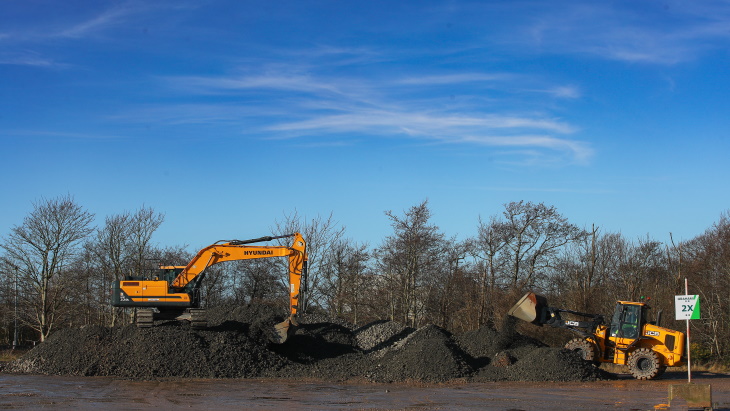
Aggregate at STIM (Image: NWS)
“This is a first-of-a-kind activity in the UK, and it’s fantastic to see the first train load of aggregate arrive by train onto our site,” said Mike Pigott, Repository Site Director, NWS. “This work enables NWS to deliver a safe and secure long-term approach to protecting the environment and people for generations to come. Collaboration with Nuclear Transport Solutions’ rail division, Direct Rail Services, has played a pivotal role for us, with their launch of a new rail service for this project yielding significant environmental benefits.”
Nuclear Transport Solutions Rail Managing Director Gottfried Eymer added: “Rail is the obvious choice for bulk movements like these, taking many thousands of lorries off the road, reducing congestion, and improving the environment. This phase of the project will see 46,000 tonnes of aggregate delivered by 64 trains, taking an estimated 2320 lorry journeys, that’s over 150,000 miles.”
Last year, civil engineering firm Graham was awarded a four-year contract for the works, which started in September.
The final closure of the LLWR is currently expected in 2135, when the completed cap will be 10 metres thick.