Automation Technology Revolutionizes Large-Scale Solar Farm Installation

MIT-Charge-01-press

As solar panel prices continue to decline, installation costs have emerged as a major challenge for large-scale solar projects. To address this issue, new automation technology is streamlining the assembly and deployment of utility-scale solar farms, making the process faster, more cost-effective, and less labor-intensive.

Charge Robotics, a startup founded by MIT alumni Banks Hunter and Max Justicz, has developed an advanced automation system to revolutionize the assembly and installation of large-scale solar farms. The company’s approach aims to reduce costs and accelerate deployment, tackling a critical bottleneck in the expansion of solar energy.

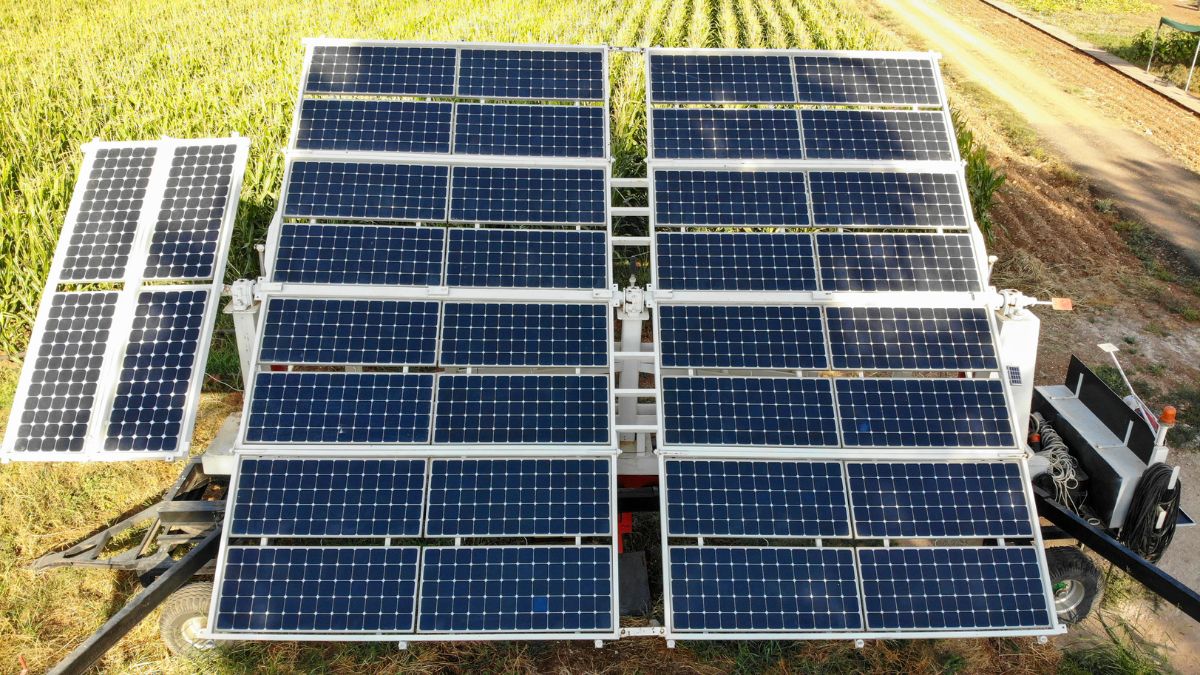
This innovative system automates the on-site construction of solar farm components. Materials such as mounting brackets, steel tracks, and solar panels are fed into an automated assembly line, where they are constructed into fully assembled sections. A robotic vehicle then transports and positions these sections at their final locations. Inspired by mass manufacturing techniques, this approach enhances efficiency, quality, speed, and safety while significantly lowering overall costs.

With solar energy accounting for 81% of new U.S. electricity capacity in 2023, addressing installation bottlenecks is crucial for sustaining industry growth. One of the biggest challenges has been labor shortages, which have slowed the deployment of large-scale solar projects. By automating most of the mechanical installation process—except for pile-driving foundation stakes—this technology greatly reduces reliance on manual labor.

Designed to work with standard solar components, the system employs machine-vision technology to ensure quality control. Each assembled segment measures 40 feet in length and weighs approximately 800 pounds, minimizing the need for repetitive manual labor while expediting construction timelines.

Multiple automated assembly units can be deployed simultaneously at a project site, enabling solar farms to be built at an accelerated pace. These systems can also operate around the clock, further enhancing efficiency. By integrating automation into solar farm construction, this technology is paving the way for faster, more scalable solar installations, helping to meet the increasing demand for renewable energy.

 

  • Related Posts

    Enviromena Begins Construction of Longpasture Solar Farm, Its Second-Largest UK Project, Targeting 2027 Energisation

    Enviromena has started construction of the Longpasture Solar Farm in County Durham, UK, marking a major milestone for the company’s second-largest UK project to date. The company acquired the project…

    Indian Green Energy Stocks Show Mixed Performance Amid Market Weakness (24 August 2026)

    Indian stock markets ended lower on August 24, 2026, as investors remained cautious amid selling pressure across benchmark indices. The S&P BSE SENSEX closed at 77,369.11, declining 0.22%, or around…

    Have You Seen?

    Exxon Eyes Shell’s $8 Billion U.S. Chemicals Business

    • August 24, 2026
    Exxon Eyes Shell’s $8 Billion U.S. Chemicals Business

    Iran Unveils Huge New Gas Discovery Amid U.S. Economic Pressure

    • August 24, 2026
    Iran Unveils Huge New Gas Discovery Amid U.S. Economic Pressure

    Norway Vows to Keep Drilling for Oil and Gas in the Arctic

    • August 24, 2026
    Norway Vows to Keep Drilling for Oil and Gas in the Arctic

    Japan Power Prices Surge to Highest Since 2023

    • August 24, 2026
    Japan Power Prices Surge to Highest Since 2023

    Enviromena Begins Construction of Longpasture Solar Farm, Its Second-Largest UK Project, Targeting 2027 Energisation

    • August 24, 2026
    Enviromena Begins Construction of Longpasture Solar Farm, Its Second-Largest UK Project, Targeting 2027 Energisation

    Indian Green Energy Stocks Show Mixed Performance Amid Market Weakness (24 August 2026)

    • August 24, 2026
    Indian Green Energy Stocks Show Mixed Performance Amid Market Weakness (24 August 2026)

    MPA Completes 780,000 kWh Solar Power System At Singapore’s Marina South Pier

    • August 24, 2026
    MPA Completes 780,000 kWh Solar Power System At Singapore’s Marina South Pier

    Solar SG Targets Next Growth Phase as Singapore Raises Solar Capacity Goal to 3 GWp by 2030

    • August 24, 2026
    Solar SG Targets Next Growth Phase as Singapore Raises Solar Capacity Goal to 3 GWp by 2030

    ACWA Signs Storage Services Agreements for 1.5 GW/6 GWh BESS Projects in Saudi Arabia

    • August 24, 2026
    ACWA Signs Storage Services Agreements for 1.5 GW/6 GWh BESS Projects in Saudi Arabia

    Lithuania approves EIA programme for Klaipėda CO2 terminal

    • August 24, 2026
    Lithuania approves EIA programme for Klaipėda CO2 terminal