Wednesday, 26 March 2025
_11126.jpg)
The uranium storage battery utilises depleted uranium (DU) as the negative electrode active material and iron as the positive one, the Japan Atomic Energy Agency (JAEA) said. The single-cell voltage of the prototype uranium rechargeable battery is 1.3 volts, which is close to that of a common alkaline battery (1.5 volts).
The battery was charged and discharged 10 times, and the performance of the battery was almost unchanged, indicating relatively stable cycling characteristics.
“To utilise DU as a new resource, the concept of rechargeable batteries using uranium as an active material was proposed in the early 2000s,” JAEA noted. “However, no studies were reporting the specific performance of the assembled uranium rechargeable batteries.”
It added: “If uranium rechargeable batteries are increased in capacity and put to practical use, the large amount of DU stored in Japan will become a new resource for output controls in the electricity supply grid derived from renewable energy, thereby contributing to the realisation of a decarbonised society.”
According to JAEA, there is currently about 16,000 tonnes of depleted uranium stored in Japan and some 1.6 million tonnes stored worldwide.
JAEA said it is now aiming to increase the capacity of uranium storage batteries (the amount of electricity they can store) by circulating the electrolyte.
“Specifically, we will be examining whether it is possible to increase capacity by increasing the amount of circulating electrolyte and the concentration of uranium and iron, and what the optimal materials are for the electrodes and membranes that make up the storage battery,” JAEA said. “If we are successful in increasing the capacity of uranium storage batteries and put them to practical use and implemented in society using depleted uranium stored in Japan, we can expect them to play new roles such as adjusting supply and demand for mega solar power plants.”
It says the need for rechargeable batteries has been increasing in recent years with an increase in the introduction of renewable energy sources. Power generation from solar, wind, and other sources is affected by weather conditions and has the instability of fluctuating power generation. To stabilise the power supply in this situation, output controls via energy storage devices such as rechargeable batteries are necessary, and the development of new energy storage technologies is attracting attention.
Batteries to last a lifetime
South Korean researchers are considering radiocarbon as a source for safe, small and affordable nuclear batteries that could last decades or longer without charging.
Su-Il In, a professor at Daegu Gyeongbuk Institute of Science & Technology, will present his results at the spring meeting of the American Chemical Society, being held 23-27 March. The research was funded by the National Research Foundation of Korea, as well as the Daegu Gyeongbuk Institute of Science & Technology Research & Development Programme of the Ministry of Science and Information and Communication Technology of Korea.
With the increasing number of connected devices, data centres and other computing technologies, the demand for long-lasting batteries is increasing. However, In says that the performance of lithium-ion (Li-ion) batteries is “almost saturated”. His team is therefore developing nuclear batteries as an alternative to lithium.
The researchers have produced a prototype betavoltaic battery with carbon-14, an unstable and radioactive form of carbon, called radiocarbon. “I decided to use a radioactive isotope of carbon because it generates only beta rays,” said In. Moreover, a by-product from nuclear power plants, radiocarbon is inexpensive, readily available and easy to recycle. And because radiocarbon degrades very slowly, a radiocarbon-powered battery could theoretically last for millennia.
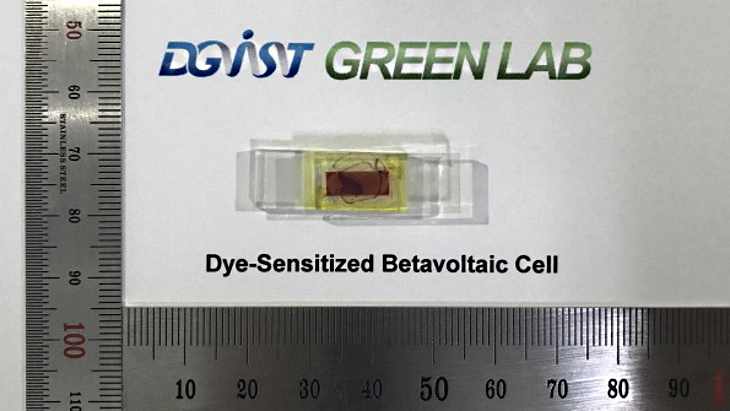
(Image: Daegu Gyeongbuk Institute of Science & Technology)
To significantly improve the energy conversion efficiency of their new design, the team used a titanium dioxide-based semiconductor, a material commonly used in solar cells, sensitised with a ruthenium-based dye. They strengthened the bond between the titanium dioxide and the dye with a citric acid treatment. When beta rays from radiocarbon collide with the treated ruthenium-based dye, a cascade of electron transfer reactions, called an electron avalanche, occurs. Then the avalanche travels through the dye and the titanium dioxide effectively collects the generated electrons.
The new battery also has radiocarbon in the dye-sensitised anode and a cathode. By treating both electrodes with the radioactive isotope, the researchers increased the amount of beta rays generated and reduced distance-related beta-radiation energy loss between the two structures.
During demonstrations of the prototype battery, the researchers found that beta rays released from radiocarbon on both electrodes triggered the ruthenium-based dye on the anode to generate an electron avalanche that was collected by the titanium dioxide layer and passed through an external circuit resulting in usable electricity.
These long-lasting nuclear batteries could enable many applications, says In. These include powering implants, remote applications, and satellites. For example, a pacemaker would last a person’s lifetime, eliminating the need for surgical replacements.
However, this betavoltaic design converted only a tiny fraction of radioactive decay into electric energy, leading to lower performance compared to conventional Li-ion batteries. In suggests that further efforts to optimise the shape of the beta-ray emitter and develop more efficient beta-ray absorbers could enhance the battery’s performance and increase power generation.