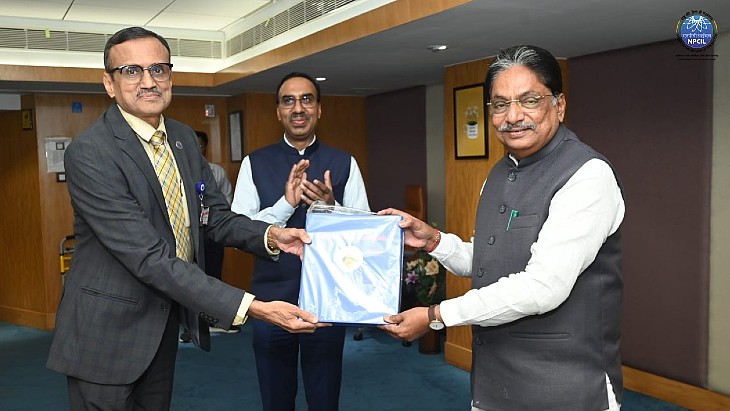
The signing ceremony, held at HD Hyundai’s Global R&D Centre in Bundang, Gyeonggi Province, was attended by Kwon Byeong-hun, head of the electrification centre at HD Korea Shipbuilding & Offshore Engineering (HD KSOE), Shim Hak-moo, head of the design department at HD Hyundai Samho Heavy Industries (HD HSHI), and Matthew Muller, sales representative for Far East Asia at the American Bureau of Shipping (ABS).
According to the agreement, ABS and HD Hyundai will collaborate in the following areas: basic design of a uclear-linked electric propulsion system for 16,000 TEU container ships; selection of electrical equipment specifications; and electrical equipment layout design. In particular, HD Hyundai plans to integrate the characteristics of small modular reactors (SMRs), which can stably supply up to 100 MW of power, into the electric propulsion system to verify the potential of SMRs as a new ship power source.
In this process, HD Hyundai plans to develop a power operation system tailored to large container ships requiring long-distance and high-speed operation, while also applying a twin-screw propulsion system to enhance propulsion and manoeuverability.
Furthermore, the company plans to adopt a direct-coupled propulsion system, where the engine motor is directly connected to the propeller, minimising energy loss during power transmission and enhancing operational efficiency. This will also allow for increased loading of reefer containers for transporting energy-intensive refrigerated and frozen cargo, enabling a more flexible response to shippers’ transportation needs.
_11d610ae.jpg)
A rendering of a 15,000 TEU-class SMR-powered containership (Image: HD KSOE)
HD Hyundai will also accelerate efforts to ensure safety related to nuclear power generation. First, the company will incorporate enhanced safety standards into the design to ensure safety even in emergency situations, such as collisions and flooding. Furthermore, the company plans to apply an onboard power system that complies with International Maritime Organization (IMO) regulations and International Atomic Energy Agency safety standards, ensuring compliance with international regulations and operational reliability.
“This project represents an important step in exploring the potential of a nuclear-powered electric propulsion system for container vessels,” Mueller said. “By combining HD Hyundai’s shipbuilding expertise with ABS’s deep engineering experience in maritime safety, we aim to evaluate technologies that can support safer, more efficient and lower-emission operations for the next generation of propulsion solutions.”
Kwon added: “In response to the growing demand for eco-friendly ships, we are continuously pursuing the development of electric propulsion systems using nuclear energy – a carbon-free energy source. We will expand our R&D efforts to strengthen our technological competitiveness in nuclear-linked electric propulsion.”
HD Hyundai first unveiled its nuclear-powered container ship model in February last year, and in September it received approval in principle (AIP) from ABS for the conceptual design of the electric propulsion system for a 16,000 TEU container ship.
The shipping industry consumes about 350 million tonnes of fossil fuel annually and accounts for about 3% of total worldwide carbon emissions. In July 2024, the shipping industry, via the IMO, approved new targets for greenhouse gas emission reductions, aiming to reach net-zero emissions by or around 2050.