The control room simulator allows training of future control room operators in an environment exactly matching the control room they would find themselves in at an AP1000 unit.
Training can cover all plant procedures from startup to shutdown, as well as simulating malfunctions or component failures. It also allows certification of operators and system development and testing.
Luca Oriani, who is President of APX at Westinghouse Electric, the global head of its new reactor business, speaking to World Nuclear News at the new academy, explained that the training of control room operators begins about five years before a plant goes online.
“It’s because it is not just the time it takes to train one operator; you need to train enough operators for the plant to run 24 hours a day, every day, every year, so you need a very deep pool of qualified operators.”
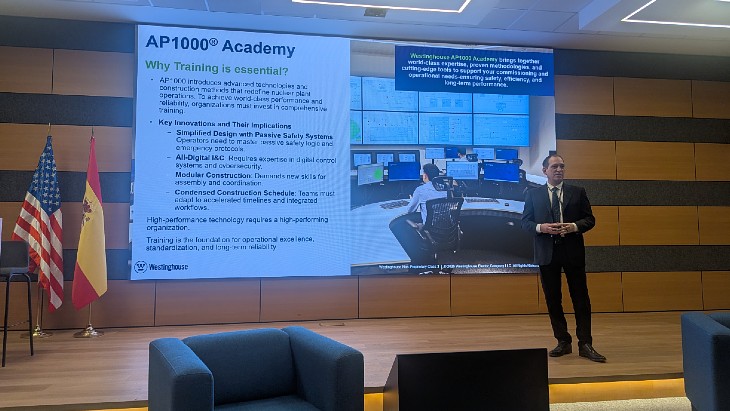
Luca Oriani outlining the aims of the training process (Image: WNN)
Once new AP1000 units are built, each will have its own replica control room for training purposes, but the plan is for the Spanish training centre to continue to be the Europe-wide centre for training for future plants.
Oriani added that “Westinghouse is one of the few companies in the current economy in which we typically retain new employees for 25 or more years, and that’s why investment in training is so important for us because we create those capabilities and we develop them over long periods of time”.
The AP1000 in the world
Westinghouse says it is the original equipment manufacturer or technology provider to 50% of the current global nuclear fleet. In terms of the AP1000, there are four units operating in China, with a further 14 under construction, and there are two units operating in the USA.
There are contracts with Ukraine for nine AP1000s, with Poland for three units and with Bulgaria for two units. It has also been selected by India for six future units.
Spain’s nuclear policy
The new AP1000 training centre is based in Spain, where there are no current plans for new nuclear units, so the first group of future AP1000 operators elsewhere in Europe is on-site this week, undergoing training.
At a media tour of the facility Oriani was asked about the decision to locate the new academy in Spain, which currently has a policy of phasing out nuclear power.
He said the location was convenient to bring together experts from the USA and Central and Eastern Europe, adding: “Political debates change. Spain is going to build new nuclear power, maybe not next year, maybe not in the next five years – Westinghouse has been around for 140 years. We can wait until the time comes.”
Xavier Coll, the head of Westinghouse’s Spanish business, said he expected the nuclear power plants in Spain which are currently scheduled to be shut down in the coming years, to have their lifetimes extended. It would be “very difficult from an energy point of view in Spain to shut them – so let’s see”, he said.
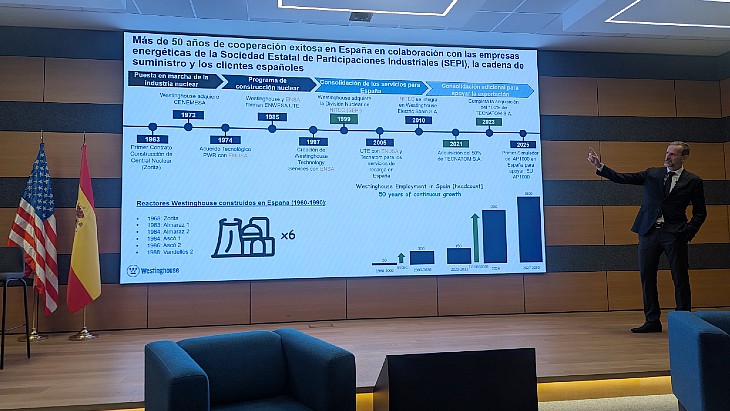
Xavier Coll outlines Westinghouse’s history in Spain (Image: WNN)
Oriani added that in the USA, plants are being extended to 80 years, with the prospect of future extensions to 100 years. He said the Spanish plants had the same potential for extended operation and “we hope people are paying attention to what’s happening in Germany as they evaluate their energy decisions”.
Both executives stressed Westinghouse’s more than 60-year history in Spain, including the country’s first nuclear power plant – the 142 MWe Zorita single-loop pressurised water reactor – which they described as essentially an SMR. They forecast a 300-person increase in headcount, to about 1,500 in Spain by 2030, which would be unaffected even if the Spanish nuclear closures went ahead.
Outlook
“We see a very strong demand, especially in Northern and then Central and Eastern Europe in terms of new units,” Oriani said, saying that together with the French nuclear plans, the outlook for nuclear capacity in Europe could potentially “reach the levels being seen in Asia and also in North America”.
Westinghouse already has contracts signed for AP1000 units in Ukraine, Poland and Bulgaria and it is known to be in the running for other potential units in Europe.
Oriani said “we typically don’t comment on other projects until the customers are the one commenting, but we have a number of additional countries which are performing front-end engineering studies”, which may lead to potential AP1000 units.
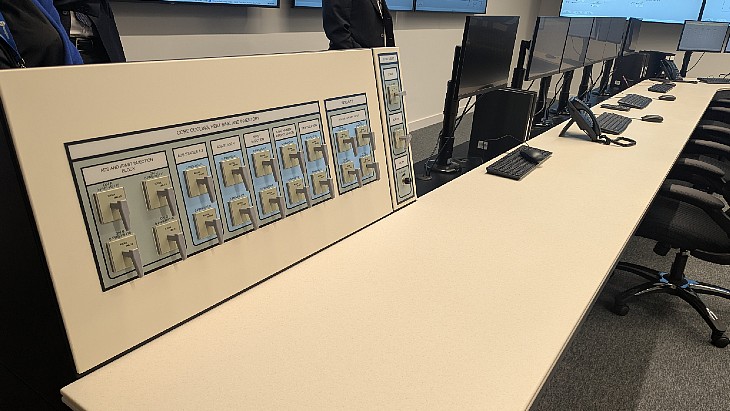
There are still some physical switches in the control room (Image: WNN)
Asked about the relative cost of an AP1000 unit, he said that there were a number of variables with the cost of a unit, such as the readiness of the site, whether it was a country’s first nuclear power plant, transportation and access to the sea, and the regulatory structure. However their projections were that on the nth-of-a-kind, the cost per megawatt produced by an AP1000 would be “between half and a third of the previous generation of plants”.
He said that the plant designs, and their passive safety systems, were intended to be suitable in an “extreme range of conditions” from 50 degrees Celcius to minus 40 degrees Celcius, so they can be located anywhere “from the Arctic Circle to the deserts of Arizona … and that was done on purpose so that in an evolving world, in different locations, you wouldn’t have to change the design of the plants. Fleet standardisation is extremely important to control those costs. The units at Vogtle, the future units in Europe, the future units in the United States, the units in China are, for all practical purposes, identical”.
Background
The AP1000 is a two-loop pressurised water reactor providing 3.4 GWt/1.2 GWe. Westinghouse says that modularisation “allows many more construction activities to proceed in parallel and improves quality and efficiency by increasing factory-based manufacturing and assembly”.
Its passive safety systems provide it with a 72-hour “coping period” if there is a station blackout and loss of external power, as a result of its use of natural forces, such as natural circulation, gravity and convection. It also claims to have the smallest footprint per MWe of any nuclear reactor.
Spain’s seven operating nuclear power reactors – Almaraz I and II, Ascó I and II, Cofrentes, Trillo and Vandellós II – generate about 20% of its electricity. Under the country’s nuclear phase-out plans, agreed in 2019, four reactors are scheduled to close by the end of 2030 – including the two Almaraz ones – while the remaining three reactors will shut by 2035.