The Preliminary Documented Safety Analysis establishes the preliminary safety basis for a criticality test of the reactor, documenting how the design meets the US Department of Energy’s (DOE) requirements for hazard analysis, accident mitigation, and operational controls. Approval of the Preliminary Documented Safety Analysis means Deployable Energy is now positioned to complete final preparations for its upcoming demonstration, including commissioning and startup activities under DOE oversight, the company said.
The purpose of a Preliminary Documented Safety Analysis – or PDSA – is to provide a comprehensive and preliminary assessment of the safety aspects of a nuclear facility or activity. It forms part of the pathway for the authorisation by the US Department of Energy’s Office of Nuclear Energy of nuclear facilities. Executive Order 1430, Reforming Nuclear Reactor Testing at the Department of Energy, signed by President Donald Trump in May last year, directed the DOE and the National Laboratories to expedite the review, approval, and deployment of advanced reactors under the jurisdiction of the DOE.
“The PDSA approval is an important step in bringing a new reactor to life,” Deployable Energy CEO Bobby Gallagher said. “Completing this review in 106 days since programme kickoff demonstrates both the strength of our safety approach and the urgency with which our team is executing toward demonstration.”
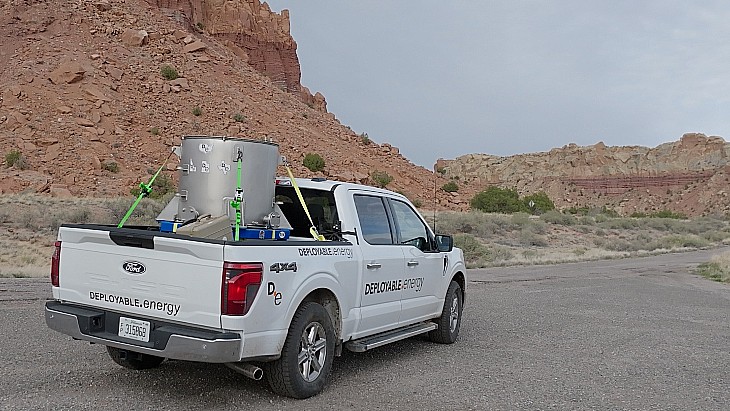
Deployable Energy said it is now positioned to complete final preparations for the upcoming criticality demonstration. It has already delivered its criticality test rig to Idaho National Laboratory following a cross-country road trip by truck, which the company says underscores “the compact and deployable nature of the Unity system”. The fuel that will be used during the initial criticality test has already been manufactured.
The Unity microreactor is described by the company as a 1 MWe compact, factory-built nuclear system designed to use 4.95% enriched uranium oxide fuel and helium coolant to deliver reliable, transportable power in “remote and infrastructure-constrained environments”. Using standard fuels, materials, and industrial processes already available at commercial scale results in a system that can be produced in volume and deployed quickly, the company says. It envisages its “nuclear batteries” being operated across a wide range of applications across the defence, commercial, maritime, and industrial sectors.
In April, Deployable Energy was selected to enter the DOE Nuclear Energy Launch Pad, an initiative led by the Idaho National Laboratory-based National Reactor Innovation Center to provide streamlined pathways for developers to demonstrate advanced nuclear technology and accelerate commercial deployment. At that time, Deployable Energy said it was aiming to achieve criticality “on or before July 4th, 2026”.