Friday, 6 June 2025
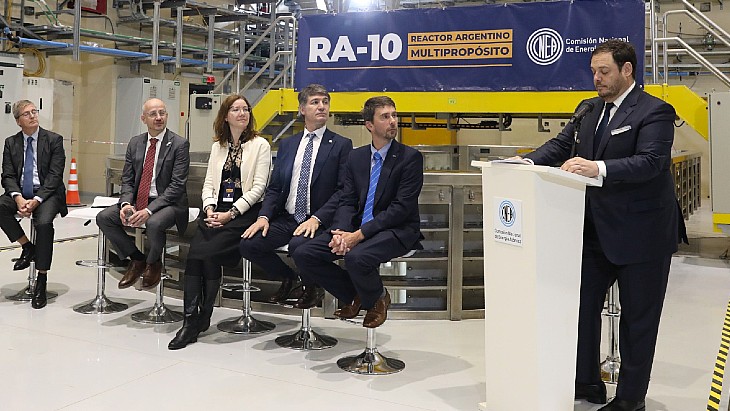
Demian Reidel, President of the Argentine Nuclear Council, told the event held at the site of the RA-10 multipurpose reactor: “With the development of the ACR-300, we will offer the world a clean, stable, and scalable source of energy. The ACR-300, a 300 MW technological marvel designed by Argentine engineers, is a centrepiece of the Nuclear Power Plan, which will position our country at the forefront of the new energy revolution.
“We are going to begin construction of four modules at the Atucha site, which will allow us to nearly double the country’s installed nuclear capacity. This is only the first stage. Then, we will license this technology to the rest of the world. This will not only transform our energy mix, it will also change Argentina’s export mix.”
Germán Guido Lavalle, President of the National Atomic Energy Commission (CNEA), outlined the organisation’s five key targets for the coming year: reaching criticality at the RA-10 plant; beginning the refurbishment of the Heavy Water Industrial Plant (PIAP); restarting uranium mining; launching the Argentine Proton Therapy Center; and resuming uranium enrichment to complete the nuclear fuel cycle.
He said: “We have a National Atomic Energy Commission that, through technological development and human resource training, has provided the platform for the emergence of nuclear sector companies that today compete globally, export, create jobs, and offer services in Argentina. This is a true success of state policy.”
Reidel, a chief adviser to Argentina’s President Javier Milei, told last week that the aim was for Argentina to be the first country, or among the first, to be commercially selling small modular reactors (SMRs). He said that the National Nuclear Plan aimed to accelerate the development of the ACR-300, developed by INVAP with private capital, and “aims to have the four modules operational within five years”.
He has also suggested that the SMRs could be sold with a commitment to purchase Argentine uranium, saying in a March interview with that it was “crazy” for the country to be importing uranium for its existing reactors despite having substantial reserves.
The anniversary ceremony was broadcast across all CNEA’s centres. The commission, created in 1950, says its mission “is to consolidate Argentina’s position as a leading nation in the peaceful and safe use of nuclear energy, having been committed to scientific and technological development since its inception”.
The background
Argentina currently has three operable nuclear power units – Atucha 1, connected in 1974, Atucha 2, which was connected in 2014 and Embalse which was connected to the grid in 1983. Between them they generate about 5% of the country’s electricity. There had been plans for a fourth unit, as Atucha III, but it appears that has been superceded by the SMR plans.
Argentina has already had an SMR in development: the CAREM SMR – the name comes from Central Argentina de Elementos Modulares – is a 32 MWe prototype and is Argentina’s first domestically designed and developed nuclear power unit. First concrete was poured in 2014, but construction has since been suspended a number of times. It is currently estimated to be about two-thirds complete. With reports of funding uncertainty, a Critical Design Review was ordered for it in May last year.