Passive safety systems aim to bring a reactor to a safe shutdown state and maintain this state for a long period of time without the need for human intervention and with limited reliance on support functions. One of the avenues of development and innovation being pursued by nuclear power plant designers and operators is the integration of passive systems into new-generation reactors, including small modular reactors (SMRs).
In 2016, France’s Institute for Nuclear Safety and Radiation Protection (IRSN) – which became the Autorité de Sûreté Nucléaire et de Radioprotection (ASNR) in January 2025 following its merger with the Autorité de Sûreté Nucléaire (ASN) – looked into the reliability and safety benefits of passive systems based on natural phenomena (convection, condensation, etc) and issued recommendations. In addition to these recommendations, IRSN believes it is essential to carry out anticipatory research aimed at understanding the phenomena involved in these passive systems. The aim is to prepare its technical appraisal of the safety dossiers relating to these systems that will be submitted by nuclear operators.
The PASTIS (Passive Systems Thermal hydraulic Investigations for Safety) project aims to study the physical phenomena involved in passive safety systems dedicated to the evacuation of residual power from a light water reactor in incident or accident situations.
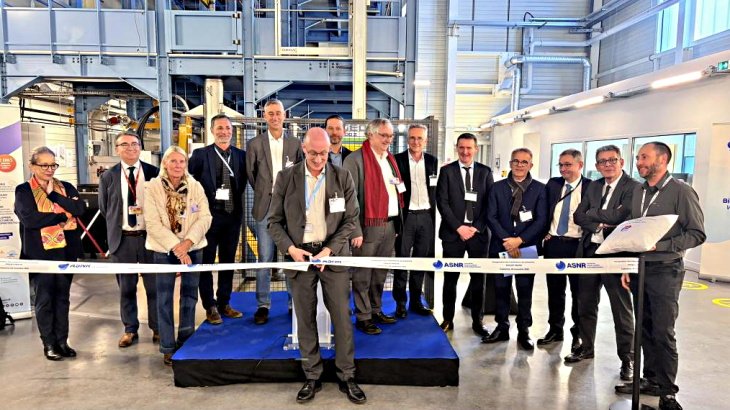
With funding of EUR9 million (USD10 million) by the French government as part of the France 2030 initiative, the PASTIS project provides the ASNR with a leading scientific tool. The experiments conducted on the platform will produce reference data to improve the understanding of physical phenomena and enhance the reliability of models used for safety assessments. This work will notably allow for a better evaluation of the performance of passive safety systems designed to dissipate residual heat in accident scenarios during the operation of future SMRs and other innovative reactors.
The PASTIS project has two priority research topics: convective phenomena in the hydraulic circuits of passive systems (primary circuit, secondary circuit) in incident or accident situations; and convection and condensation phenomena within an enclosure immersed in a large volume of water (immersion of an SMR reactor enclosure in a pool) in accident situations.
The new research facilities at Cadarache consist of two platforms that are sufficiently modular and scalable to be able to test different geometric and thermal-hydraulic configurations, thereby assessing the performance and reliability of passive systems. The first platform is a thermal-hydraulic loop, called ALCINA, which will determine the losses of pressure in a pipe, in forced convection (with pump) and in natural circulation, in single phase or in two-phase in incidental or accidental situations. The second platform is a confinement enclosure, called KoKoMo, which will study convective movements and wall condensation simulating the principle of a cold wall condenser, and more particularly the coupled effects of condensation and stratification.
Experimental research for the development of thermal-hydraulic models and validating codes, which will then be used for expert appraisal, will begin this year and will be open to national and international collaborations.
“The knowledge acquired will be capitalised in particular in the numerical simulation tools used in France (CATHARE for normal and incidental operation and ASTEC for severe accident situations), through specific developments,” ASNR said. “This acquisition of knowledge will essentially be fed by new experiments dedicated to the study of physical phenomena of interest that are still too little known, following a scientific approach that is sufficiently generic not to be dependent on a specific system or component, since industrial concepts are not yet totally set in stone.”
It added: “The research conducted within it will contribute to knowledge sharing and the development of cooperation with other expert and research organisations. Collaborations are already underway with EDF R&D teams at the national level, as well as with various international partners, particularly within the framework of the Euratom programme funded by the European Union (EASI-SMR project).”
“State support within the framework of France 2030 was crucial in bringing PASTIS to fruition,” said Sébastien Desmarest, PASTIS project manager. “This investment now allows us to have a unique research platform, designed to produce the scientific knowledge that safety expertise will need in the decades to come.”