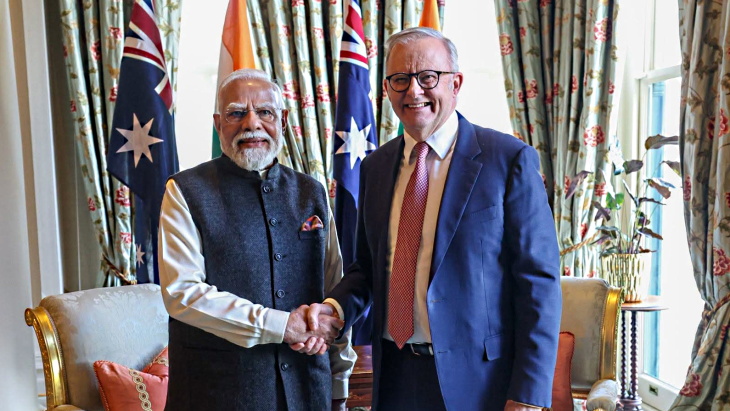
The announcement came during an official visit by India’s Prime Minister Narendra Modi to Australia.
“The arrangement facilitates Australian uranium exports to India to help increase the share of non-fossil fuel power capacity, providing an additional market for the Australian resources sector,” the Australian government said in a statement.
India has an ambitious nuclear power programme but few indigenous uranium resources, and could provide a significant market for Australian uranium. Australia is the world’s fourth-largest producer of uranium behind Kazakhstan, Canada and Namibia. All of its production – almost 4,600 tU in 2024 – is exported under strict controls to ensure that it is only for civilian use. Australia is a signatory of the Nuclear Non-Proliferation Treaty (NPT), but also requires any countries to which it sells uranium to put in place a rigorous bilateral safeguards treaty.
While India has an impeccable nuclear non-proliferation record it is not a signatory of the NPT, and was effectively isolated from world nuclear trade until 2008, when it signed a safeguards agreement with the International Atomic Energy Agency (IAEA). The 45-member Nuclear Suppliers Group subsequently agreed to exempt the country from rules prohibiting trade with non-members of the NPT, opening the door to the possibility of nuclear trade with India. Since then, India has signed nuclear cooperation agreements with several countries.
A bilateral agreement between Australia and India for the supply of uranium was signed in 2014, and came into force in November 2015 during a state visit to India by Tony Abbott, Australia’s prime minister at the time. However, Australia’s Joint Standing Committee on Treaties recommended that uranium sales should begin only after conditions concerning India’s nuclear regulatory regime, routine inspections and reactor decommissioning plans were fulfilled. A bill on Civil Nuclear Transfers to India was passed by both Australian houses in November 2016.
Australia and India have now finalised the administrative arrangements necessary to enable the export of Australian uranium to India for exclusively peaceful purposes and under IAEA safeguards, as provided for under the 2015 cooperation agreement.
Australian Prime Minister Anthony Albanese said: “Australia’s natural resources are vital for other countries’ energy security and stability, and we look forward to becoming a reliable, trusted supplier of uranium to India.”
Prime Minister Modi added: “Today, we have signed an important agreement in the field of nuclear energy. This will open the way for uranium supplies from Australia to India and give new impetus to our clean energy objectives.”
In March, Canada’s Cameco entered a long-term agreement to supply uranium ore concentrate to India’s Department of Atomic Energy (DAE), for use in the country’s fleet of nuclear reactors. The agreement will see Cameco supply nearly 22 million pounds of uranium ore concentrate (U3O8) to the DAE between 2027 and 2035 on market-related price terms, with a total contract value estimated at about CAD2.6 billion (USD1.9 billion). Cameco previously supplied uranium to India under a five-year contract that began in 2015.
India currently has 24 operating reactors along with ambitious plans to deploy dozens more to reach 100 GW by 2047.