By
14 min ago 3 min read
ExxonMobil has shed more light on its integrated carbon dioxide ‘superhighway’ along the US Gulf Coast – drawing on automotive language to drive home its concept.
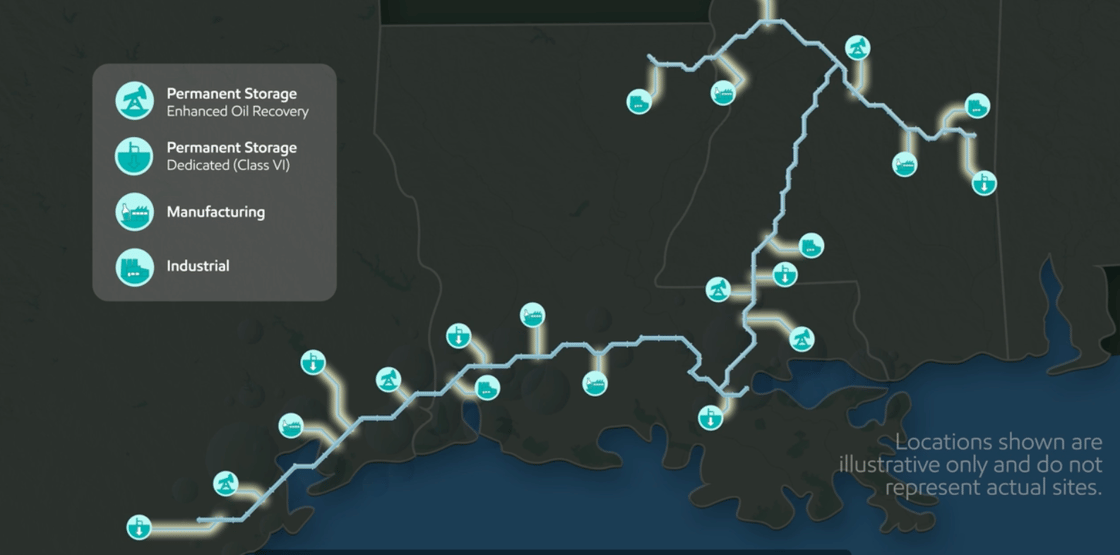
The network aims to connect multiple emitters to storage sites and CO2 customers, allowing greater flexibility as captured CO2 moves to different endpoints – permanent dedicated storage (Class VI wells), permanent storage via enhanced oil recovery (EOR), or industrial uses (utilisation) – all while being checked, measured, and monitored 24/7.
As new capture projects, storage sites, and pipeline connectors are added, the system can expand without being rebuilt. A video claims the network provides ‘over 900 miles of optionality’.
“Let’s say customer B sends three million metric tonnes of CO2 into the superhighway for dedicated storage,” it explains. “First the CO2 gets checked for quality, like a car stopping at a ramp meter, then it joins all the other molecules. Some traffic exits for EOR, some for beverage production, and the [majority] exits at dedicated storage wells. CO2 is tracked at every entrance and exit, like at toll booths, so we know how much is on the highway and where it’s going.”
The project has been spurred by ExxonMobil’s $4.9bn acquisition of Denbury’s 1,300-plus mile pipeline network . It could offer a viable pathway to lower emissions for hard-to-abate sectors like steel, hydrogen, power generation, and chemical manufacturing.
But challenges include safety concerns, reconciling EOR with climate goals, and commercial and policy uncertainties. No timeframe has been given for the completion of the network or specific deliverable timeframes.
ExxonMobil is making progress. In February it began its second commercial carbon capture and storage (CCS) project , with two additional projects expected to come online in 2026.
The company has begun transporting and permanently storing captured CO2 from its New Generation Gas Gathering (NG3) system along the Gulf Coast.
It followed ExxonMobil transporting and storing CO2 from fertiliser firm to support low-carbon ammonia production.
The company has secured approximately 9 mtpa total contracted CO2 from industrial customers.
Its Low Carbon Solutions division is advancing plans for the Sunflower Carbon Storage Project in Southeast Texas. This project includes an 11-mile pipeline extension to link deep underground storage aquifers directly to their inherited regional transport network.
The CO2 pipeline market is facing a “critical phase of industrial hardening,” characterised by rising long-term demand for carbon capture infrastructure alongside persistent state permitting hurdles, community pushback, and strategic project pivots, according to GlobalData.
Major interstate proposals, involving , have faced prolonged state-level regulatory and legal resistance.
While North America remains the leading CCUS region by total pipeline capacity, its capacity contracted in the first half of 2026, declining 5.5% from year-end 2025 to Q2 2026, driven primarily by early-stage attrition, with feasibility capacity down 15% and FEED down 14%.
But it found later-stage execution has improved, indicating a bifurcated CCUS development landscape. Commissioning capacity rose sharply from 0.5 mtpa to 5.7nmtpa.
Sandeep Kibey, Market Analysis Advisor at ExxonMobil Low Carbon Solutions, said the evolution from point-to-point CCS to an integrated network is an important shift.
“The ability to integrate technology, infrastructure, and markets creates flexibility for customers and unlocks value at scale,” he said.