The majority of CEO view China and India as the regions with the most momentum in clean hydrogen, with North America widely seen as stalling.
That was the takeaway from a survey within the Hydrogen Council’s Global Hydrogen Compass 2026, which sought the views of almost 70 leaders from the group’s membership.
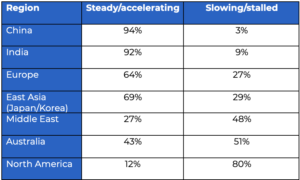
Asked whether they viewed regions as “slowing/stalled” or “steady/accelerating”, China emerged as the region with the highest perceived regional momentum, with 94% voting steady/accelerating. India followed closely with 92% voting favourably.
Europe, Japan, and Korea saw mixed results, though most respondents suggested acceleration rather than slowdown, while the Middle East and Australia were broadly seen to be cooling.
Perceived regional momentum by % of respondents claiming “steady or accelerating”

Respondents attributed the positive Chinese and Indian outlooks to “assertive, state-backed demand signals” set out by governments in recent years. Nicholas Loughlan, Managing Director of Cellcentric, claimed China was “clearly moving full speed ahead.”
“It’s become the global proof point that removes the ‘will hydrogen work?’ question,” he added.
North America’s bleak perception, meanwhile, was broadly observed as a consequence of regulatory instability that US developers have been subjected to.
The phase-out of the US’ 45V clean hydrogen production tax credit of up to $3/kg, an incentive the country’s industry has always as critical, was cited as especially damaging to progress.
Originally implemented under the Biden administration, the credit is ending five years earlier than legislated after changes by the Trump government. Projects have to break ground before 2028 to access the subsidy.
Europe’s picture is varied, and while the EU’s Renewable Energy Directive III (RED III) and carbon pricing frameworks were referenced as positive policy signals, executives in the region continued to see regulatory demand aggregation as “uncertain.”
The uneven implementation of RED III across EU member states was viewed as a bottleneck for the broader region. To date, only six countries have transposed into law RED III’s requirement that renewable fuels of non-biological origin (RFNBO) account for 42% of energy used in industry.
The varying approaches create a growing disconnect between the mechanism’s implied demand stimulation and that which producers can realistically bank on.
The requirement also doesn’t impose a corresponding purchasing obligation on industrial consumers, further limiting RED III’s effect on demand.
Despite India’s perceived momentum, its committed investment remains meagre next to the leading players. China has added $11.8bn over the past year, bringing its total to $45bn; Europe added $7.9bn for an overall $30bn; and North America committed $3.1bn toward a $26bn total.
India, by contrast, added just $500m to reach $6bn overall – roughly 13% of China’s total, 20% of Europe’s, and 23% of North America’s.
Gain access to the insights, data, and analysis trusted by hydrogen professionals worldwide.
With a H2 View subscription, you get:
- Unlimited access to 15,000+ articles
- Monthly digital magazine + H2 Review
- Exclusive interviews, webinars and reports
- Expert analysis shaping the hydrogen conversation