
A field demonstration on a 500-MW-class coal-fired unit shows how targeted fuel chemistry can mitigate severe slagging and fouling while delivering measurable operating benefits—including approximately 50% lower superheater spray demand, 53% lower reheat spray demand during comparable trial conditions, lower air preheater (APH) inlet gas temperatures, improved combustion flexibility, reduced selective catalytic reduction (SCR)-inlet NOx and ammonia demand, and continued operation without a slag-related forced outage or de-slagging derate.
For a coal-fired unit, there’s no shortage of things that can reduce performance—draft, mills, emissions, age, and fuel quality. But for boilers burning challenging fuels (and in this case, high-sodium Powder River Basin [PRB] and blended western coals), the quiet one is ash chemistry.
Ash chemistry can cause a unit to fail in slow motion. Deposits build, attemperator sprays climb, gas temperature creeps up, soot blowing increases, and soon the plant is forced to decide whether to hold load or protect the unit by derating. Unit failure including a clinker fall and a damaged bottom-ash removal system stops being a heat-transfer nuisance and becomes an availability event—often at the exact moment the market is calling for the unit and power prices are peaking.
During combustion, silicates, iron, sulfur, sodium, potassium, and calcium interact to produce ash whose melting, sintering, and adhesion behavior decides whether a furnace stays online. Alkali-bearing species are troublemakers. They flux the ash, lower its melting temperature, and seed an initial sticky layer that insulates the tube, raises surface temperature, and accelerates the buildup until it densifies into a glassy mass that ordinary soot blowing and thermal cycling cannot move.
Plant operators on the unit we worked put it bluntly: running the high-sodium fuels burned during this test for more than a few days without a derate, they said, would have been “impossible.” Not difficult. Not expensive. Impossible.
This article shows what happens when you treat ash chemistry as an operating variable rather than a force of nature. In a three-week demonstration in January 2026 on a 500-MW-class unit, treated deposits went from glassy and tool-breaking to friable and hand-crushable, attemperator spray flow fell by half, and the unit held load on fuels it previously couldn’t burn.
Selected Coal-Stream Ash Sodium and Qualitative Deposition Potential
Fuels burned during the trial were from different coal seams, including higher sodium, and accordingly, higher slagging coals. Analyses showed sodium oxide (Na2O) from 1.8% to 5.0%, with associated differences in predicted slagging and fouling (Table 1). These coals produced vastly different boiler impacts. A treatment program was designed based on these impacts to provide flexibility in the fuel being burned and not based on a fixed recipe.
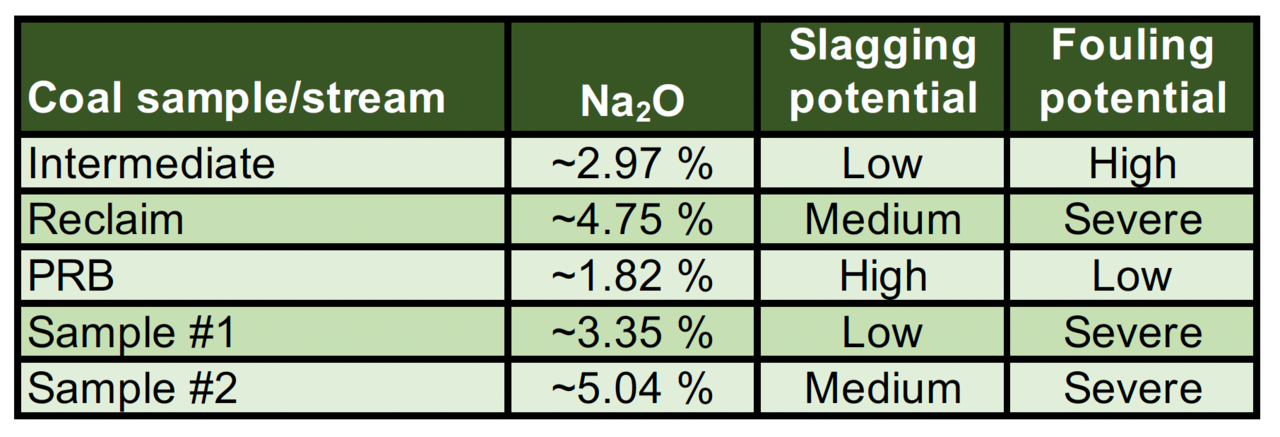
Na2O alone does not predict behavior—the low-sodium PRB stream showed high slagging potential while higher-sodium streams showed severe fouling. Ash chemistry is a multivariate problem where sulfur, calcium, and silica ratios matter as much as alkali content, which is precisely why a fixed additive recipe misses the mark and a program matched to the fuel does not.
Conventional mitigation is typically a response to boiler operational issues, and measures such as increased soot blowing, excess air changes, load shedding, water injection, and de-slagging outages are often necessary. However, these responses are costly, consuming steam, water, labor, and megawatt-hours, while having no impact on the root cause (ash chemistry).
Treatment Approach
CoalTreat reagents were applied to the coal upstream of firing using an automated “OnDemand” system. To treat the fired subbituminous coals, a combination of CT300 and CT110 additives were applied at varying dosages and ratios for efficient ash modification. The ash modification mechanisms shift the ash toward higher-melting, more-crystalline, less-adhesive structures while binding problematic alkalis earlier in the ash formation pathway.
The chemistry behind this is straightforward once you look at the phases involved. Sodium and potassium, left alone, flux the ash—they lower its melting temperature and seed the sticky first layer that everything else builds on. The additives remove that option by reacting with the alkali species in the burner zone, sequestering sodium and potassium into high-melting aluminosilicate phases that stay solid well past furnace temperatures. That is the “earlier in the ash path” part that matters: bind the alkali before it volatilizes and condenses onto tube surfaces, and you prevent the entire cascade—no sticky layer, no insulated tube, and no accelerating buildup.
The two reagents divide the work. CT300 is the primary ash modifier, driving the shift toward crystalline, high-melting structures. CT110 is dosed as a secondary component, modulating the response as fuel quality and furnace condition change. The result is the deposits that form are weak and friable instead of glassy and strong.
Resulting deposits are weaker, more friable, and more responsive to soot blowing. The objective is not a deposit-free furnace. It is a furnace in which deposits do not become an operating constraint.
CT300 was adjusted from about 1,000 parts per million (ppm) to 1,200 ppm and later reduced to about 750 ppm as furnace conditions improved. CT110 ranged from 0 to 75 ppm and was later cut to about 25 ppm. Modulation matters: the additive program is a control strategy matched to fuel and furnace condition, not a fixed additive rate.
A Three-Week High-Sodium PRB Demonstration
The demonstration ran for three weeks during January 2026. During the demonstration, the unit operated mainly between about 480 MW and 525 MW (mid to high load capacity) and fired increasingly difficult PRB, including coals with sodium concentrations of 3.7% and 5%, without a slag-related forced outage or a de-slagging shutdown.
Performance was evaluated based on several parameters:
- Daily high-temperature probe (HTP) testing.
- Infrared and conventional furnace photography.
- Coal, bottom-ash, and fly-ash sampling.
- Qualitative deposit-strength and friability observations.
- Continuous plant operating data.
Spray flows, gas temperatures, and damper positions can vary for many reasons, including operator inputs. However, concurrent changes in deposit character, furnace appearance, sprays, gas temperature, gas-side pressure drop, and ash-fusion behavior are difficult to dismiss as coincidence. Load, coal blend, excess oxygen, mill lineup, and soot blowing activity remain necessary in context for every comparison below.
Heat Transfer
Perhaps the clearest operating trend was attemperator spray flow demand. As furnace and convective surfaces clean up, upstream heat transfer is improved, gas temperatures are reduced, and less spray is required to maintain steam temperatures. Under comparable conditions, superheater spray flow fell by roughly 50% and reheat spray flow by about 53% (Figure 1).
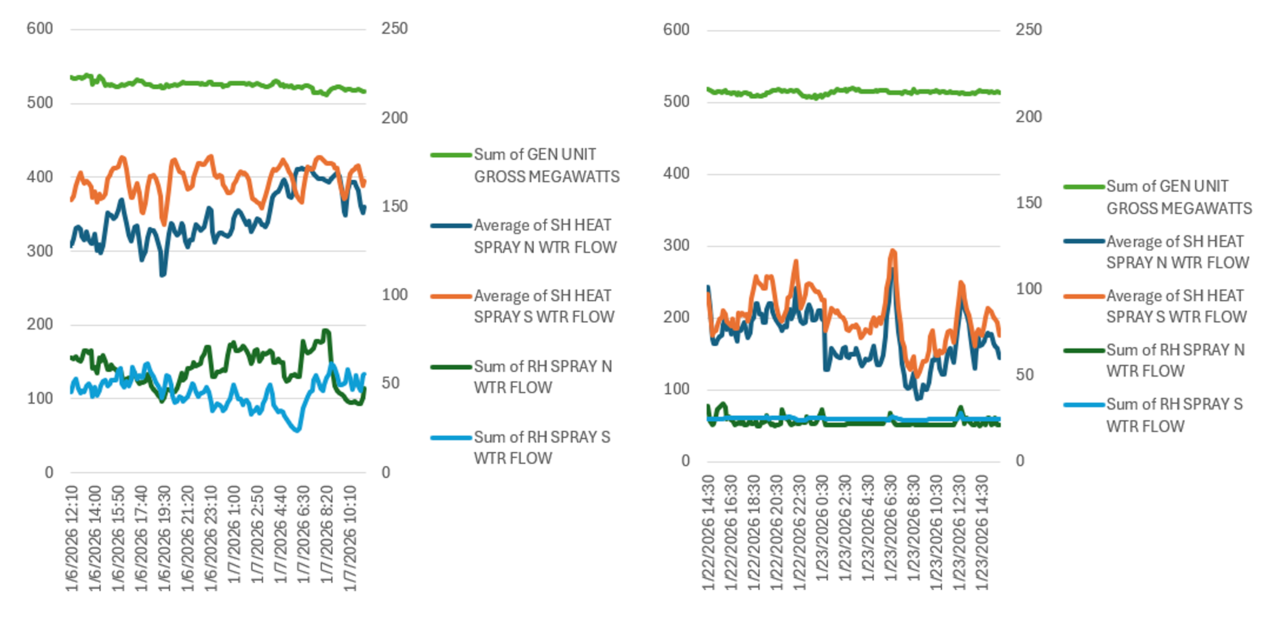
Another January-to-January comparison produced a smaller reheat-spray reduction (about 32%), providing a more conservative, but still significant value when comparing year-over-year rather than matched (untreated vs. treated) conditions during the trial. The year-over-year figure is the more conservative estimate, and rightly so—it carries the noise of different coal quality, ambient temperature, and load profile between two Januarys, whereas the matched comparison isolates the treatment effect.
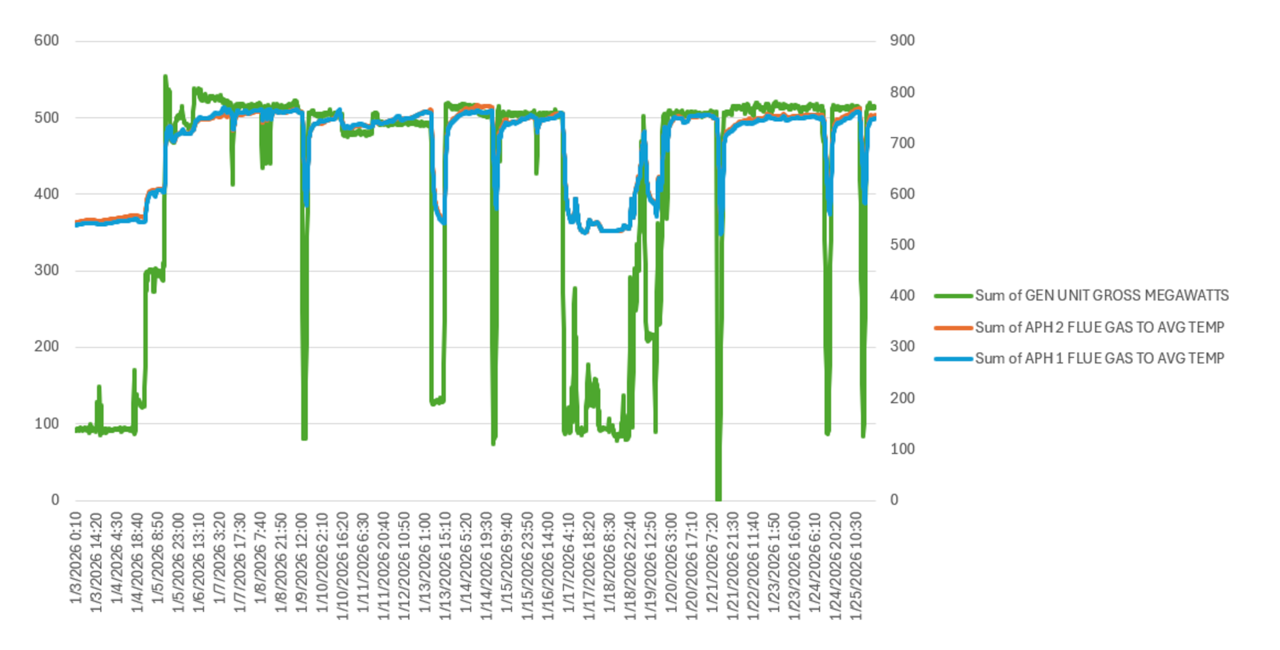
Air-preheater (APH) inlet gas temperature followed suit. APH gas inlet temperatures decreased from 10F to 20F during the trial (Figure 2). Both the lower attemperator spray demand and APH inlet temperatures are consistent with improved furnace heat absorption. They indicate a reduction in boiler heat rate and efficiency increase—not merely a change in attemperator setpoint.
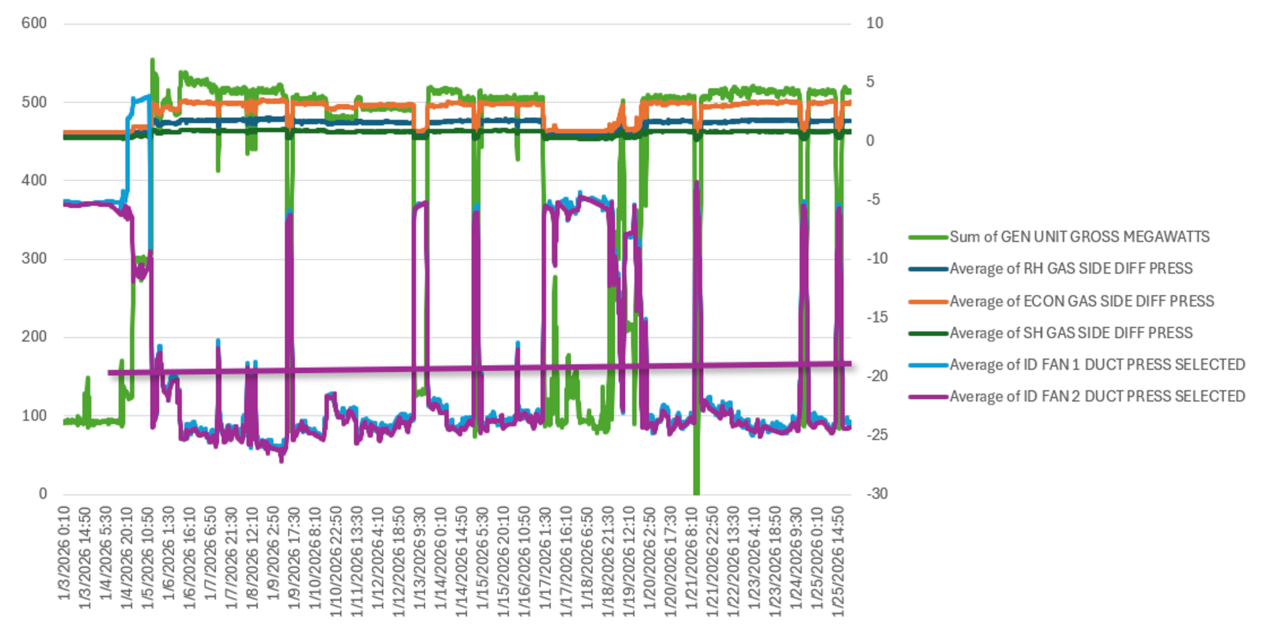
Gas-side differentials remained controlled across the reheater, economizer, and superheater sections, while overall furnace-to-ID-duct pressure drop declined (Figure 3). The maintenance and/or slight reduction of gas-path resistance suggests reduced and/or consistent ash accumulation with the ability to maintain gas flow rates despite firing of high-sodium, high-fouling fuel.
The Deposits Changed
In-situ high-temperature probe (HTP) testing is invaluable as a field tool for assessing changes in generated ash characteristics. The baseline (untreated) HTP collected deposits were dark, glassy, and hard. On a qualitative 0–5 friability scale—5 requiring tools to break the sample—baseline slag/fouling scored a 4 to 5. Treated samples were less dense, brittle, and friable (crushable by hand), scoring 2 to 3 (Figure 4).
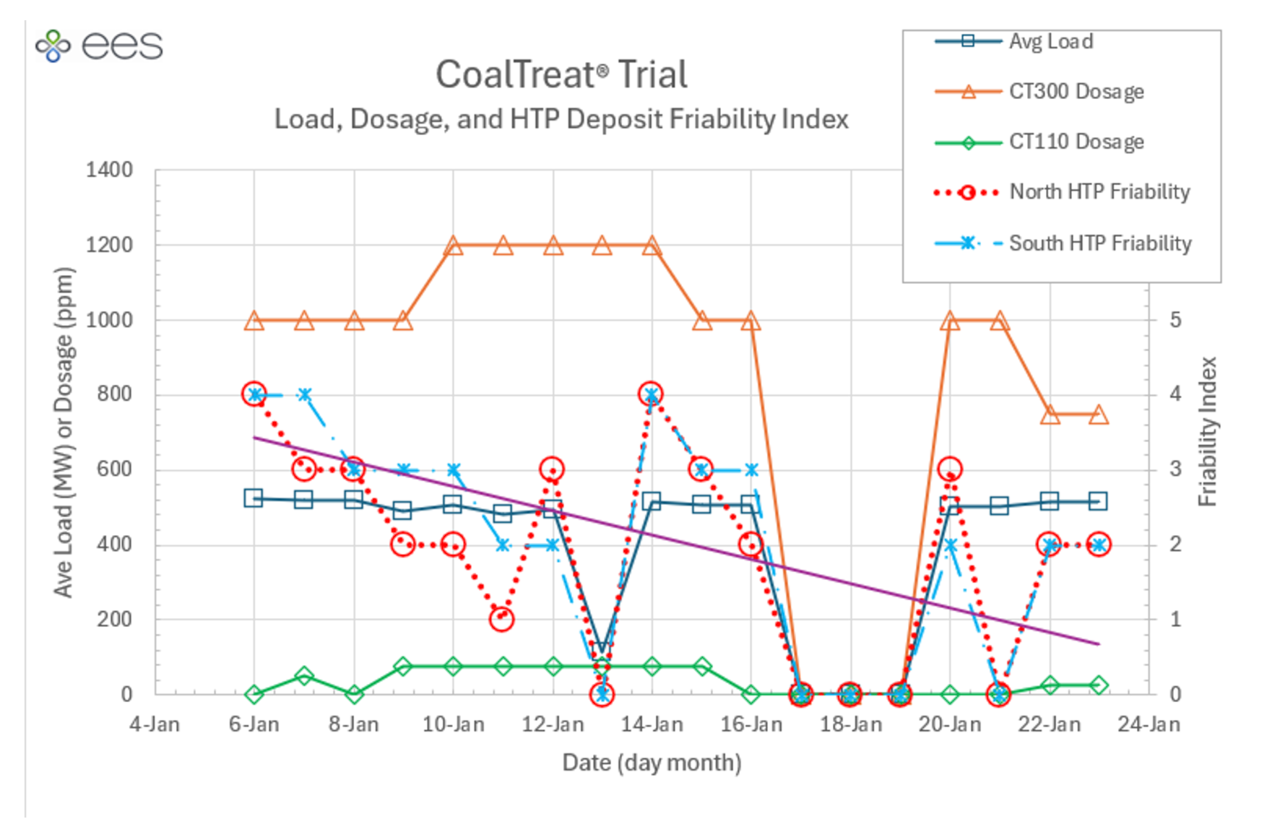
Notably, the friability improvements were held through the period when the highest-sodium fuel (about 5% Na2O) was in the furnace—the coal the plant said it could not fire for more than a few days untreated.
These changes are consequential—high-strength glassy deposits strongly adhere to boiler surfaces. They resist soot blowing, insulate boiler tubes, and drive spray flow, and increase draft loss. Friable deposits shed with normal cycling and greatly enhance soot blower effectiveness as well as bottom ash handling.
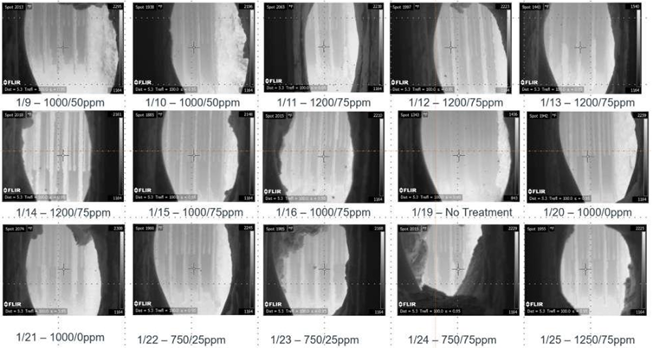
Visual evidence, by means of infrared photography, showed the progression inside the furnace. Baseline images documented significant pre-existing slag, including tubes largely obscured by deposits. Mid-trial photographs showed shedding and thinner accumulation. By the end of the demonstration, many wall areas were relatively clean, and individual tubes were visible (Figure 5). It is worth noting that these observations understate treatment effectiveness—as high-sodium fuels burned during the trial could not be fired for more than a few days without derating. Often, what we do not see (de-rate) is just as valuable as what we do.
Laboratory ash-fusion tests indicate crystalline changes in ash chemistry. The PRB reference sample had an initial deformation temperature of about 2,208F, while treated samples measured higher, with some reaching the equipment limit of about 2,700F. Fusion temperature alone cannot predict changes in boiler performance, but combined with the observed change in friability (glassy to friable) and positive boiler parameter trends from distributed control system data, the results are compelling evidence of ash modification.
Combustion Flexibility and a Secondary Emissions Benefit
With treatment, stable and controlled slagging and fouling in the furnace allowed operators to close burner-air dampers from about 77% open to approximately 40%, thus increasing staging and lowering stoichiometry in the lower furnace. Cleaner walls mean better furnace heat absorption, which creates the headroom to run lower stoichiometry in the burner zone without the temperature penalty that aggravates slagging on a fouled unit. Take the slag constraint off the table, and staging flexibility returns, along with the NOx reduction that follows.
Otherwise, in a heavily slagged unit, increased or aggressive staging may worsen slagging and temperature imbalances. With uncontrolled slagging and fouling, flexibility is lost.
As a result of improved operator flexibility and the increased staging allowed, significant emissions improvements were realized. At comparable excess O2 levels, end-of-trial SCR inlet NOx was about 34% lower than under baseline conditions, and ammonia injection flow was approximately 50% lower. Opacity declined from about 9% to about 6%, and CO was controlled (Figure 6).
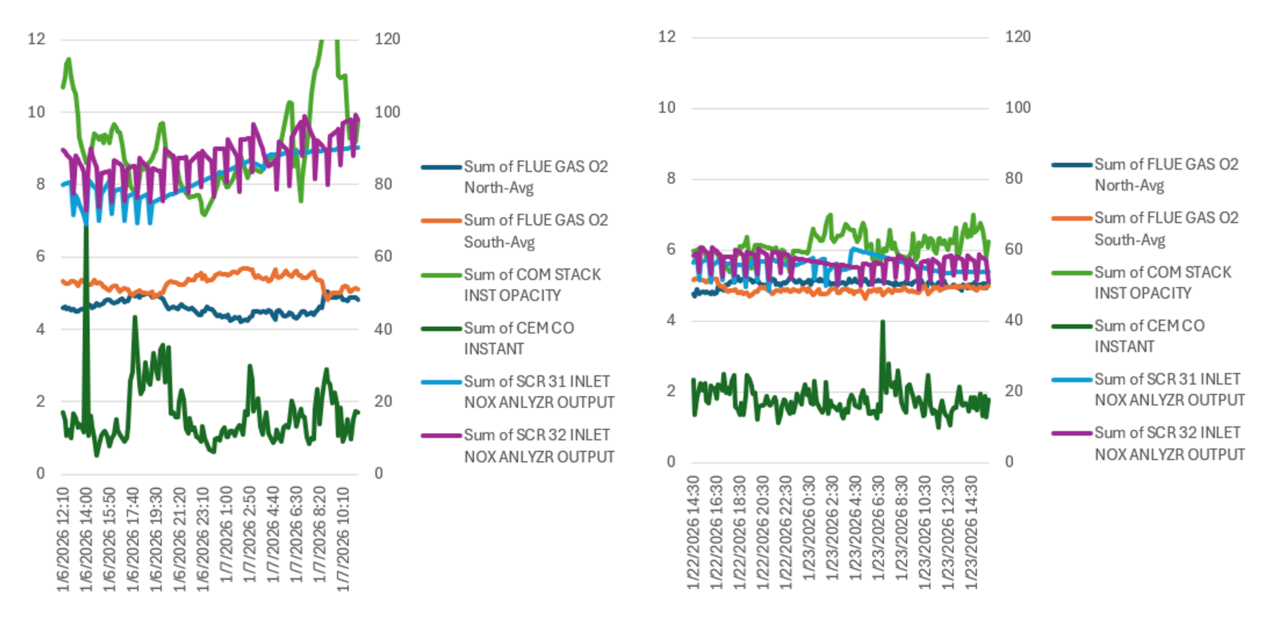
While not emissions-control technology, slagging and fouling additives can regain operational flexibility leading to improvements in NOx, CO, and opacity. As shown in this trial, removing constraints inhibiting increased furnace staging can help reduce NOx emissions, ammonia injection rates, and opacity.
Reliability
Station history has always included periodic de-slagging shutdowns. Furthermore, it was reported by plant operators that they could not burn the high-sodium fuels tested during this trial for more than a few days without derating or a forced outage. During the demonstration, the unit remained online without a slag-related forced outage, derate, or cleaning shutdown.
The demonstration was performed on a single unit at the station, but a coincident comparison was available on an adjacent unit. Photographs taken the same day on the sister unit, firing comparable high-sodium coal without treatment, showed heavier buildup and tube obscuration relative to the treated unit. Directly paired data like this, even if qualitative, tends to carry more weight than year-over-year comparisons.
For much of the remaining U.S. coal fleet, improved availability and reliability may provide a better return on investment than just an improvement in heat-rate. While a 30-MW or 50-MW slag derate in a low-price hour may be a minor problem, the same derate in a winter peak or a high-price reliability event is a significant event. Avoiding shutdowns also avoids startup fuel, contractor cleaning, extra maintenance, thermal cycles, and the risk of taking a large unit off and bringing it back.
A preliminary internal estimate of annual benefit was prepared from fuel flexibility, heat rate, reagent, and avoided outages. The savings are sensitive to coal contracts, capacity factor, and power prices, and are not published here. The broad conclusion does not depend on a single dollar figure: slag control is a reliability and dispatch problem, not just a boiler-cleaning expense.
From Cleaning to Fuel Management
The traditional cycle of allowing ash/slag deposits to grow and then expend steam, water, labor, or an outage to remove them is no longer advantageous.
Fuel treatment modifies ash characteristics before they become a problem by generating weak and friable deposits amenable to soot blower removal. The ability to control ash can also affect fuel procurement—less expensive, high-sodium or off-specification fuels may be burned effectively, providing another tool in a station’s fuel strategy toolkit.
A Practical Form of Modernization
A lot of the industry’s conversation is still about large projects: new builds, environmental retrofits, repowering, carbon capture, and retirement. But most operators live in a different reality—they’re being asked to run an existing boiler past its original retirement date on whatever coal the contract delivers, and to keep it dispatchable when it’s called, which is never on a schedule they control.
Over three weeks, this unit held load burning difficult fuel while sprays fell, APH inlet temperature dropped, deposits went from glass to friable ash, furnace walls cleaned up, gas-side resistance held, NOx and ammonia use came down, and no slag outage forced the unit offline. No single number tells that story. Together they add up to one thing: the plant had control over its ash, instead of the ash quietly controlling the plant.
There is an arithmetic underneath it that matters more than any heat-rate gain. A 30-MW or 50-MW slag derate in a low-price hour is a nuisance. The same derate in a winter peak, when the grid is leaning on the unit, is a very different event—lost revenue, startup fuel, contractor cleaning, thermal cycles, and the risk that comes with taking a large unit off and coaxing it back. An avoided outage is worth more than any single efficiency number, because it is worth nothing to save a megawatt you can’t deliver when it matters.
The coal fleet is being asked to outlive its design life on fuels it was never expected to burn. Fuel treatment isn’t a boiler rebuild and it isn’t magic—it’s a way to buy that fleet the flexibility it needs to make it through.
—P. Robert Santangeli, PE is vice president of Engineering and Operations at He can be reached at info@eescorp.com.