“The need for emission-free and stable energy sources that can help manage the natural and climate crisis and meet an increasing need for power has contributed to raising the question of nuclear power in Norway, as have the technological development and plans to establish nuclear power production from private players in cooperation with municipalities,” the government said.
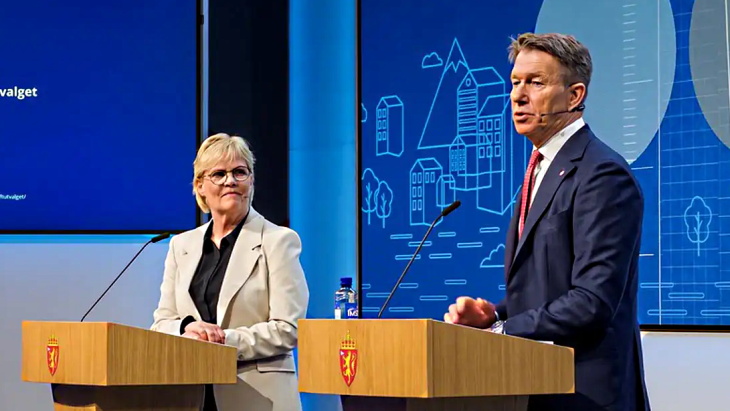
The Norwegian government appointed the commission in June 2024 to conduct a broad review and assessment of various aspects of a possible future establishment of nuclear power in the country. The commission – chaired by Kristin Halvorsen, former director of the Centre for International Climate and Environmental Research – Oslo (Cicero) – was tasked with examining several key issues, including whether nuclear power is suitable for the Norwegian power system, the status of research and technology development, costs and other significant consequences for governments and private actors, land and environmental impacts, waste issues, nuclear safety, security and non-proliferation, preparedness and competence needs. Nuclear power in Norway was last examined by a public committee in 1978.
The commission has now to Norway’s Minister of Energy, Terje Aasland.
“The Nuclear Commission has done thorough work, and this report provides a good basis for a knowledge- and fact-based discussion about nuclear power,” Aasland said. “The need for an updated knowledge base about nuclear power was an important reason for the appointment of the Nuclear Commission. The committee has now submitted a comprehensive and thorough report.”
The report says: “It will take at least 20 years to establish nuclear power production in Norway. For a newcomer country, as Norway would be, comprehensively developing the necessary regulations, clarifying the allocation of responsibilities between authorities and establishing the necessary infrastructure is an extensive and long-term process … A political decision on the introduction of nuclear power in Norway must be based on assessments of and trade-offs between a range of considerations and a firmly anchored democratic process. Economic, technological and ethical aspects must be included in the assessment, not least in light of the long-term commitment that the establishment of nuclear power involves.”
The report concludes that, given current cost projections and market prices, nuclear power is not economically profitable in Norway. “Due to the high fixed costs associated with establishing a disposal facility, as well as the extensive governmental apparatus that must be built up, it would become disproportionately expensive to develop ‘a small amount’ of nuclear power in a country,” it says. “Looking ahead to 2050, Norway has good alternatives that are either established or under development, and as things stand, the Commission finds no specific socio-economic justifications for state aid for nuclear power, such as security of supply or the climate targets. Nuclear power can make only a minor contribution to meeting the 2050 climate targets and must primarily be seen as a solution to meet increased energy demand after 2050. A political decision to introduce nuclear power now could delay investments in other generation capacity, which would be able to come online sooner. Due to its hydropower, the Norwegian power system is not dependent on the system characteristics of nuclear power.
“Ultimately, it is investors who will assess whether nuclear power should be realised, and they will weigh the profitability of nuclear power against other investments,” the report adds.
However, the commission says that uncertainty regarding future developments suggests that nuclear power “may become an option for Norway at a later date”.
“The Commission recommends that a national competence project be established to enable a faster introduction of nuclear power should this become relevant in the future,” the report says. “In the future, the cost situation and the trade-offs between costs, the environment, land use, safety and other values may change. A national competence project spanning relevant ministries, agencies and sectors could lay the groundwork for and shorten any future process.”
The Commission proposes that a limited but targeted academic environment in nuclear power technology be established at Norwegian universities and that better conditions be created for participation in international research programmes.
The report will now be sent for consultation. The consultation deadline is 8 October. “After that, the government will consider the further process,” the government said. “The government will involve the Storting [parliament] in an appropriate manner.”
A total of ten notifications with proposals for an exploratory programme for the establishment of nuclear power in Norway have so far been submitted. In February this year, the Ministry of Energy, the Ministry of Health and Care Services and the Ministry of Climate and Environment established an environmental impact assessment programme for the plans for a nuclear power plant in Taftøy Næringspark in the municipalities of Aure and Heim. The plant is planned to consist of several small modular reactors, which together will produce around 12.5 TWh of electricity annually, if the plant is realised in its entirety.
The government has stated that it will await the assessments from the Nuclear Commission before taking a position on the processing of the other notifications.