The company’s Board of Directors made its final investment decision in February, after receiving final federal regulatory approvals for the start of construction from the Canadian Nuclear Safety Commission. Provincial-level approvals were already in place. Earlier in the month, Denison announced it had awarded consulting and engineering company Wood Canada Limited the construction management contract to oversee the building of the mine. Site preparation and early works construction activities began in March, with a ceremonial groundbreaking ceremony being held in June.
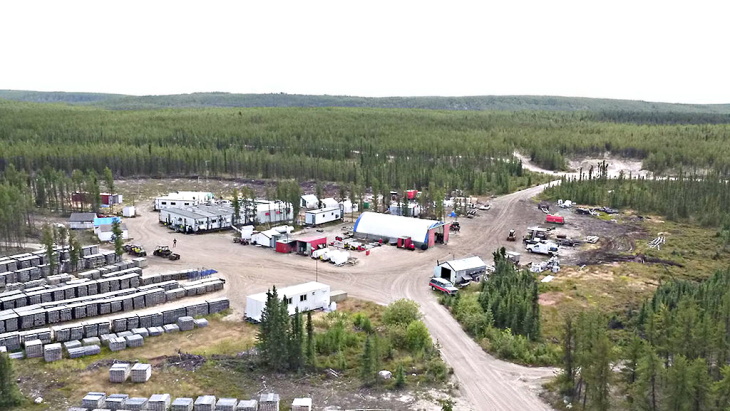
Denison said that, since site preparation and early works began, significant progress has been made to complete several critical site preparation activities – including substantial completion of site clearing activities, advancement of schedule-sensitive site civil works, and the establishment of construction management facilities. Preparation activities also involved the installation and commissioning of temporary construction camp facilities, which significantly increases the accommodation capacity of the Wheeler River property to nearly 400 people and allows a ramp-up in the on-site workforce.
Additionally, aggregate production required for various site civil purposes continues at a nearby quarry, and the concrete batch plant has been mobilised to site. Schedule-critical concrete-related activities for the substation and the main process plant foundations are currently expected to commence in August.
“Completing the site-preparation activities needed to ramp up our on-site workforce and achieve a full-scale rate of construction is an important initial milestone for the Phoenix project,” said Denison President & CEO David Cates. “Site civil work has progressed well during the early works programme, with more than 20% of overall site civil work estimated to be completed to date. Importantly, we have achieved near-100% completion of civil subgrade work for the process plant and wellfield areas, which is needed to facilitate the planned concrete pour for the plant and the initiation of the freeze wall installation programme.
“Construction activity is expected to accelerate through the remainder of the summer months with the commencement of a second shift, which means seasonally sensitive civil and other construction work can continue virtually 24-hours a day in support of the completion of our key first-year construction milestones – including concrete pours of the foundations for the process plant and main power transformer, installation of the freeze wall, as well as earth works for the airstrip and on-site power distribution. Achieving these positive early results demonstrates the readiness and commitment of Denison and our construction partners as we advance this unique nation-building project to become Canada’s first new large-scale uranium mine since Cigar Lake.”
Phoenix – part of the Wheeler River project – is described by Denison as the largest undeveloped uranium project in the infrastructure-rich eastern portion of the Athabasca Basin region, in northern Saskatchewan. The project is host to the high-grade Phoenix and Gryphon uranium deposits, discovered by Denison in 2008 and 2014, respectively.
In-situ recovery (ISR) – also referred to as in-situ leach – is a method of recovering uranium minerals from ore in the ground by dissolving them in situ, using a mining solution injected into the orebody. The solution is then pumped to the surface, where the minerals are recovered from the uranium-bearing solution. More than half of the world’s uranium production is now produced by such methods, which do not generate conventional mine tailings.
Phoenix is the first uranium mine in Canada to use the ISR mining method, and the first large-scale Canadian uranium mining project to be approved for construction in more than 20 years.