Specialists from construction company Titan-2 Holding oversaw the moving of the core catcher into the concrete shaft of the reactor containment building for what is the third unit in the second phase of the Leningrad plant.
The core catcher is a container in the form of a cone made of thermally resistant steel which, in the event of an emergency, would securely hold a melted reactor core and not allow radioactive substances to leave the containment of the reactor.
Alexey Mochalov, Deputy Chief Engineer for the Construction of New Power Units at Leningrad NPP-2, said: “The likelihood that this passive safety system will ever be truly needed is extremely low: all the decisions made in the design of domestic power units with VVER-1200 reactors, the high-quality construction, installation, and commissioning work, as well as the highly qualified and responsible personnel of the nuclear power plant, will leave the trap in standby mode for the entire design life of the unit.”
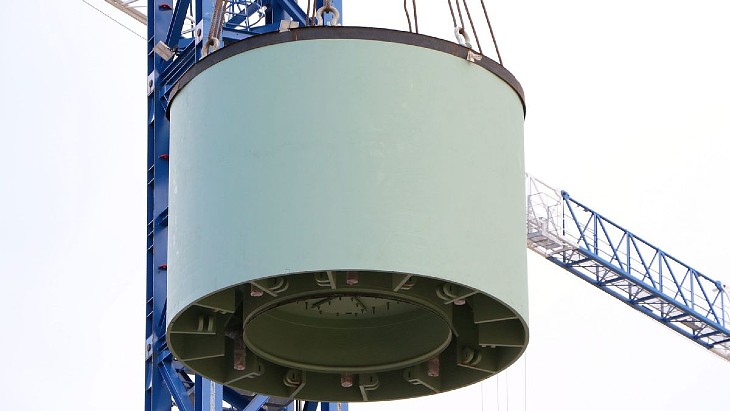
(Image: Rosatom)
Konstantin Khudyakov, director of the Leningrad NPP facilities programme at Titan-2, said: “As of today, the reactor shaft of unit 3 is 55% complete and filled with equipment weighing nearly 900 tonnes. Next, we will install thermal insulation, support and thrust trusses, and other equipment, assemble measuring channels, and concrete the shaft to the design height, so that the reactor vessel can be assembled as early as next year. Work is on schedule, some even ahead of schedule.”
Background
The Leningrad nuclear power plant is one of the largest in Russia, with an installed capacity of 4,400 MWe, and provides more than 55% of the electricity demand of St Petersburg and the Leningrad region, or 30% of all the electricity in northwest Russia.
Leningrad 1 shut down in 2018 after 45 years of operation. Leningrad 2, also a 1,000 MWe RBMK unit, started up in 1975 and was permanently shut down in November 2020. As the first two of the plant’s four RBMK-1000 units shut down, new VVER-1200 units started up at the neighbouring Leningrad II plant. The 60-year service life of these fifth and sixth units (also known as Leningrad II-1 and Leningrad II-2) secures power supply until the 2080s, with the possibility of a further 20-year extension beyond that. Units 7 and 8 (also known as Leningrad II-3 and Leningrad II-4) will replace units 3 and 4 as they are shut in the coming years.
The pouring of the first concrete for unit 7 in March 2024 marked the start of the main phase of construction of the new power unit. First concrete was poured for the eighth unit in March 2025.