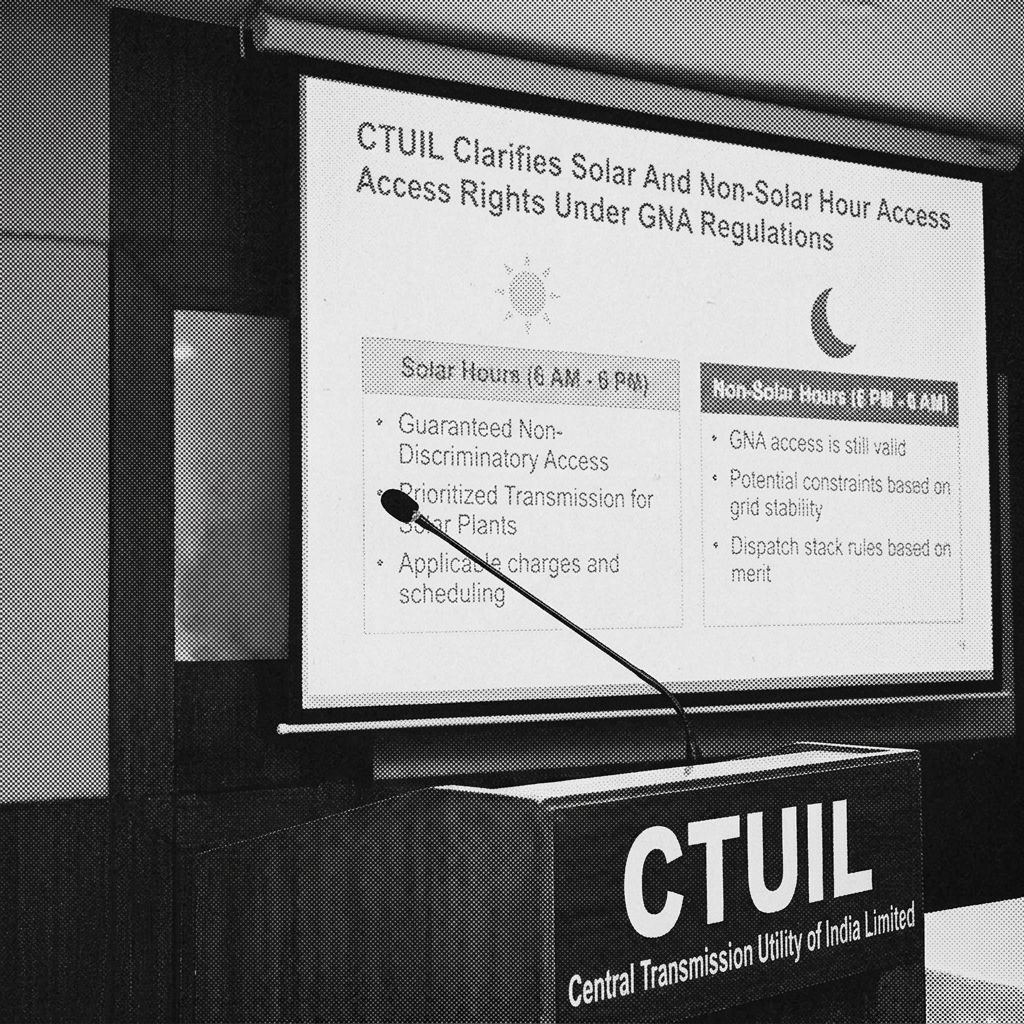
The Central Transmission Utility of India Limited (CTUIL) has issued guidelines clarifying the treatment of solar and non-solar hour access rights and substation margins under the Central Electricity Regulatory Commission (CERC) General Network Access (GNA) Regulations. The guidelines, issued on August 13, 2026, are aimed at providing greater clarity to entities seeking connectivity to the transmission grid.
Under the framework, the non-solar hour access capacity of substations is generally calculated at the same level as the solar-hour access capacity. However, Pumped Storage Plants (PSPs) and standalone Energy Storage Systems (ESS) will not receive guaranteed access during solar hours. Their ability to inject power during these hours will depend on the margins available in the transmission system.
CTUIL also clarified that entities granted access will receive formal injection rights only after completing the applicable regulatory requirements and receiving the official connectivity intimation. The access capacities and margins published by CTUIL are indicative and should not be treated as final connectivity approvals.
Actual connectivity will be determined through detailed system studies after an application is submitted. In case of any difference between the published information and the formal connectivity grant, the conditions specified in the official grant intimation will prevail.
The published margins are calculated after considering connectivity already granted, capacities agreed during recent Connectivity and Medium-Term Open Access (CMETS) meetings, and applications received up to the specified cutoff date. CTUIL noted that some of the published net margins may include capacity reserved for re-allocation to existing applicants under Regulation 11C of the GNA Regulations. As a result, available margins may reduce or become unavailable following such re-allocation.
CTUIL further stated that bay-wise margins can support mechanisms such as bay sharing, but the total connectivity at a substation will remain subject to the overall capacity limit of the substation. Standard margins have been considered at 300 MW for 220 kV bays and 900 MW for 400 kV bays. However, the applicable capacity may be higher where a specific connection quantum has already been granted.
Special provisions apply to Renewable Energy Generating Stations (REGS) and Renewable Hybrid Generating Stations (RHGS) connected through conventional power plants without using renewable energy zone transmission schemes. Solar projects will receive solar-hour access rights, while Battery Energy Storage Systems (BESS) will receive both solar and non-solar hour access rights.
CTUIL also cautioned that certain reserved capacities may remain subject to ongoing judicial directions. Stakeholders have been advised to verify their connectivity details against their official grant documents and immediately report any discrepancies to the concerned regional CTUIL offices.
Subscribe to get the latest posts sent to your email.