Rosatom says that the 30-year decommissioning work will “serve as a benchmark for all subsequent pressure-tube reactor dismantling projects worldwide”.
The Russian state nuclear corporation says that what it calls the “Immediate Dismantling” concept has been adopted for the decommissioning of the unit, which “involves dismantling equipment, including reactor units, building structures, and facilities, and removing waste generated from the unit site. During the first eight years after receiving the decommissioning licence, the necessary decommissioning infrastructure will be created at the unit, and decontaminated and lightly-contaminated equipment will be dismantled and removed”.
The plan is for dismantling of the reactor facility to take place during the final stage of decommissioning, with the work carried out using specially designed robots. The dismantled and shredded components will then be placed in special containers and transferred for long-term storage.
Leningrad 1 was shut down for decommissioning, after 45 years of power generation, in December 2018. Leningrad 2 was shut down in November 2020. They were considered operational until their nuclear fuel was removed, a process which was completed for unit 1 in August 2021.
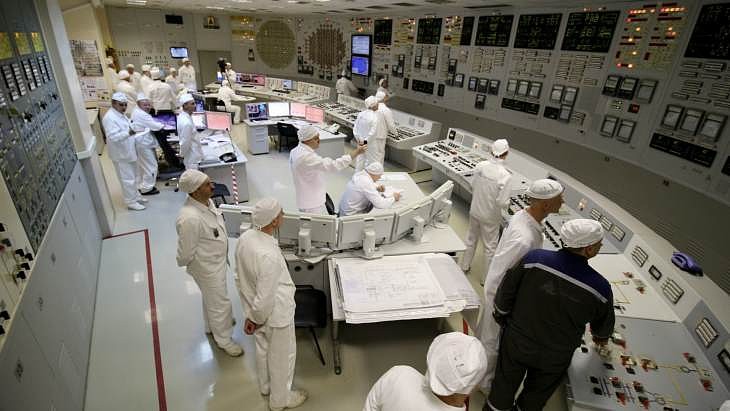
Vladimir Pereguda, Director of the Leningrad NPP, said: “One of our company’s key tasks at this stage was removing nuclear fuel from the power units, as well as developing design documentation for decommissioning. These tasks were successfully accomplished thanks to the coordinated collaboration of the plant’s team with scientific, design, and engineering institutes, as well as equipment manufacturers. Today, the successful decommissioning of RBMK-1000 power units that have reached the end of their service life is the most important task facing Russian nuclear scientists.”
The Leningrad nuclear power plant is one of the largest in Russia, with an installed capacity of 4,400 MWe, and provides more than 55% of the electricity demand of St Petersburg and the Leningrad region, or 30% of all the electricity in northwest Russia.
As the first two of the plant’s four RBMK-1000 units shut down, new VVER-1200 units started up at the neighbouring Leningrad II plant. The 60-year service life of these fifth and sixth units (also known as Leningrad II-1 and Leningrad II-2) secures power supply until the 2080s. Units 7 and 8 (also known as Leningrad II-3 and Leningrad II-4) will replace units 3 and 4 as they are shut in the coming years.
There are currently seven operating RBMKs in Russia and four which have been shut down. There were also four RBMK reactors at Chernobyl in Ukraine, the last of which closed down in 2000, and two in Lithuania, which shut down in 2004 and 2009 respectively.