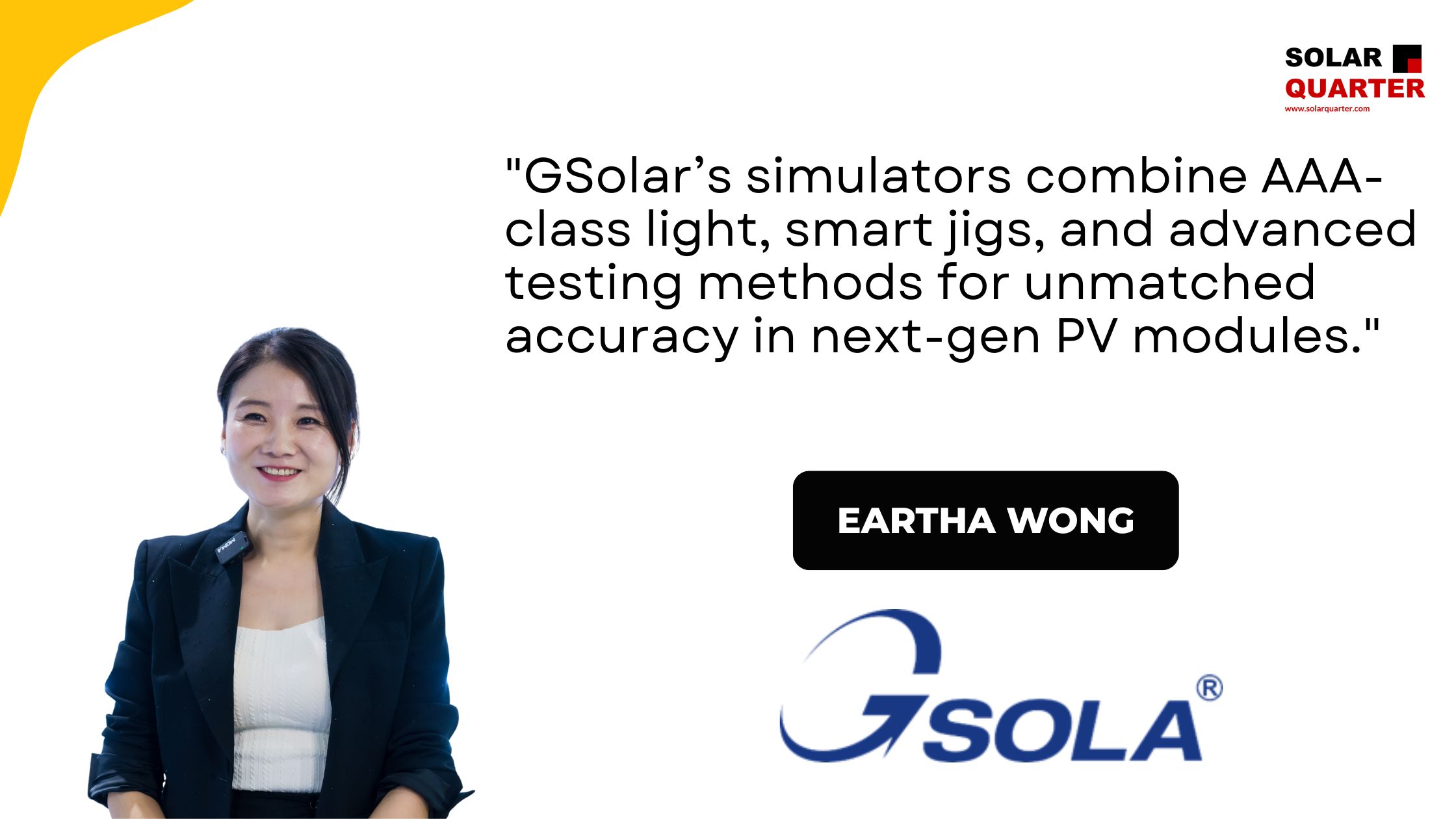
What new technologies has GSolar added to improve PV module testing accuracy?
Testing accuracy in PV modules is influenced by three core components: light source performance, testing methodology, and electrical connection quality. At GSolar, we’ve engineered innovations across all three to deliver best-in-class performance.
Our sun simulators utilize AAA-class light sources that fully comply with IEC standards, setting a benchmark for precision. These simulators feature an irradiance non-uniformity of less than 1%, spectral mismatch within 12.5%, and temperature instability below 1%. Unlike systems that use reflected light, our simulators illuminate panels directly, significantly increasing measurement accuracy.
We also developed proprietary solutions like GSM (GSolar Super Long Linear Testing Method). This breakthrough allows our 20 ms flash time to simulate the performance of a much longer 1200 ms linear sweep, which is particularly crucial when testing high-capacitance modules such as TOPCon, HJT, and IBC. Combined with advanced four-wire cable connections and smart testing jigs embedded with chips, our systems actively reduce contact resistance and calibrate in real time ensuring reliable measurements across mass production environments.
How does GSolar ensure its simulators meet global PV testing standards?
All GSolar simulators are developed in strict accordance with international standards, particularly IEC 60904 and IEC 60891. These standards define parameters for accuracy, repeatability, and equipment behavior under varied test conditions.
By following these protocols rigorously, we ensure both reliability and consistency of data in any market. Moreover, we continuously adapt our systems to support evolving technologies in PV cells, such as tandem perovskite modules and high-efficiency silicon cells. We back this up with patented testing methodologies, ongoing R&D, and updates to keep pace with technological evolution and regional compliance requirements.
How do GSolar’s simulators stand out from global competitors in performance, cost, and support?
GSolar distinguishes itself in three key areas: technical versatility, cost-effectiveness, and after-sales support.
Firstly, we offer both Xenon and LED-based sun simulators, giving customers the flexibility to choose the best solution for their specific module types and R&D requirements. In fact, our LED simulators—launched in 2023—are now widely adopted by tandem perovskite research labs and commercial clients. We are proud to say that GSolar currently holds the No. 1 global market share in the tandem perovskite application segment.
In terms of cost, our simulators match or exceed the performance of leading European and Chinese brands, but at a more economical price point, making them highly attractive for both R&D and large-scale manufacturing.Lastly, our global support infrastructure is unparalleled. We maintain international service centers and spare parts warehouses to ensure quick turnaround. Our principle is to respond to customers within 10 minutes, provide spare parts on time, and ensure minimal downtime. In markets like India, for example, we have six experienced service engineers on the ground who offer full technical support and knowledge sharing. This local presence is a key reason why GSolar now commands 96% of the Indian market share for PV simulators.