Wednesday, 19 March 2025
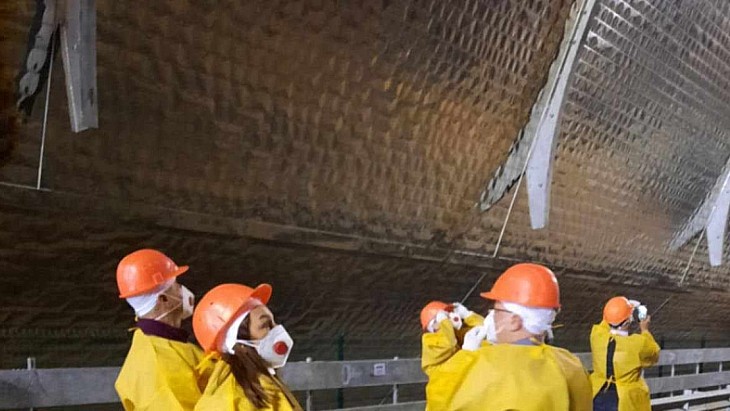
During the visit they inspected the shelter – the New Safe Confinement (NSC) – and held meetings with Chernobyl nuclear power plant (ChNPP) leaders.
The shelter
Chernobyl unit 4 was destroyed in the April 1986 accident (you can read more about it in the ) with a shelter constructed in a matter of months to encase the damaged unit, which allowed the other units at the plant to continue operating. It still contains the molten core of the reactor and an estimated 200 tonnes of highly radioactive material.
However it was not designed for the very long-term, and so the New Safe Confinement – the largest moveable land-based structure ever built – was constructed to cover a much larger area including the original shelter. The New Safe Confinement has a span of 257 metres, a length of 162 metres, a height of 108 metres and a total weight of 36,000 tonnes and was designed for a lifetime of about 100 years. It was built nearby in two halves which were moved on specially constructed rail tracks to the current position, where it was completed in 2019.
It has two layers of internal and external cladding around the main steel structure – about 12 metres apart – with both breached in the drone incident. The NSC was designed to allow for the eventual dismantling of the ageing makeshift shelter from 1986 and the management of radioactive waste. It is also designed to withstand temperatures ranging from -43°C to +45°C, a class-three tornado, and an earthquake with a magnitude of 6 on the Richter scale.
According to World Nuclear Association, the hermetically-sealed New Safe Confinement allows “engineers to remotely dismantle the 1986 structure that has shielded the remains of the reactor from the weather since the weeks after the accident. It will enable the eventual removal of the fuel-containing materials in the bottom of the reactor building and accommodate their characterisation, compaction, and packing for disposal. This task represents the most important step in eliminating nuclear hazard at the site – and the real start of dismantling”.
The EBRD involvement
The New Safe Confinement was financed via the Chernobyl Shelter Fund which was run by the European Bank for Reconstruction and Development (EBRD). It received EUR1.6 billion (USD1.7 billion) from 45 donor countries and the EBRD provided EUR480 million of its own resources.
On 4 March the EBRD allocated EUR400,000 from the administrative budget of the continuing fund for specialist-led damage assessment.
The drone damage
The giant shelter was struck by a drone on 14 February. The impact caused a 15-square-metre hole in the external cladding of the arch, with further damage to a wider area of about 200-square-metres, as well as to some joints and bolts. It took about three weeks to fully extinguish smouldering fires in the insulation layers of the shelter.
According to the International Atomic Energy Agency (IAEA) and Ukrainian nuclear regulators, radiation levels have remained within normal levels throughout. But the IAEA last week warned: “This arch-shaped structure has multiple functions: to protect the environment from any potential release of radioactive material into the atmosphere, to prevent any degradation of the old shelter structure beneath it from external factors and to facilitate dismantling activities.
“As a result of the drone strike, however, the confinement function of the NSC has been compromised. The fires and smouldering resulted in extensive damage, including to the northern side and to a lesser extent to the southern side of its roof, according to an initial site evaluation shared with the IAEA team based at the site. The NSC will require extensive repair efforts.”
The wider context
The Chernobyl nuclear power plant lies about 130 kilometres north of Ukraine’s capital Kyiv, and about 20 kilometres south of the border with Belarus. A 30-kilometre exclusion zone remains around the plant, although some areas have been progressively resettled. Three other reactors at the site, which was built during Soviet times, continued to operate after the accident, with unit 3 the last one operating, until December 2000.
When Russia launched its invasion of Ukraine in February 2022 it rapidly took control of the Chernobyl plant. Its forces remained there until withdrawing on 31 March 2022 and control returned to Ukrainian personnel. The IAEA has had experts stationed at the site as the war has continued, seeking to help ensure the safety and security of the site.
IAEA teams are also in place at Ukraine’s three operating nuclear power plants and the Zaporizhzhia nuclear power plant, which has been under the control of Russian forces since early March 2022.
Ukraine has blamed Russia for the drone strike, while Russia denied it was responsible and blamed Ukraine. The IAEA has not attributed blame to either side during the war, with Director General Grossi explaining in a press conference at the United Nations in April last year that this was particularly the case with drones, saying “we are not commentators. We are not political speculators or analysts, we are an international agency of inspectors. And in order to say something like that, we must have proof, indisputable evidence, that an attack, or remnants of ammunition or any other weapon, is coming from a certain place. And in this case it is simply impossible”.