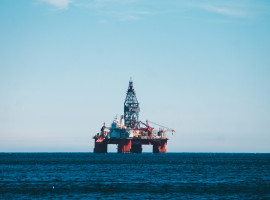
The U.S. Energy Information Administration (EIA) projected that the Brent spot average price will drop in 2026 and 2027 in its latest short term energy outlook (STEO), which was released this week.
According to this STEO, the EIA sees the commodity coming in at $55.87 per barrel this year and $54.02 per barrel next year. The Brent spot price averaged $69.04 per barrel in 2025, the STEO highlighted.
A quarterly breakdown included in the EIA’s January STEO projected that the Brent spot price will average $58.93 per barrel in the first quarter of 2026, $56.00 per barrel in the second quarter, $55.35 per barrel in the third quarter, $53.34 per barrel in the fourth quarter, $53.00 per barrel in the first quarter of 2027, $54.00 per barrel across the second and third quarters of 2027, and $55.00 per barrel in the fourth quarter of next year.
In its STEO, the EIA highlighted that the Brent crude oil spot price averaged $63 per barrel in December 2025, which it pointed out was $11 per barrel lower than the average in December 2024.
“Crude oil prices fell, or were flat, in every month during the second half of 2025 (2H25),” the EIA said in its outlook report.
“Growing crude oil production and increasing oil in floating storage outweighed the effect of potential disruptions to oil exports driven by tensions in Russia and Venezuela,” it added.
“We forecast that growing global oil production will continue to drive high global oil inventory builds through the forecast, causing crude oil prices to fall through 2026. However, inventory builds begin to gradually moderate next year, stemming price declines,” it continued.
“Strong global oil production growth outpaced consumption growth, driving our assessment that global oil inventories rose quickly in 2H25. We expect this trend to continue in both 2026 and 2027, although at a decreasing rate in 2027 as supply growth begins to slow and global oil demand growth increases to 1.3 million barrels per day from 1.1 million barrels per day in 2026,” the EIA went on to state.
The EIA projected in its report that global oil inventory builds will average 2.8 million barrels per day in 2026, which it said “is similar to this year’s increase”. It forecast in the STEO that builds will average 2.1 million barrels per day in 2027.
In its report, the EIA went on to note that “there are signs increasing volumes of oil are accumulating in transit on the water or in floating storage”, which the EIA said “have begun to weigh on oil prices”.
“However, the excess supply that we estimate built up last year has not yet been fully reflected in observable inventories of crude oil such as those at storage hubs in Cushing, Oklahoma, or the U.S. Gulf Coast,” it added.
“We expect that lower near-term oil prices relative to those for oil deliveries further in the future (in other words, contango market structure) will encourage market participants to begin to store crude oil on land until supply and demand imbalances moderate and inventory builds decrease,” the EIA said.
The EIA stated in its January STEO that China’s continued strategic inventory builds provide a major source of support for crude oil prices going forward.
“We assess that a large portion of oil inventory builds during 2025 went into strategic stockpiles in China. Because these strategic builds acted as a source of demand, similar to the consumption of oil, they limited downward price movements often associated with large inventory accumulation,” the EIA noted.
“We assume that China will continue building strategic stockpiles at nearly the same rate of just under 1.0 million barrels per day in 2026 before decreasing its rate of strategic builds by nearly a third in 2027,” it added.
The EIA also highlighted in its STEO that, although it forecasts OPEC+ will produce almost 0.9 million barrels per day less on average than its current targeted production in 2026, it expects “much of this shortfall to be driven by underproduction from members such as Russia and Mexico due to sanctions and declining productivity, respectively”.
“Of the nine OPEC members subject to production targets (a group that excludes Iran, Libya, and Venezuela), we expect production will track closely with stated targets during 2026,” the EIA pointed out.
“On January 4, OPEC+ reaffirmed plans to keep production flat in the first quarter of 2026 (1Q26), but allowed for future adjustments, including plans to re-evaluate the maximum sustainable production capacity to be used in setting 2027 production targets when the group meets in 4Q26,” the EIA highlighted.
“Despite no plans to announce 2027 targets until 4Q26, we do not expect OPEC+ will increase production next year given our expectation of large inventory builds over the forecast period,” it said.
The EIA also warned in its January STEO that “evolving conditions” in Venezuela remain a “key uncertainty” in its forecast.
“The oil blockade and the interception of sanctioned oil tankers near Venezuela halted most of Venezuela’s oil exports, resulting in production shut-ins. We estimate that about 0.6 million barrels per day of Venezuela’s oil exports are currently disrupted, and an equivalent amount of production has been shuttered,” the EIA said.
“Most of these volumes likely would have been exported to China. Our forecast assumes that sanctions on Venezuela remain in place throughout the forecast,” it added.
“Any sanctions relaxation or other U.S. government policy changes related to Venezuela that could result in more oil production than we assumed in this forecast would put additional downward pressure on oil prices,” the EIA went on to state in its January STEO.
Rigzone has contacted the Department of Information and Press of the Russian Ministry of Foreign Affairs, the Venezuelan embassy in the UK, the International Press Center of China’s Ministry of Foreign Affairs, OPEC, Mexico’s Ministry of Foreign Affairs, and the White House for comment on the EIA’s January STEO. At the time of writing, none of the above have responded to Rigzone.
To contact the author, email