Wednesday, 12 March 2025
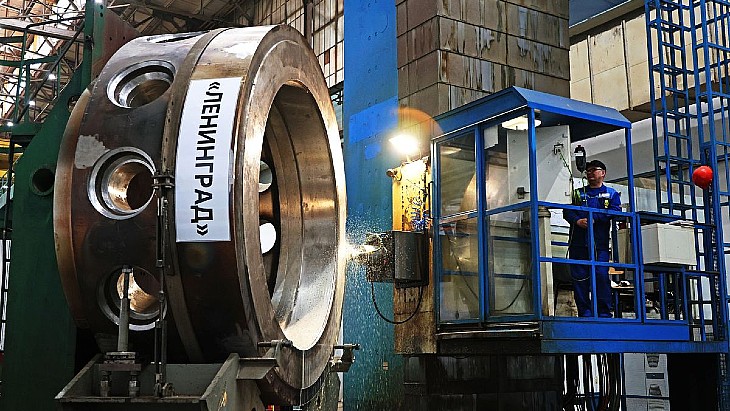
The new generation of Russian nuclear-powered icebreakers – the Project 22220 vessels – each feature two RITM-200 reactors and the ZIO-Podolsk plant, part of Rosatom’s machine-building division, has already manufactured 10 of them for the icebreakers Arktika, Sibir, Ural, Yakutia and Chukotka.
The RITM-200 reactors, having demonstrated their suitability for Arctic conditions, are also going to be used in floating power plants which are being built to supply electricity for a large industrial consumer in Chukotka. Another project will use the RITM-200N as part of a land-based small modular reactor nuclear power plant in Yakutia. There is also an agreement for six such reactors in Uzbekistan.
According to Rosatom: “Currently, for the first time in the plant’s history, there are eight RITM series reactor units at different stages of production (for icebreakers and floating power units).”
The nuclear-powered icerbreakers are a key part of Russia’s plan to develop the Northern Sea Route, the shipping lane along its north coast, which can cut the distance and speed for shipping goods by sea from northern Europe to Asia.
Plant Director Anton Lebedev said: “We have accumulated a colossal amount of knowledge and skills, and today we have competencies that no one else in the world has, having mastered and launched the flow production of the latest reactor units of the RITM series. This is not only RITM-200 for nuclear icebreakers and small nuclear power, but also their more powerful analogues RITM-400, which will help ensure year-round navigation along the Northern Sea Route.”
Background
The Leningrad will be the sixth in the Project 22220 series of icebreakers that are 173 metres long, 34 metres wide and with a height from the waterline to the mainmast of 57 metres. They are designed to break through ice up to three metres thick and have a speed of 22 knots in clear water. The RITM-200 is a pressurised water reactor with a thermal capacity of 175 MW, which converts to 30 MW at the propellers. It is 7.3 metres high with a diameter of 3.3 metres and an integral layout which its manufacturers say means it is lighter, more compact and 25 MW more powerful than previous generations used on nuclear-powered icebreakers. The service life is 40 years.
Rosatom’s proposed floating nuclear power plants, with power capacities of 100 MW and 106 MW, have been designed using reactors based on the RITM-200 ones used in the icebreaker fleet. Under a contract signed in 2021, Rosatom’s Machine Engineering Division is supplying four floating power units, each with a capacity of up to 106 MW of electric power, for the Baimsky Mining and Processing Plant. Three of the FPUs will be primary units, while the fourth will serve as a backup and the project is designed to be the first “serial” reference for floating power units and the world’s first experience in electrification using a floating power unit for mineral extraction projects.
The nuclear power plant agreement with Uzbekistan is for a six-unit small modular reactor project featuring the 55 MW RITM-200N, adapted from that used in the icebreakers. The Yakutia plant, which was granted a construction licence in April 2023 and which has a commissioning target of 2028, is also due to feature one or two RITM-200N 55 MW reactors, with a service life of 60 years and a five-year refuelling schedule. The proposed RITM-400 is an 80 MW pressurised water reactor and is an option for a 320 MW four-SMR plant in Norilsk.