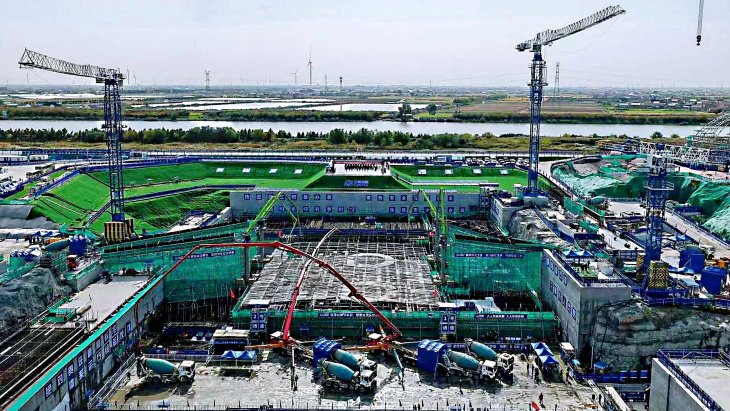
In November 2022, the then Polish government selected Westinghouse AP1000 reactor technology for construction at the Lubiatowo-Kopalino site in the Choczewo municipality in Pomerania in northern Poland. An agreement setting a plan for the delivery of the plant was signed in May 2023 by Westinghouse, Bechtel and Polskie Elektrownie Jądrowe (PEJ) – a special-purpose vehicle 100% owned by Poland’s State Treasury. The Ministry of Climate and Environment in July 2024 issued a decision-in-principle for PEJ to construct the plant. The aim is for Poland’s first AP1000 reactor to enter commercial operation in 2033. The total investment costs of the project are estimated to be about EUR42 billion (USD47 billion).
In September last year, the Polish government notified the European Commission (EC) about its intention to support this investment through: an equity injection of about EUR14 billion covering 30% of the project’s costs; state guarantees covering 100% of debt taken by PEJ to finance the investment project; and a two-way contract for difference (CfD) providing revenue stability over the entire lifetime of the power plant of 60 years.
Under EU state aid rules, the European Commission analyses the compatibility of the measure under Article 107(3)(c) of the Treaty on the Functioning of the European Union, which enables Member States to support the development of certain economic activities under certain conditions. The support should remain necessary and proportionate and not adversely affect trading conditions to an extent contrary to the common interest. The Commission opened a formal investigation into Poland’s proposed support package for the nuclear power project in December 2024.
The EC has now completed its investigation of the Polish state aid and concluded that it meets EU rules.
“During the in-depth investigation, Poland revised key elements of the aid package to address the Commission’s concerns,” the EC noted. “To ensure that the aid is appropriate, proportionate, and does not unduly distort competition in the internal market, Poland committed to several significant adjustments.”
These included: a shortened duration of the direct price support, with the period of the CfD reduced from 60 to 40 years; a revised design of the CfD to ensure strong incentives for PEJ to operate the plant efficiently and to make use of its abilities to respond to market signals; and the strike price of the CfD will be set using a ‘discounted cash flow’ model that takes into account the equity injection and the state guarantees provided, ensuring that the total aid is limited to the project’s funding gap.
To mitigate risks related to market concentration and to prevent the aid from being passed through to consumers, Poland has agreed to strict conditions regarding electricity trading. At least 70% of the plant’s annual electricity output will be sold on the open power exchange – covering day ahead, intraday and futures markets – throughout the lifetime of the power plant. The remaining output may be sold via auctions conducted under objective, transparent and non-discriminatory terms. Poland also committed to ensure that PEJ will be legally and functionally independent from other major operators in Poland’s electricity market.
“The construction of Poland’s first nuclear power plant is becoming a reality, and the European Commission’s decision underscores the enormous potential of the project we are implementing,” said Miłosz Motyka, Poland’s Minister of Energy. “It was our government that secured the funding and applied for the Commission’s approval, which we received in record time – less than 12 months. This confirms that our actions are not only ambitious but also rapid and extremely effective. Nuclear energy will be one of the foundations of the Polish energy mix. Today, we have taken a crucial step towards its unleashing. Nuclear energy will become the foundation of Poland’s energy security and a driver of our economic development. We are already the 20th largest economy in the world. With nuclear energy, we can reach even further.”
Wojciech Wrochna, Secretary of State in the Ministry of Energy and Government Plenipotentiary for Strategic Energy Infrastructure, added: “Receiving the final decision from the European Commission is the culmination of our team’s extremely hard work. It served to develop a mechanism that will allow for the financing and implementation of the nuclear power plant project, while taking into account the interests of the state, the investor, and, most importantly, the electricity consumers.
“This decision is one of the key stages of this project. During the dialogue, we clarified all the concerns of the European Commission, even the smallest ones. The next step will be to transfer state budget funds to the Polish Nuclear Power Plants company to continue implementing the project according to the established schedule. The Polish nuclear power plant is taking shape. This investment will be built – we are convinced of that.”
“The Commission’s final decision approving state aid – one of the largest, if not the largest, individual aid in the history of the European Union – within this timeframe and in this form is a huge success for the Polish side and an example of exemplary cooperation between the administration and a state-owned company,” said Marek Woszczyk, president of PEJ’s management board. “It paves the way for the signing of a contract for the construction of the power plant with a consortium of American companies, Westinghouse (technology supplier) and Bechtel (construction contractor). I thank everyone involved in the dialogue process with the European Commission.”