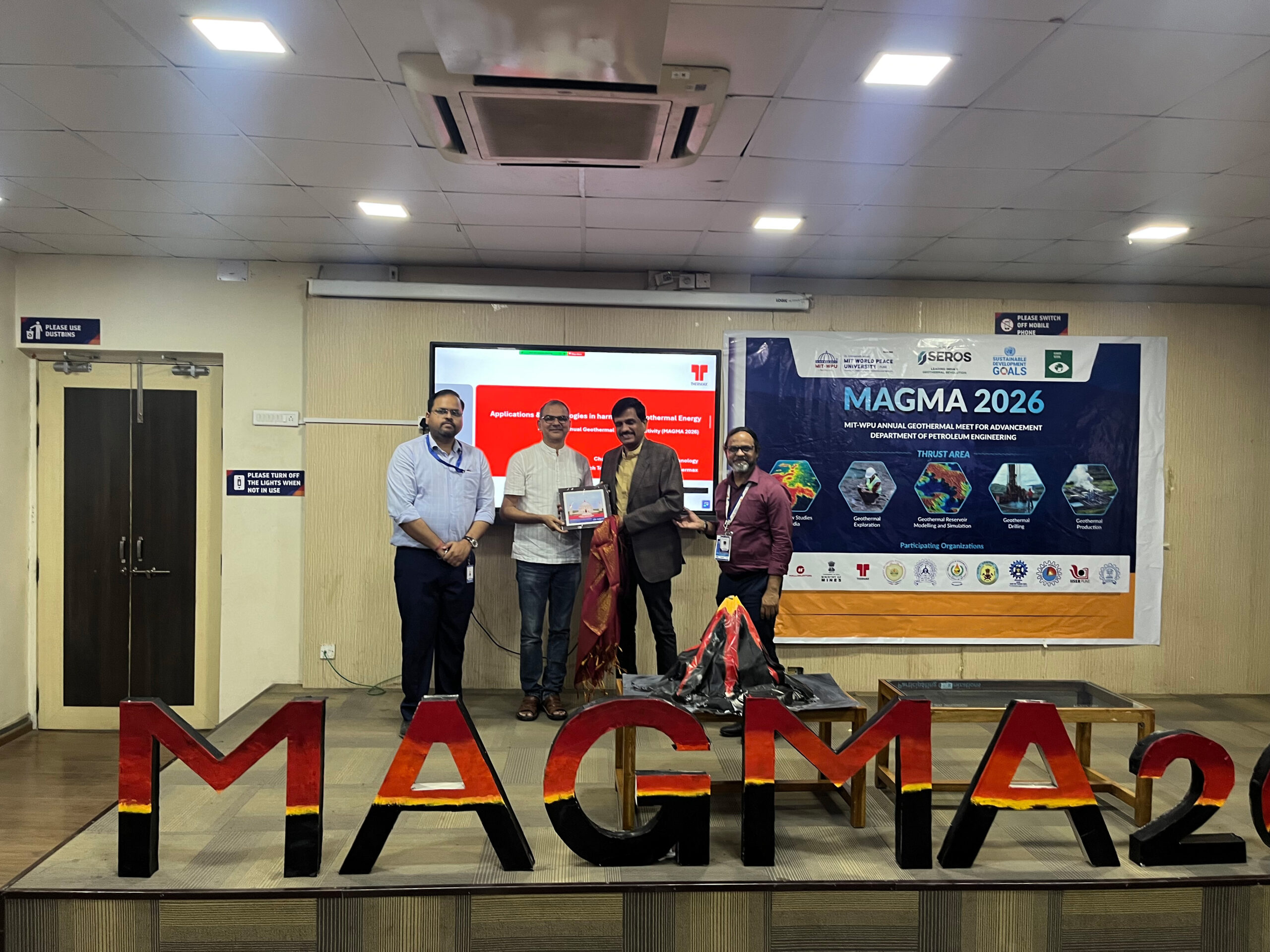
At the Annual Geothermal Meet for Advancement (MAGMA 2026) hosted by MIT World Peace University, experts highlighted that India must urgently diversify its energy mix in response to rising global energy uncertainty and geopolitical tensions that continue to disrupt fuel supply chains. They stressed that accelerating investment in emerging energy sources such as geothermal energy and natural hydrogen will be essential for strengthening long-term energy security.
The five-day workshop on Geothermal Energy Exploration and Production brought together more than 16 organisations from around the world. Participants included national institutions such as the Geological Survey of India, IITs, IISER, CDAC, CSIR laboratories, and leading international companies like Halliburton, CMG, Beicip-Franlab, Apex Wells, and Black Reiver.
Indian companies including SEROS Energy, Thermax, and Nishra Energy also took part, along with several universities from Pune. SEROS Energy, which is currently involved in drilling geothermal wells in the Puga Valley, served as the title sponsor of the event.Discussions at the conference emphasised that India’s long-term energy resilience will depend not only on expanding solar and wind capacity but also on developing reliable base-load energy sources that can provide 24×7 power.
Experts noted that geothermal energy has strong potential in India, estimated at over 10 GW, and could play an important role in reducing dependence on imported fossil fuels while strengthening energy sovereignty.The event was inaugurated by Dr. Ashish Agarwal, Managing Director and CEO of SEROS Energy, who highlighted that geothermal development is critical for India’s energy security and reaffirmed his company’s commitment to advancing this sector.
The guest of honour, Dr. Prakash Kumar, Director of the National Geophysical Research Institute (NGRI) under CSIR, discussed advancements in geophysical technologies and explained that integrated geological and geophysical methods can now identify geothermal prospects with much higher accuracy than before.
Experts at the event noted that geothermal energy in India is still at an early exploration stage and is being developed through a cautious, phased approach due to high upfront costs and its site-specific nature. Rather than being underutilised, the sector is progressing steadily through pilot projects and government-supported initiatives aimed at ensuring long-term commercial viability.
At the valedictory session, Dr. Shalivahan, Director of the Indian Institute of Petroleum and Energy (IIPE), stated that geothermal energy in India will grow as part of a broader, diversified energy strategy rather than as a standalone solution. He emphasized that it will play a complementary role within India’s energy mix, contributing to reduced import dependence and improved energy security.He further highlighted that India must adopt a more aligned exploration strategy supported by high-quality data and modern technologies.
According to him, artificial intelligence, machine learning, and advanced data analytics can significantly reduce exploration uncertainty, improve subsurface understanding, and increase the commercial viability of emerging energy projects by enabling faster and more accurate decision-making.The conference also focused on growing global interest in natural hydrogen alongside geothermal energy.
Experts explained that naturally occurring hydrogen deposits could potentially be extracted at lower costs compared to conventional production methods, making it a promising future energy resource. India’s diverse geological formations were identified as having strong potential for both geothermal and natural hydrogen resources, and early exploration could position the country as a future leader in this field.Dr. Charles P, Principal Technologist and General Manager RTIC at Thermax, noted that India’s energy transition must balance ambition with practicality.
He explained that while solar and wind energy are expanding rapidly, geothermal energy could provide critical localized power solutions, especially in remote areas where diesel-based systems remain costly and inefficient.Dr. Rajib K. Sinharay, Professor in the Department of Petroleum Engineering at MIT-WPU and convenor of MAGMA 2026, emphasized the importance of a long-term, mission-driven approach to energy development.
He stated that energy security is closely linked to economic and strategic stability and called for stronger collaboration between academia, industry, and policymakers to advance innovation and energy self-reliance.Experts collectively stressed the need for a more strategic and coordinated national approach to energy planning, similar to other successful mission-oriented initiatives.
Strengthening domestic capabilities in geothermal exploration, hydrogen development, and subsurface technologies was identified as a key priority to reduce vulnerability to global disruptions.The discussions concluded with a shared consensus that while solar and wind energy will continue to dominate India’s renewable energy expansion, emerging resources such as geothermal energy and natural hydrogen will play an important supporting role in building a more resilient, diversified, and future-ready energy system.
Subscribe to get the latest posts sent to your email.