Summary
- Exxon, Chevron cautious on Venezuela investments despite U.S. push
- Exxon, Chevron CEOs stress need for legal, political stability
- Venezuela’s political shifts may benefit Exxon, Chevron in Guyana
(Reuters) – U.S. oil majors Exxon Mobil and Chevron offered investors a few pieces of new insight into their thinking about Venezuela on Friday, even though neither company announced long-term investment commitments despite President Donald Trump’s continued push to convince American oil firms to rebuild the South American country’s energy sector.
Get the Latest US Focused Energy News Delivered to You! It’s FREE:
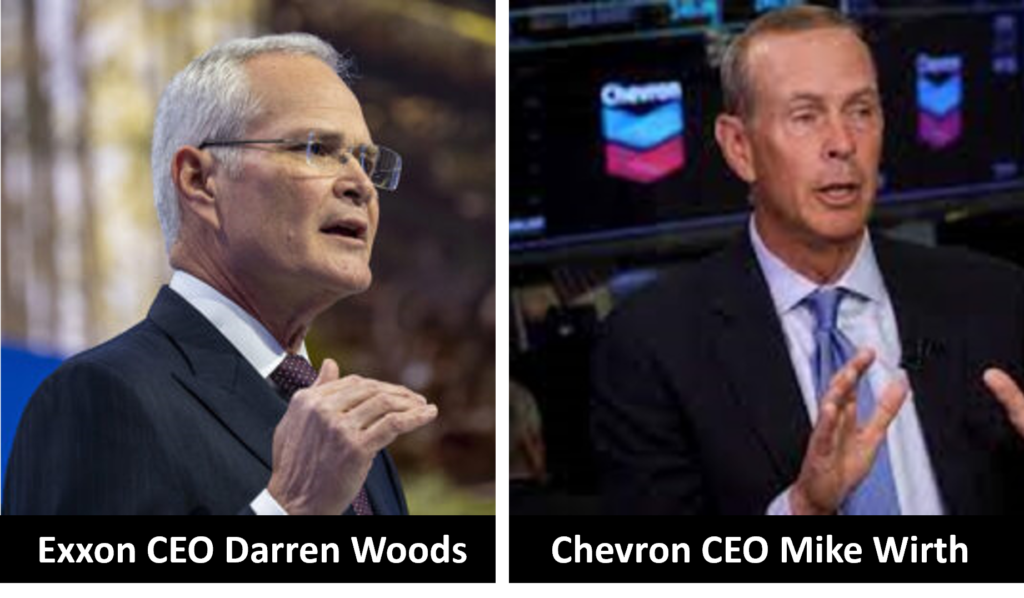
Exxon CEO Darren Woods plugged his company’s technological capability to potentially extract Venezuela’s traditionally expensive heavy crude for a lower cost, while Chevron CEO Mike Wirth said his firm would process more Venezuelan crude through its refineries in the U.S. Both chiefs said they still needed to see strong legal frameworks and a stable political environment before making decisions about any long-term projects.
The comments during the fourth-quarter earnings calls on Friday, where geopolitical themes dominated questions received from analysts, illustrate the challenge ahead for the Trump administration to attract $100 billion of American investment to reactivate Venezuela’s oil sector following its ouster of President Nicolas Maduro earlier this month. Chevron is currently the only U.S. oil major with production in the country.
Exxon’s Woods – who called the country “uninvestable” just weeks ago – said he believed the U.S. administration is committed to making the changes needed to attract and secure new investment, including an eventual transition to democracy. Exxon left Venezuela nearly 20 years ago after its assets there were nationalized.
The Treasury’s Office of Foreign Assets Control on Thursday moved to ease some sanctions on the country, while the National Assembly in Caracas passed new legislation that is expected to grant greater autonomy to private producers.
Chevron, which said it could grow its gross production in Venezuela by about 50% in the short term, can process an additional 100,000 barrels per day of the country’s crude through refineries on the U.S. Gulf and West coasts, Wirth said. The company currently processes 50,000 barrels of Venezuelan crude per day at its refineries.
Still, Wirth – who recognized the large resource potential in Venezuela – said that it was too early to articulate a longer-term outlook for the country amid the ongoing questions about stability and regulatory clarity.
“We certainly could see operations and footprint expand in Venezuela. And we’re working with the U.S. government and the Venezuelan government to try to create circumstances that would enable that,” Wirth said.
The dramatic political shifts in Venezuela, meanwhile, may lead to an easier operating environment in nearby Guyana, Exxon’s Woods added. Such a scenario could potentially be a boon to both Exxon and Chevron, which are joint venture partners in the Stabroek oilfield in Guyana.
“With the developments in Venezuela, perhaps we’ll see an opportunity to (have) less naval patrols, that’ll make it a little more friendly environment,” Woods said.
Portions of the Stabroek Block are under force majeure and remain unexplored due to a territorial dispute between Guyana and Venezuela that Woods said is currently before the International Court of Justice.
“One of the advantages of force majeure is it pauses the clock, and so we will have an opportunity to do what we need to do in that portion of the (Stabroek) block when it’s available to us,” Woods said.
Reporting by Sheila Dang in Houston; Editing by Nathan Crooks and Daniel Wallis
Share This:
More News Articles