The Paks II project is for two Russian VVER-1200 units – the pouring of first concrete marks the official point when the project gains the status of a “nuclear power plant under construction”.
The quality of the concrete in the foundation slab is crucial for the strength and durability of the building which is designed to safely host an operating nuclear power reactor for an initial service life of 60 years, with a possible life extension to 80 or even 100 years. In total 9,000 tonnes, or 43,000 cubic metres, of reinforced concrete will be required for the foundation slab and concreting is expected to continue all year.
Hungary’s Foreign Minister Peter Szijjártó said that “many people wanted and want to prevent this investment” but that had not stopped the project, and he said: “Today is a historic day … the nuclear power plant will mean that we will be able to produce approximately 70% of electricity demand in Hungary. This will significantly reduce our dependence on international markets and their often completely insane price increases.”
At the ceremony on Thursday, Alexey Likhachev, CEO of Russia’s state nuclear corporation Rosatom, said: “Today’s landmark event illustrates the constructive and mutually beneficial relations that have developed between our countries. The Paks II NPP is a logical continuation of our long-standing cooperation in nuclear energy. For Hungary, the Paks II NPP is undoubtedly a strategic step that will bring the country a number of fundamental advantages and will drive the development of the national economy. For Rosatom, this project is further proof of its leadership in the nuclear industry and a contribution to the development of Russian industry.”
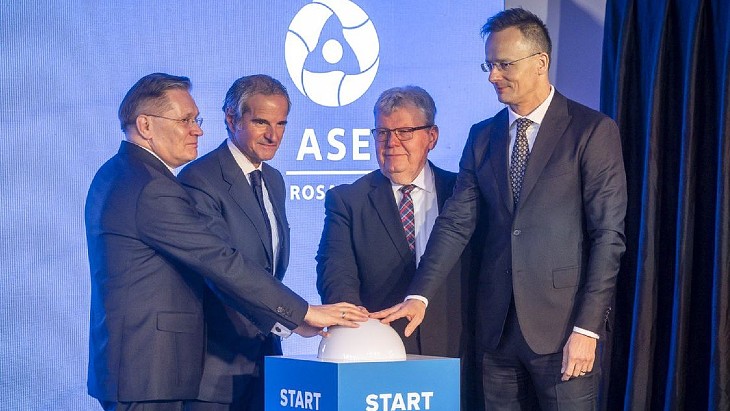 (Image: Peter Szijjártó/Facebook)
International Atomic Energy Agency Director General Rafael Mariano Grossi, speaking at the ceremony, said the Paks II project had faced many “headwinds” and it was an “example of determination to move forward in spite of difficulties faced”. It was a “great day” for “Hungary, for Russia, for nuclear cooperation, a great day for energy sustainability”. He said it was an honour to be there to see the transition from an “excellent project, to a reality we can see already emerging from the earth”.
The Paks plant, 100 kilometres south of Budapest, currently comprises four Russian-supplied VVER-440 pressurised water reactors, which started up between 1982 and 1987. An inter-governmental agreement was signed in early 2014 for Russian enterprises and their international subcontractors to supply two VVER-1200 reactors at Paks as well as a Russian state loan of up to EUR10.0 billion (USD10.5 billion) to finance 80% of the project.
The construction licence application was submitted in July 2020, the licence was issued in August 2022, and a construction timetable was agreed in 2023, with a target to connect the new units to the grid at the beginning of the 2030s. The Hungarian Atomic Energy Authority issued permits in November for first concrete pouring for the foundation of what will be Paks unit 5.
The project is the first Russian nuclear energy construction project started in a country while it is a member of the European Union, and is taking place despite sanctions targeting Russia. It is the first pouring of first concrete for any nuclear energy unit in the European Union since first concrete was poured in the then EU member country, the UK, for Hinkley Point C unit 2 in December 2019.
Hungary’s Szijjártó told World Nuclear Exhibition in Paris in October that at that time two million cubic metres of soil had been already excavated, and 43,000 cement columns placed in the ground as part of earthworks while 30 buildings have been completed and 50 more under construction. He said that long-lead items are being manufactured in six countries, with French and German companies involved, as well as the key reactor internals and steam generators being manufactured by Rosatom in Russia.