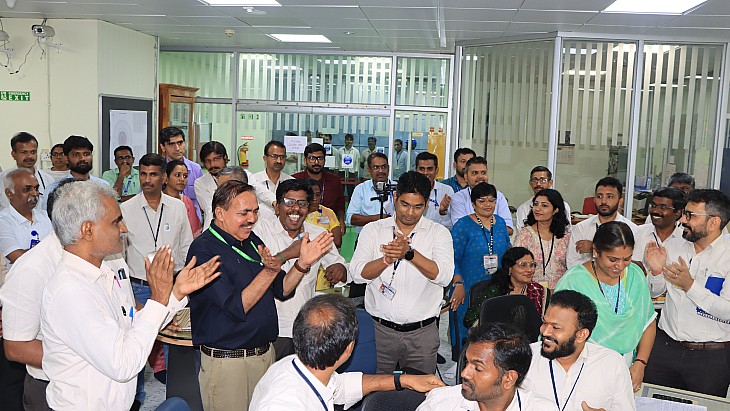
The 500 MWe Prototype Fast Breeder Reactor (PFBR) at Kalkpakkam in Tamil Nadu attained first criticality on 6 April at 08:25 pm, the Department of Atomic Energy (DAE) announced, with the milestone marking “a significant step toward strengthening India’s long-term energy security and advancing its indigenous nuclear technology capabilities.”
The PFBR technology was designed and developed by the DAE’s Indira Gandhi Centre for Atomic Research (IGCAR). The reactor was built and commissioned by Bharatiya Nabhikiya Vidyut Nigam Ltd (BHAVINI), a government enterprise under the DAE. Construction began in 2004, with an original expected completion date of 2010. India’s Atomic Energy Regulatory Board officially granted permission for the First Approach to Criticality – including the loading of fuel into the reactor core and the start of low power physics experiments – in mid-2024. Last August, Minister of State Jitendra Singh told India’s parliament that delays in completion of the project had been mainly due to “first-of-a-kind technological issues” during the commissioning process.
The attainment of first criticality “follows the successful completion of all stipulated safety requirements, with clearance granted by the Atomic Energy Regulatory Board (AERB) after rigorous review,” BHAVINI said.
“Today, India takes a defining step in its civil nuclear journey, advancing the second stage of its nuclear programme,” Prime Minister Narendra Modi said on social media, adding that the PFBR “reflects the depth of our scientific capability and the strength of our engineering enterprise. It is a decisive step towards harnessing our vast thorium reserves in the third stage of the programme. A proud moment for India.”
The PFBR uses uranium-plutonium mixed oxide, or MOX, fuel surrounded by a ‘blanket’ of uranium-238, which, through neutron absorption, is converted into fissile plutonium-239. This enables the reactor to generate more fuel than it consumes – it ‘breeds’ fuel. The PFBR is also designed to use thorium-232 in the blanket, which can be transmuted into fissile uranium-233.
“This unique capability significantly enhances the utilisation of nuclear fuel resources and enables the country to extract far greater energy from its limited uranium reserves while also preparing for large-scale use of thorium in the future,” BHAVINI said. The fast breeder programme “strengthens strategic capabilities in nuclear fuel cycle technologies, advanced materials, reactor physics and large-scale engineering,” and the knowledge and infrastructure developed through the programme “will support future reactor designs and next-generation nuclear technologies”.
Fast breeder reactors form the second stage of India’s three-stage nuclear programme, using plutonium recovered from the reprocessing of used fuel from the pressurised heavy water and light water reactors that form the first stage of the programme. The third stage envisages using advanced heavy water reactors to burn thorium-plutonium fuels and breed fissile uranium-233, achieving a thorium-based closed nuclear fuel cycle.
According to , some 20 fast neutron reactors, including some that have supplied electricity commercially, have operated around the world since the 1950s – although not all have been breeders.
India currently has about 7,900 MW of nuclear generation from 24 operable nuclear power plants, and is planning a large expansion of its nuclear capacity. The country says that 17 nuclear power reactors with a total of 13,100 MW capacity are either under construction (7) or under pre-project activities (10). It is aiming to reach a nuclear energy capacity of about 100 GW by 2047 as part of its Viksit Bharat development strategy.