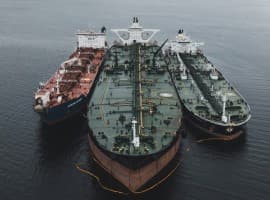
A tanker flying the flag of Pakistan has just become the first vessel to ship crude out of the Strait of Hormuz since the U.S. blockade outside the chokepoint began on Monday, ship-tracking data compiled by Bloomberg showed on Friday.
The Shalamar crude oil tanker of the Aframax size is now in the Gulf of Oman en route to Karachi, Pakistan, half-full with an estimated cargo of 450,000 barrels of crude loaded at Das Island in the United Arab Emirates, according to the data.
The Shalamar is expected to arrive in Karachi on Sunday, April 19, per data on MarineTraffic.
The Pakistan-flagged crude tanker entered in the Persian Gulf from the Strait of Hormuz last Sunday, April 12, on its second attempt. The Shalamar first tried to pass the Strait inbound to the Gulf earlier on Sunday, but abandoned the attempt after news of the collapsed U.S.-Iran talks broke.
Despite the passing of a crude carrier that loaded oil at a non-Iranian port, traffic at the Strait of Hormuz remains severely restricted.
As many as 823 vessels were present across the Gulf as of April 15, “reflecting continued accumulation without corresponding release into normal transit patterns,” maritime intelligence firm Windward said in its daily report on Thursday.
However, Windward analysts have observed that Iranian oil exports remain structurally active, despite the enforcement environment of the U.S. blockade aimed at preventing Iranian oil shipments.
As of April 15, about 153.7 million barrels of Iranian oil were on the water, with 84.9% destined for China. Average daily export volumes from Kharg Island between February and April remain elevated at approximately 2.04 million barrels per day, according to the intelligence firm.
While Iran-linked vessels appear to steer clear of the U.S. blockade outside the Strait of Hormuz, several ships have undertaken lengthy and winding routes to move from the UAE coast to the actual Strait close to Iran’s shoreline.
Amid the U.S. blockade, Iran continues “reliance on dark operations, fraudulent flagging, and concentrated loading activity to sustain export flows,” Windward said.
By Tsvetana Paraskova for Oilprice.com
More Top Reads From Oilprice.com
- Japan to Deploy $10 Billion to Help Southeast Asia Cope With Oil Shock
- Equinor Signals Trading Windfall as War-Driven Volatility Lifts Results
- Middle East Oil Output May Take Two Years to Recover