Wednesday, 21 May 2025
The Rossiya, which will be the first of the proposed Project 10510 nuclear-powered icebreakers, will feature two RITM-400 pressurised water reactors. It will be able to penetrate ice up to 4.3 metres thick and clear a channel up to 50 metres wide. The vessel is being built at a shipyard near Vladivostok in eastern Russia. The most recent reported construction target service date is 2030.
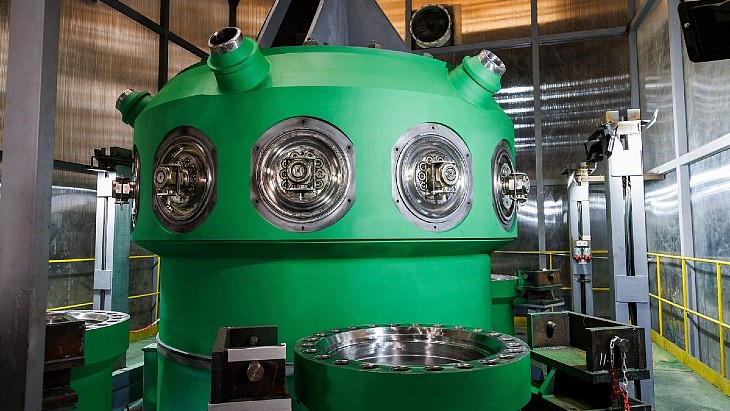
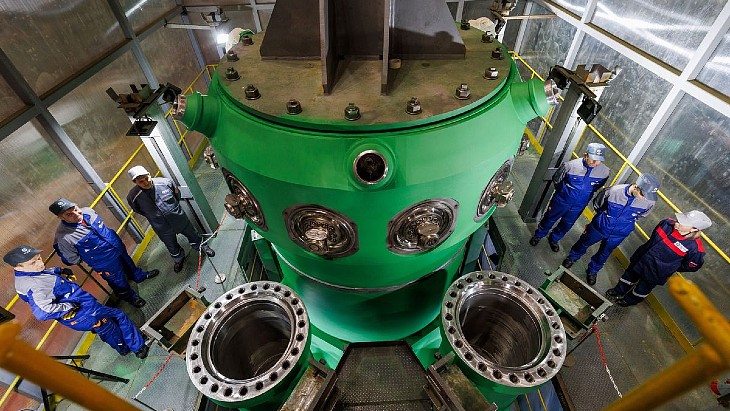
The RITM-400 is a development of the RITM-200 reactor design which already has variants for icebreakers, floating power plants and for use on land. As a scaled-up model, RITM-400 produces 315 MWt, with a propeller power of 120 MW, compared with RITM-200’s 165 MWt, but uses the same technologies.
The RITM-400 reactor unit was manufactured at ZiO-Podolsk, Rosatom’s machine-building division, with the completion coinciding with the Russian state corporation’s events to mark the 80th anniversary of the nuclear industry.
Igor Kotov, head of Rosatom’s machine building division, said the second reactor would be completed “in a couple of months” and “both units will be sent to the shipyard for installation on the Rossiya … the completion of this project opens up new opportunities in developing the Northern Sea Route”.
Alexey Likhachev, Director General of Rosatom said: “The completion of the RITM-400 reactor is a significant event for the icebreaker fleet, for Rosatom and for our entire country. The reactor units of the next-generation Rossiya nuclear icebreaker will allow it to break over 4 metres of thick ice.”
(Image: Rosatom)
Russia currently has eight operating nuclear-powered icebreakers: the 50 Let Pobedy, Vaigach, Yamal, Taimyr, and the Project 22220 vessels the Arktika, Siberia, Ural and Yakutia. There are also three more Project 22220 vessels in various stages of construction – the Chukotka, Leningrad andStalingrad. Ten RITM-200 reactors have been manufactured for the Project 22220 vessels with a further 10 currently being manufactured for use in icebreakers or small modular reactor plants on land and sea.
The nuclear-powered icebreakers are a key part of Russia’s plan to develop the Northern Sea Route, the shipping lane along its north coast, which can cut the distance and speed for shipping goods by sea from northern Europe to Asia. The 5600-kilometre route runs from St Petersburg and Kaliningrad to Vladivostock. Russia says the distance from Murmansk to Japanese ports is halved by using the Northern Sea Route rather than the Suez Canal, with the duration cut from about 37 to 18 days. Global warming has made large-scale navigation along the route more feasible, and it is being facilitated by the construction programme of nuclear-powered icebreakers.
Rosatom reported that in 2024 nearly 37.8 million tonnes of cargo traffic used the Northern Sea Route, 1.6 million tonnes above the previous high. There was also a record number of transit voyages – 92 – which helped set a record of 3 million tonnes of transit cargo. The nuclear icebreaker fleet provided 976 icebreaker escorts.