Ahead of the presentation of the report to the 31 March meeting of the International Chernobyl Cooperation Account, the plant, the European Bank for Reconstruction & Development, Bouygues and Vinci discussed the proposals for the restoration work.
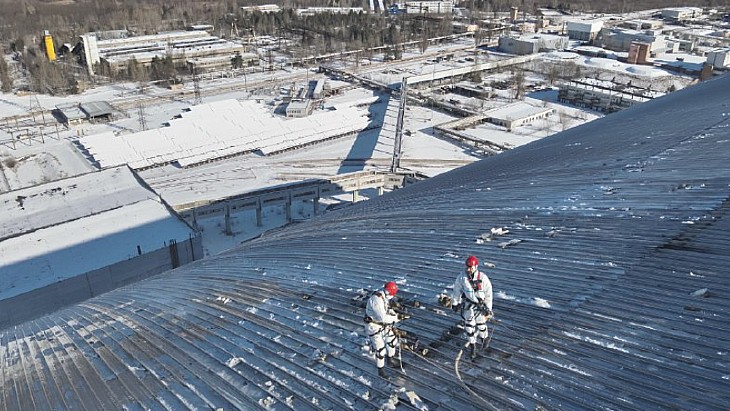
The repair work is required because of the damage caused by a drone strike last February on the giant arch-shaped New Safe Confinement (NSC) shelter, which covers the ruins of Chernobyl’s unit 4. Temporary repair work was carried out before the winter to prevent weather damage.
Tarakanov said: “Now it is necessary to undertake comprehensive repairs and full restoration of the NSC functionality. In our opinion, no one will be able to handle this task better than the companies that designed and built the Confinement. These are the French companies Bouygues and Vinci.”
He said that it would be a joint effort between the French experts and SSE Chornobyl NPP staff to ensure the work is carried out as soon as possible.
“It is very important to restore the function of containing radioactive substances within the NSC, as well as active anti-corrosion protection to ensure the functioning of the Confinement for the designed 100 years. After completing the comprehensive repair work within the specified time frame (by 2030), we will be able to move on to the implementation of the main task for which the New Safe Confinement was built – dismantling the unstable structures of the Shelter Object and transforming it into an environmentally safe system,” he said.
The work required includes the replacement of all damaged membranes, repair of the main cranes maintenance system, some steel supporting systems and restoring full tightness of the outer cladding.
Background
Chernobyl unit 4 was destroyed in the April 1986 accident (you can read more about it in ) with a shelter constructed in a matter of months to encase the damaged unit, which allowed the other units at the plant to continue operating. It still contains the molten core of the reactor and an estimated 200 tonnes of highly radioactive material.
However that shelter was not designed for the very long-term, and so the New Safe Confinement – the largest moveable land-based structure ever built – was constructed to cover a much larger area including the original shelter. The New Safe Confinement has a span of 257 metres, a length of 162 metres, a height of 108 metres and a total weight of 36,000 tonnes and was designed for a lifetime of about 100 years. It was built nearby in two halves which were moved on specially constructed rail tracks to the current position, where it was completed in 2019.
With the new NSC in place there were plans to make safe and dismantle the original shelter. The aim of the current restoration project work is to restore the protective qualities of the New Safe Confinement to allow planning for that safety work on the original shelter to resume.