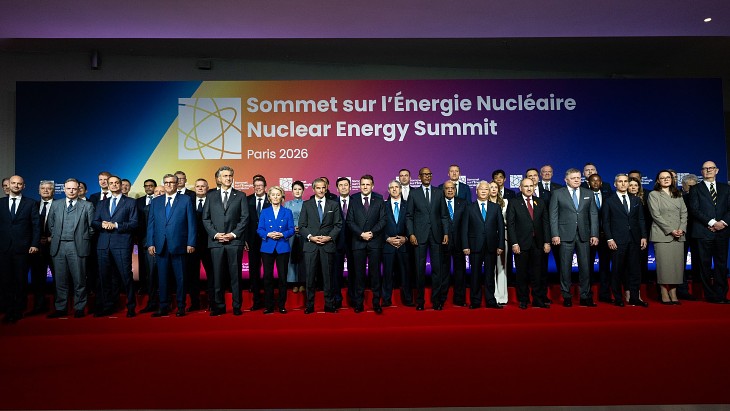
The decision by the countries, announced at the Nuclear Energy Summit 2026 in Paris, means there are now 38 countries signed up to the Declaration to Triple Nuclear Energy by 2050.
Earlier this month South Africa also signed the declaration, with the country’s Minister of Electricity and Energy, Kgosientsho Ramokgopa, emphasising the importance of reliable and scalable power to support economic development and industrial growth across Africa.
Chinese President Xi Jinping’s Special Representative Zhang Guoqing attended the summit, which heard that, to address climate change and ensure energy security, China endorsed the tripling declaration, and “to deliver such ambitious goals we should uphold multilateralism, strengthen solidarity and cooperation and resist unilateralism and protectionism. We are ready to work with all related parties to implement the building of a community with a shared future for all”.
Italy’s Minister of the Environment and Energy Security Gilberto Pichetto announced the country had signed the declaration and said the country was “building a responsible, modern and transparent nuclear strategy – our goal is a secure, decarbonised and competitive energy mix capable of integrating all sustainable sources within a framework of technological neutrality”.
He said: “In the short to medium term we are looking closely at advanced third-generation small modular reactors, while also carefully considering fourth-generation technologies, particularly lead-cooled fast reactors.”
Sama Bilbao y León, Director General of World Nuclear Association – speaking from the summit – said: “Today’s announcement adds tremendous momentum to the global coalition of the ambitious, who are supporting the declaration to triple nuclear capacity by 2050. The ambition of the countries joining the declaration is recognised in our which shows nuclear capacity can exceed the tripling goal, if government targets are met. Collectively, governments and industry must now turn this ambition into action and deliver.”
It was during COP28 – held in Dubai, UAE, in December 2023 – that an initial 25 countries backed a Ministerial Declaration calling for an at least tripling of global nuclear energy capacity by 2050. The declaration says the countries recognise the need for a tripling of nuclear energy capacity to achieve “global net-zero greenhouse gas/carbon neutrality by or around mid-century and in keeping a 1.5°C limit on temperature rise within reach”. It also recognises that “new nuclear technologies could occupy a small land footprint and can be sited where needed, partner well with renewable energy sources and have additional flexibilities that support decarbonisation beyond the power sector, including hard-to-abate industrial sectors”.
The number of signatories has continued to grow, to reach the current total of 38 countries – Armenia, Belgium, Brazil, Bulgaria, Canada, China, Croatia, Czech Republic, El Salvador, Finland, France, Ghana, Hungary, Italy, Jamaica, Japan, Kazakhstan, Kenya, Kosovo, Moldova, Mongolia, Morocco, Netherlands, Nigeria, Poland, Romania, Republic of Rwanda, Senegal, Slovakia, Slovenia, South Africa, South Korea, Sweden, Turkey, Ukraine, UAE, the UK, and the USA.
Read more: