Wednesday, 11 December 2024
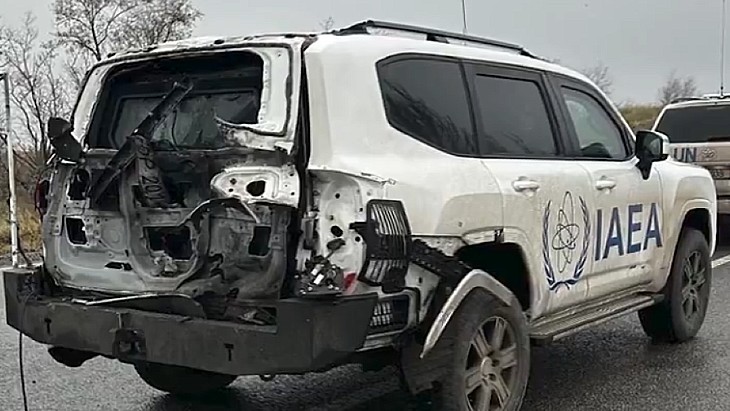
The IAEA driver and a security officer, who were in the vehicle at the time of the drone attack, were unharmed. The incident happened at 14:05 local time on Tuesday about 8 kilometres from the front-line, within Ukrainian-controlled territory.
Director General Rafael Mariano Grossi said: “I condemn in the most firm terms this attack on IAEA staff. Fortunately, there were no victims, and our teams are safe. The rotation has been completed. I have said in the past that attacking a nuclear power plant is a no-go. Attacking those who care for the nuclear safety and security of these plants is also absolutely unacceptable.”
The agency did not attribute blame for the drone attack – which came as a convoy was moving towards the front to pick up the IAEA team which were finishing their month-long rotation at Zaporizhzhia – and Ukraine and Russia have each blamed the other side.
The Zaporizhzhia nuclear power plant is Europe’s largest, and has been under the control of Russian military forces since early March 2022. It is situated close to the front-line of Russian and Ukrainian military forces. The IAEA has had experts stationed at the plant since September 2022 as part of efforts to promote nuclear safety and security at the site.
Grossi Nobel speech
On Wednesday, Grossi delivered a speech during the Nobel Peace Prize Forum 2024, a prize which this year went to Nihon Hidankyō and the hibakusha, survivors of the 1945 Hiroshima and Nagasaki atomic bombs, recognising their efforts to rid the world of nuclear weapons.
He warned that the “world has come to a crucial crossroads – our deep psychological connection caused by collectively seeing the horror of the consequences of nuclear war seems to be evaporating, taking with it our joint resolve to do everything possible to prevent a repetition”.
“War has returned to Europe, and it directly involves a nuclear weapon state. The conflict in Ukraine is also an indirect confrontation between the world’s biggest nuclear weapon states, the first since the end of the Cold War. But nuclear exercises and open references to the use of nuclear weapons in the theatre of this war are increasing the risks and cannot be ignored,” he said.
He also referred to tensions between Israel and Iran – “on one side, the assumed presence of nuclear weapons looms in the background. On the other, the very real potential of nuclear proliferation is raising the stakes”.
“We find ourselves in a harmful loop: the erosion of the restraints around nuclear weapons is making these conflicts more dangerous. Meanwhile, these conflicts are contributing to the erosion of the restraints. The vicious circle dynamic is in motion.
“Doctrines regarding the use of nuclear weapons are being revised or reinterpreted. The quantity and quality of nuclear weapon stockpiles are being increased. And in some non-nuclear weapon states – states that are important in their region – leaders are asking “why not us?”
He said that a return to diplomacy and dialogue was needed, citing the examples of US Presidents Kennedy, Reagan and Trump as well as Soviet Union leaders Khrushchev and Gorbachev as having reached out to a nuclear-armed adversary.
Following the start of the Russian-Ukraine war, and the situation of having a nuclear power plant in the middle of a combat zone, “observing this from the outside was never, in my mind, an option”.
“Staying on the sidelines and later reflecting on ‘lessons learned’ may have been the more traditional – or expected – path for an international organisation. But to me this would have been a dereliction of duty. So, we leaned into our core mission, crossed the front lines of war, and established a permanent presence of IAEA experts at all Ukraine’s nuclear power plants. That makes us the only international organisation operating independently in occupied territory. We are informing the world of what’s going on and reducing the chance that a radiological incident enflames the conflict and causes even more devastation,” he said, adding that he was in constant communication with both sides.
Together with various other ‘hotspots’ and tensions, he said the world has “to make a new path”, with leaders recognising “the need for responsible management of their nuclear arsenals” and an “iron-clad resolve to observe and strengthen the global non-proliferation regime” was needed.
“We need to walk through perilous times by recognising limitations and keeping our eyes on our common objectives. Nuclear disarmament cannot be imposed on the nuclear armed. Realism is not defeatism. Diplomacy is not weakness. Difficult times call for enlightened leadership, at the national level, and at the international level as well. Putting the international system back on track is within our reach,” Grossi added.