Founded in October 2021, Helical is building on research conducted by the National Institute for Fusion Science on the Helical Stellarator design. It aims to achieve “the world’s first practical power generation using fusion energy” through the Helix Programme, which aims to commercialise fusion energy using Japan’s unique “helical fusion reactor”. The programme aims to complete individual demonstrations of the two major development elements – the high-temperature superconducting magnet and the blanket/divertor – by the mid-2020s. In the 2030s, the programme plans to conduct integrated demonstrations using the final demonstration device, the Helix HARUKA, and achieve the world’s first practical fusion power generation device, the Helix KANATA.
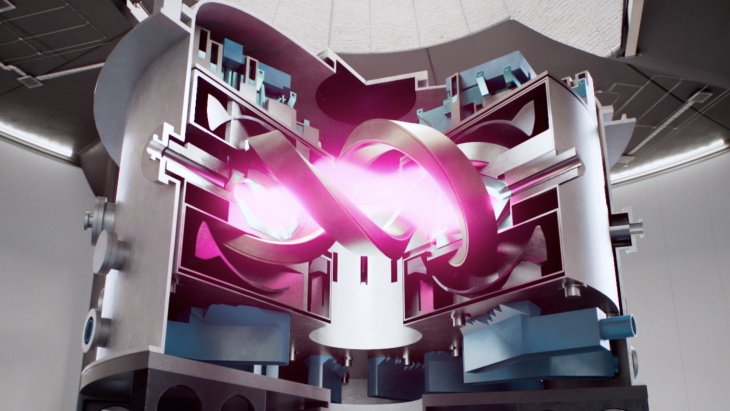
A stellarator fusion reactor is different to a tokamak fusion reactor such as the Joint European Torus in the UK or the ITER device under construction in France. A tokamak is based on a uniform toroid shape, whereas a stellarator twists that shape in a figure-8. This gets round the problems tokamaks face when magnetic coils confining the plasma are necessarily less dense on the outside of the toroidal ring.
Helical’s Helix Programme defines three essential requirements for commercially viable fusion power: steady-state operation, net electricity output, and regular, efficient component maintenance. The Helical Stellarator is uniquely capable of meeting all three criteria with existing technologies, the company said.
Helical now said it has been selected as a conditionally approved project operator for the Ministry of Economy, Trade and Industry’s (METI’s) FY2025 Supplementary Grant for Promoting Fusion Energy Power Generation Demonstration Project. This project, under the Basic Energy Plan and the national strategy for nuclear fusion development, the Fusion Energy Innovation Strategy, promotes and supports diverse challenges in order to realise world-leading fusion energy power generation demonstrations in the 2030s. By the end of February 2029, a total of about JPY60 billion (USD370 million) in subsidies is expected for all selected project operators. Formal selection and grant amounts will be announced at a later date.
In power generation demonstrations in the 2030s, the goal is to demonstrate the technical feasibility of power generation systems that are expected to be marketable and economically viable, and to systematically acquire fundamental knowledge of the technologies necessary for commercial power plants. Furthermore, ensuring safety, implementing rational safety measures, and engaging in dialogue with the local community are also prerequisites.
Takaya Taguchi, CEO of Helical, said: “This subsidy programme aims to determine which technologies are realistic for realizing power plants, and Helical Fusion has selected and developed technologies based solely on this criterion. I am confident that the helical system, with its characteristics suitable for power plants – high power generation efficiency, steady-state operation, and maintainability – will undoubtedly become a strength for Japan in the international competition surrounding fusion energy.”