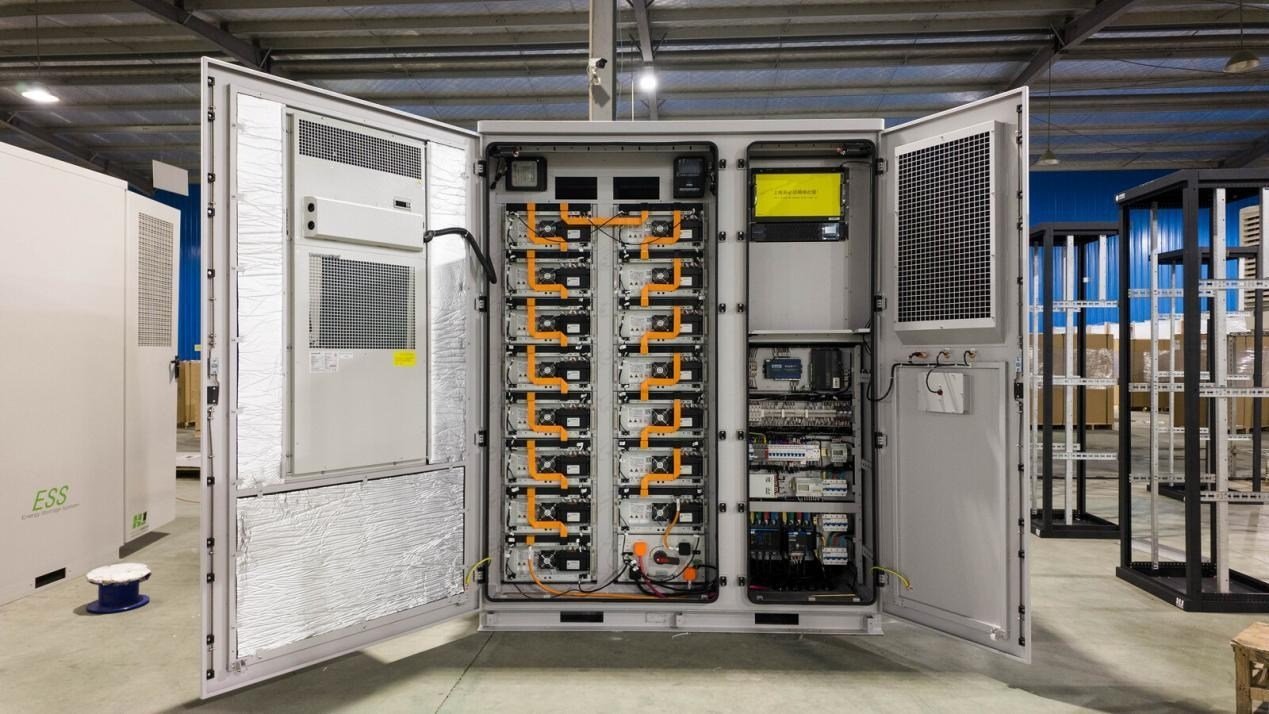
With the advent of larger-scale Battery Energy Storage Systems (BESS), proper thermal management becomes a determining factor influencing performance, cost-effectiveness, and reliability.
All lithium-ion battery systems generate heat in the process of discharging/charging. In large storage systems, there are thousands of cells that occupy limited areas, and efficient cooling of these becomes essential. If the temperatures become too high, it can lead to increased battery degradation and reduced capacity and possibly compromise system safety.
One of the solutions currently in development is a new approach called liquid cooling, which enables more efficient heat removal from batteries and temperature stabilization in comparison with the widely used air cooling technique. For the developers of utility-scale energy storage, liquid cooling represents a number of benefits.
Temperature affects electrochemical performance and degradation of batteries. Increased heat results in fast battery reaction, which leads to increased degradation, higher internal resistance.
Another issue of temperature that affects batteries is the non-uniform heat between individual cells of batteries, because it complicates balancing and reduces overall performance of a battery rack.
This problem is especially relevant to utility-scale storage projects since they include many racks and all racks are placed in containers or special enclosures.
There are a number of operational factors that contribute to the generation of heat:
- High charge/discharge rates
- Operation during peak electricity demand
- High ambient temperature of outdoor sites
- Tight packing of batteries with reduced airflow
- Non-uniform heat generation in battery modules
Effective thermal management should take care not just about the reduction of average temperature in batteries, but also ensure temperature stability and the ability to adjust the system to varying operating conditions.
Liquid cooling systems use coolants to dissipate the heat from the batteries.
There is a standard approach of an indirect cooling. The connection is established between battery modules and a heat exchange system (cooling plates). The coolant circulates inside the system and picks the heat, releasing it into the environment using a heat exchanger.
The full liquid cooling system usually includes a range of devices:
Pressing of the plates to battery modules is the way to establish the thermal connection with them. Channels inside the plates serve for transferring the heat through a coolant.
The system requires pumps for the circulation of the coolant through the system. Adequate control of circulation helps ensure the efficiency of the heat transfer.
The parts of the system responsible for the extraction of the heat from the coolant. The heat transfer depends on whether the refrigeration system uses a mechanical device (heat removal by a compressor), or natural cooling is employed.
It includes the sensors measuring the temperature of the battery and coolant in the system. Control system regulates the cooling depending on operating conditions of the battery.
On large scales, this system works along with the Battery Management System (BMS) and the Energy Management System (EMS).
Temperature uniformity is the main advantage of the technology in contrast to conventional cooling. The airflow-based air cooling system is often not enough to evenly distribute heat among all cells; some cells have sufficient amount of cool air, while others are hotter. However, liquid cooling provides more effective temperature control by means of cooling plates and circulation system.
A recent 2021 study in the journal of Energy Storage showed that indirect liquid cooling system featuring microchannel heat exchanger ensured better temperature uniformity and much lower temperature in batteries than conventional cooling plates. It resulted in substantially better performance in contrast to air-cooled solution.
Since the temperature control is linked directly to the aging of the batteries, liquid cooling can positively impact on it by ensuring appropriate operating conditions in the batteries. This issue is important for utility-scale projects, because the cost of battery replacement is one of the main expenses related to energy storage. Although it does not guarantee increased lifetime, proper thermal management is important for keeping up the good performance of storage facilities.
Due to the rising popularity of renewable energy storage systems, more frequent changes in the charge/discharge powers arise. Higher powers increase heat generation in batteries. The liquid cooling enables efficient heat removing and therefore works well for the cases when tight packing of battery configuration and significant cycling is required.
Yet, the real benefit of the technology depends on the type of battery, design of the system, cooling capacity, and operating conditions.
Usually, utility-scale BESS projects face various restrictions regarding land use and installation.
The usage of liquid cooling can enable better battery packing and make the system less dependent on big channels for airflow and extensive air handling devices. It gives developers of the system more opportunity to optimize the internal configuration of battery containers and improve the storage capacity of storage facilities in limited space.
Therefore, space utilization plays important role in utility-scale BESS projects, especially in cases when it impacts on project costs due to lack of available land, shipping constraints, etc.
Both technologies have a place in battery energy storage, but their suitability differs according to project requirements.
| Comparison | Air Cooling | Liquid Cooling |
| Heat transfer | Lower heat transfer capability | Higher heat transfer capability |
| Temperature uniformity | More challenging in dense configurations | Generally better controllability |
| System complexity | Relatively simple | More components and controls |
| Maintenance | Air filters and fans | Pumps, coolant circuits and heat exchangers |
| Space utilization | May require additional airflow space | Supports compact configurations |
| Typical applications | Smaller or lower-density systems | Large-scale, high-density BESS |
Air cooling remains a practical option for certain installations because of its relatively simple architecture and maintenance requirements.
Liquid cooling, however, is becoming increasingly attractive for large battery storage projects where thermal consistency, installation density, and long-term operating performance are major considerations.
The choice should be based on the project’s technical and economic requirements rather than assuming that one cooling method is suitable for every application.
The liquid cooling is just one element of a full BESS system.
Batteries have to be coordinated with the Power Conversion System (PCS), BMS, EMS, fire safety, and of course the cooling system.
For developers evaluating integrated , cooling architecture should be considered alongside battery capacity, power rating, cycle requirements, safety systems, and the intended operating environment.
The same principle applies to solar-plus-storage projects. Battery capacity and cooling requirements must be matched to the generation profile and expected operating conditions. This is relevant not only to utility-scale solar plants but also to distributed applications, including .
However, besides the advantages, the liquid cooling raises additional requirements regarding the technical side and maintenance.
The risks of coolant leaks, failures of pumps, corrosion, condensation have to be addressed by proper choice of components and monitoring of the system condition and preventive maintenance.
Apart from the maintenance and leakage issues, energy consumption is important parameter. Cooling system consumes energy and becomes an additional part of auxiliary load in storage system. Unfavorable configuration of the controls can reduce efficiency of the BESS.
Therefore, modern research in this sphere focuses on optimization of cooling control technologies rather than increase of the cooling capacity. Variable frequency pumps, temperature monitoring and its optimization, intelligent control of the flow, natural cooling mode and heat transfer are used to find the right balance between performance and consumption of the BESS.
Today, liquid cooling is becoming more and more important for utility-scale battery energy storage, and it is associated not only with the increase in capacities, but also with growing demands regarding BESS performance. It improves heat dissipation and temperature uniformity in the battery, thus providing increased reliability and efficiency of operation of batteries. Yet, effectiveness of the liquid cooling depends on the comprehensive system design and operating conditions.
Subscribe to get the latest posts sent to your email.