Uzbekistan has embarked on its first nuclear power plant with Russia, which will feature two RITM-200N small modular reactors and two VVER-1000 large reactors. Concrete was poured for the first SMR last month, marking the official start of construction.
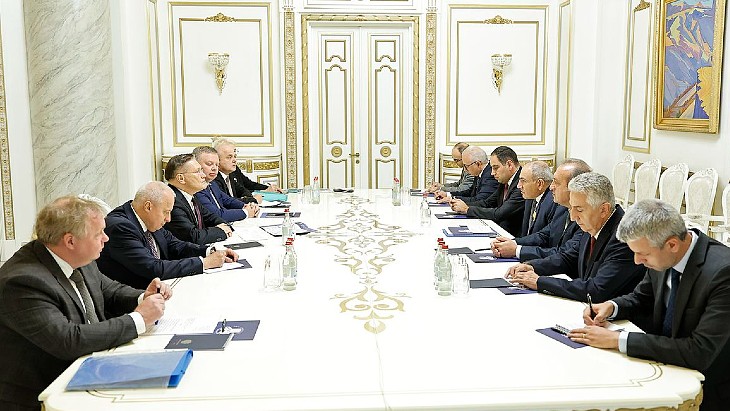
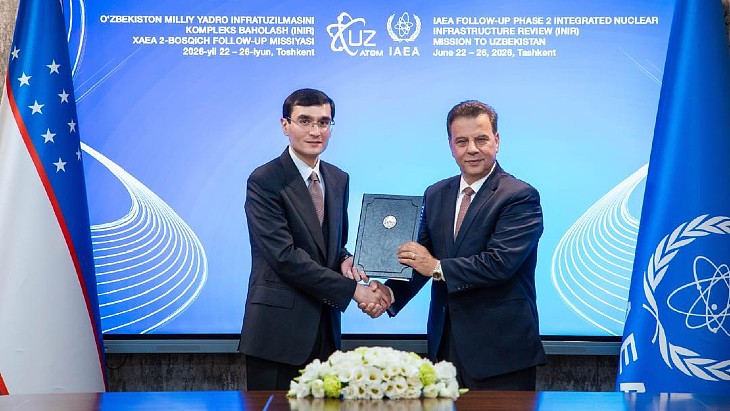
The follow-up IAEA Integrated Nuclear Infrastructure Review mission, which comprised experts from Brazil, Turkey and two IAEA staff, took place from 22 to 26 June and reviewed progress since a previous mission in 2021.
Mission team leader John Haddad, of the IAEA’s Nuclear Infrastructure Development Section, said: “Uzbekistan has demonstrated commitment to develop a safe, secure and sustainable nuclear power programme. It has worked actively to address the recommendations and suggestions from the 2021 mission and develop a sound infrastructure for the implementation stage of its programme.”
He added: “The world is eager to learn from Uzbekistan’s experience in nuclear power plant construction. Uzbekistan is one of the few countries building small modular reactors outside the country where they are built. This experience will be invaluable. Everyone will be watching you: how you did it, what you accomplished, and what lessons you learned. Get ready to play a significant role in the global nuclear landscape.”
The IAEA said the mission praised progress made in Uzbekistan, saying the country had “joined the relevant international legal instruments, revised its national nuclear legislation, and developed its regulations for licensing and oversight, management systems and the necessary electrical grid studies and enhancement plans”.
It also noted that “further work is needed to complete ongoing actions to strengthen the nuclear regulatory body and finalise feasibility studies”.
Atomic Energy Agency – Uzatom – Director Azim Akhmedkhadjaev said the mission was “a vital tool for open professional dialogue, allowing us to objectively assess the ongoing work to develop our national nuclear infrastructure, compare the results achieved with international standards and IAEA recommendations, and identify further practical steps”.
Integrated Nuclear Infrastructure Review missions are held at the invitation of the host country and are based on the IAEA’s Milestones Approach “with its 19 infrastructure issues, three phases (consider, prepare and construct) and three milestones (decide, contract and operate)”.
Following the mission, the preliminary report was submitted to the Uzbek side. It will be reviewed and a final report published by the IAEA in due course.
Background
Uzbekistan has a long nuclear-related history with considerable mineral deposits – it is the world’s fifth-ranking uranium supplier. It has also had two research reactors, a 10 MW tank type – WWR-SM – which has been operating since 1959 at the Institute of Nuclear Physics, Uzbek Academy of Sciences near Tashkent, and a small 20 kW one operated by JSC Foton in Tashkent which was decommissioned between 2015-19.
It has had long-term plans to develop nuclear energy capacity and a contract was signed in May 2024, during a visit to the country by Russian President Vladimir Putin. It was originally for the construction of a 330 MW capacity nuclear power plant featuring six units of the RITM-200N water-cooled small modular reactor (SMR), which is adapted from nuclear-powered icebreakers’ technology, with thermal power of 190 MW or 55 MWe and with an intended service life of 60 years. The first unit was scheduled to go critical in late 2029 with units commissioned one by one.
In 2025, a supplemental agreement to the contract for the new nuclear power plant – in the Jizzakh region – covered the decision to change its contents to two gigawatt-scale VVER-1000 units and two SMRs. This increased the proposed capacity to more than 2,100 MWe, compared with the previous 330 MWe.
Excavation work began in October last year for the pit for the first of the SMRs at the site. About 1.5 million cubic metres of soil were excavated during the digging of a pit 13 metres deep. In March this year, Rosatom said that about 900 cubic metres were being poured during the concrete foundation work for the reactor building. That was due for completion in April and it said that the foundation has since been levelled and waterproofed before the pouring of the first concrete for the reactor building’s foundation slab, which took place in June. It is the first export order for Russia’s SMR. The first land-based version is currently being built in Yakut, Russia, with the launch of the first unit scheduled for 2027.