Thursday, 19 June 2025
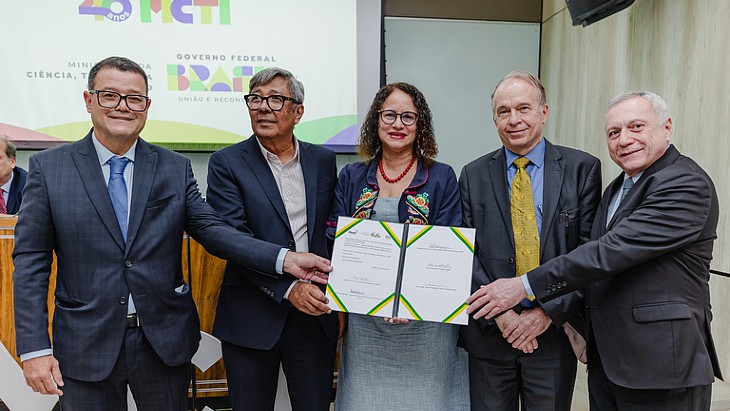
The three year BRL50 million (USD9.1 million) project also brings together research centres, universities and others, including the navy and the Institute of Energy and Nuclear Research and the Institute of Nuclear Engineering.
Industrias Nucleares do Brasil (INB) will be responsible for supplying nuclear fuel and specialised engineering services as well as providing technical and administrative support.
INB President Adauto Seixas said: “This is a historic milestone for the Brazilian nuclear sector. INB reinforces its vocation not only as a producer of nuclear fuel, but also as a technology-based, strategic company that is a leading player in the development of innovative solutions for the country. Nuclear microreactors have enormous potential to bring clean, safe and sustainable energy to remote regions, in addition to meeting industrial, defence and national energy security demands.”
INB’s Director of Nuclear Fuel Reinaldo Gonzaga said the technology “could revolutionise distributed energy generation in Brazil”.
The National Nuclear Energy Commission (CNEN) project aims to demonstrate the feasibility of the development of a Brazilian 3-5 MW microreactor. The vision is for the microreactor to fit within a 40-foot container and be operated remotely for more than 10 years without any need for refuelling.
Suggested uses including providing reliable power to remote towns, to hospitals and factories and reducing dependency on diesel generators. In March the commission said: “The project is currently at the TRL 3 technological readiness level, which corresponds to the mathematical modeling and preliminary studies phase. The goal is to advance to TRL 6, the level at which the technology is demonstrated in a relevant environment, closer to practical application.”
There are various microreactor projects at different stages of development around the world. While small modular reactors are generally seen as including reactors up to 300 MW, microreactors are said by the International Atomic Energy Agency to be those designed for up to about 20 MW, with container-based ones seen as especially having the ability to be transported to a wide range of potential locations, including isolated areas.
Meanwhile, Rosatom International’s First Deputy Director General for Marketing and Business Development Egor Kvyatkovsky was reported by Strana Rosatom to have told the St Petersburg International Economic Forum that Russia was offering Brazil joint projects for the construction of large and small-capacity nuclear power plants, and is also planning to open a transport corridor from Russia based on the port facilities of St. Petersburg.
He said: “Nuclear power plants – both land-based and floating – are an excellent solution for providing energy to various regions of Brazil. We offer a full range of services, including construction of nuclear power plants, maintenance, fuel supplies, and joint operation.”
Brazil currently has two operating power reactors – Angra 1 and Angra 2 – which generate about 3% of the country’s electricity. Work on the Angra 3 project – to feature a Siemens/KWU 1405 MW pressurised water reactor – began in 1984 but was suspended two years later, before construction began. The scheme was resurrected in 2006, with first concrete in 2010. However, amid a corruption probe into government contracts, construction of the unit was halted for a second time in 2015, when it was 65% complete. It has since restarted and been halted again, with a decision currently awaited on completing it.