Fuel loading began at 15:18 on 19 September, following the receipt of permission from the Atomic Energy Regulatory Board (AERB) and “completion of all prescribed pre-requisites”, Nuclear Power Corporation of India Ltd (NPCIL) announced.
The next major steps will include the First Approach to Criticality – the start of a controlled fission chain reaction – followed by the commencement of power generation, NPCIL said. The unit at the Rawatbhata plant is expected to commence commercial operation during the current financial year, it added.
Unit 8 is the second of two Indian-designed 700 MWe pressurised heavy water reactors (PHWRs) built as a pair at the Rajasthan Atomic Power Project, known as RAPP, for short (the plant is also sometimes referred to by NPCIL as RAPS, for Rajasthan Atomic Power Station). RAPP unit 7 reached full power earlier this year after reaching first criticality in September 2024 and being connected to the grid in March 2025. RAPP 7 and 8 are, respectively, the third and fourth reactors in a series of sixteen indigenous 700 MWe PHWRs being set up in the country. The RAPP site is already home to six operating PHWRs.
“The commencement of Initial Fuel Loading at the fourth indigenous PHWR-700 MWe represents an important achievement for NPCIL and various constituent units of the Department of Atomic Energy. It further strengthens the standardisation of the 700 MWe PHWR reactor design and supports its continued deployment in fleet mode. The milestone has been achieved with adherence to all applicable safety guidelines and AERB stipulations,” NPCIL said.
_378f8a3a.jpg)
NPCIL marked the start of geotechnical studies for more new units at the Rasjathan site (Image: NPCIL)
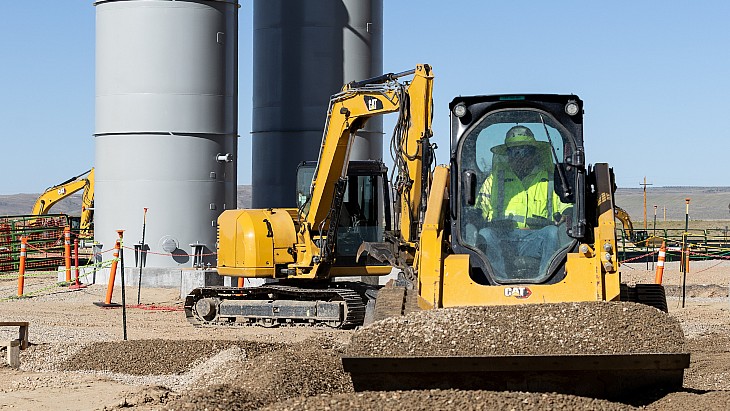
The same day that fuel loading began, NPCIL also announced the start of geotechnical investigations for RAPP units 9 and 10, which will form the technical baseline for future civil and foundation engineering. The specialised teams will conduct borehole drilling, geophysical surveys, and rigorous laboratory testing to evaluate the site’s soil and rock strata.
RAPP units 9 and 10 are two 700 MWe PHWRS listed as “proposed” in a presented to India’s lower house, the Lok Sabha, in August.
“With systematic site assessment, sound engineering practices and rigorous technical evaluation at every stage, NPCIL continues to advance the development of India’s nuclear power programme with a steadfast focus on safety, quality and reliability,” NPCIL said.
Record-breaking refurbishment completed at Kaiga
The milestone at RAPP 8 came just days after NPCIL announced the loading of the first new fuel bundle into Kaiga unit 1 after the completion of work to refurbish the 200 MWe PHWR which was first connected to the Indian grid in 2000.
_c06570c1.jpg)
Refuelling at Kaiga 1 (Image: NPCIL)
Kaiga 1 was shut down on 1 April 2025 after more than 25 years of operation to begin the major project to replace the coolant channels and feeders. The work involves defuelling the reactor, draining it of the heavy water that provides its coolant and moderator, the removal and replacement of coolant channels, in-core inspections, installation and inspection of new coolant channels, then reloading, leak testing, heavy-water filling, hydrotesting, hot conditioning and finally the approach to reactor criticality. Each stage has been carried out under “rigorous safety oversight”, NPCIL said. Kaiga 1 has reached the refuelling milestone in the shortest time for any NPCIL units that have undergone the process, it added.
“The successful completion of this complex engineering programme represents a major milestone in the life cycle of a PHWR, strengthening the foundation for continued safe and reliable generation of clean electricity,” NPCIL said.
India’s government has set a long-term objective of achieving 100 GWe of nuclear capacity by 2047. NPCIL – one of only two companies legally allowed to own and operate nuclear power plants in India – has been responsible for design, construction, commissioning and operation of thermal nuclear power plants in the country. Last year, the Indian parliament passed legislation modernise the country’s nuclear legal framework and, amongst other things, enable limited private participation in India’s nuclear sector. NPCIL said it is aiming to contribute over 50% of that total.