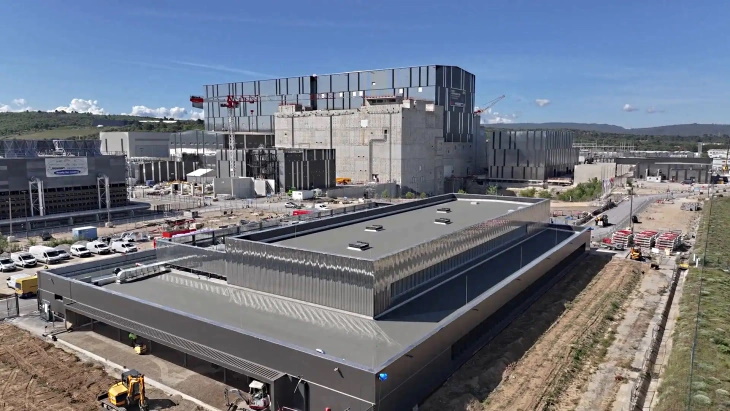
French engineering firm Demathieu Bard designed and constructed the building, which has a 3,500-square-metre footprint. The works lasted five years, totalling more than 200,000 person-hours.
Besides the main control room and server rooms, the Control Building has offices, a command post, a gallery for visitors and a dining room. Staff will enter it from the ITER headquarters (just outside the platform) via a footbridge.
Once the structure was finished, the teams started installing services like ventilation, electricity or fire protection, whilst ITER Organisation’s contractors set up all the computer hardware. In total, there are 80 cubicles containing electronic systems to process the massive volume of information.
The 800-square-metre control room is equipped with 30 workstations and the first workers have started moving in. The various temporary control rooms, in charge of monitoring the plant systems under commissioning, will now be relocated in the new building.
“Unlike the rest of the industrial buildings, this one is made to host people during the 24 hours, so we included many provisions for accessibility and ergonomics, such as noise reduction and natural indirect light,” noted Eric Brault, F4E’s Project Manager.
“We are proud to deliver another ITER building, especially one with such symbolic value, as the future centre of operations,” said Sébastien Berne, Major Project Director of Demathieu Bard. “We designed its layout and services to offer the best work experience. We then executed it meeting the complex requirements in a challenging schedule, thanks to the good planning and collaboration with F4E, as well as ITER Organisation and their suppliers.”
ITER is a major international project to build a tokamak fusion device designed to prove the feasibility of fusion as a large-scale and carbon-free source of energy. The goal of ITER is to operate at 500 MW (for at least 400 seconds continuously) with 50 MW of plasma heating power input. It appears that an additional 300 MWe of electricity input may be required in operation. No electricity will be generated at ITER.
Thirty-five nations are collaborating to build ITER – the European Union is contributing almost half of the cost of its construction, while the other six members (China, India, Japan, South Korea, Russia and the USA) are contributing equally to the rest. Construction began in 2010 and the original 2018 first plasma target date was put back to 2025 by the ITER council in 2016. However, in June last year, a revamped project plan was announced which aims for “a scientifically and technically robust initial phase of operations, including deuterium-deuterium fusion operation in 2035 followed by full magnetic energy and plasma current operation”.