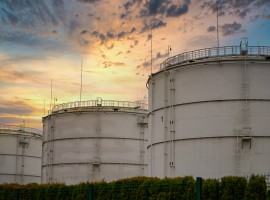
The prime ministers of Japan and South Korea have agreed to boost oil supply cooperation, which would involve joint storage, Nikkei reported today, ahead of a meeting between the top officials in South Korea. The two will discuss the financial and technical details of the joint storage system, the report said.
Both Japan and South Korea are heavily dependent on oil and gas imports from the Persian Gulf and, as a result, have been affected badly by the Strait of Hormuz closure and are actively seeking supply replacement. The meeting between Sanae Takaichi and Lee Jae Myung would be the second since the start of the year, the Japanese news outlet noted, highlighting the urgency of the energy problem in what it described as a “rocky” bilateral relationship.
Resource-poor Japan is heavily dependent on Middle Eastern oil supply and felt the supply crunch almost immediately as most supplies from the region remained trapped at the Strait of Hormuz, unable to pass through the world’s most critical oil and LNG chokepoint. For crude oil, Japanese refiners rely on imports from the Middle East for as much as 95% of their feedstocks.
South Korea is also among the world’s most import-dependent nations when it comes to energy commodities, and as such, one of the first to feel the pinch from the closure of Hormuz. In March, Seoul had to set a ceiling on fuel prices—for the first time in three decades—to stabilize the market and shield the economy.
Like Japan, South Korea has been seeking alternative suppliers for oil and gas, with senior government officials last month visiting Oman, Kazakhstan, and Saudi Arabia in a bid to secure crude oil supply that does not need to pass through the Strait of Hormuz. Both have, however, recently received oil cargoes that Iran allowed to pass through Hormuz after individual deals with the respective governments.
By Charles Kennedy for Oilprice.com
More Top Reads From Oilprice.com
- Oil Prices Fall After Trump Pauses Planned Iran Strike
- India’s Wholesale Inflation Hits 3.5-Year High as Fuel Costs Surge 25%
- China Still Cautious on Fuel Shipments Despite Eased Export Rules