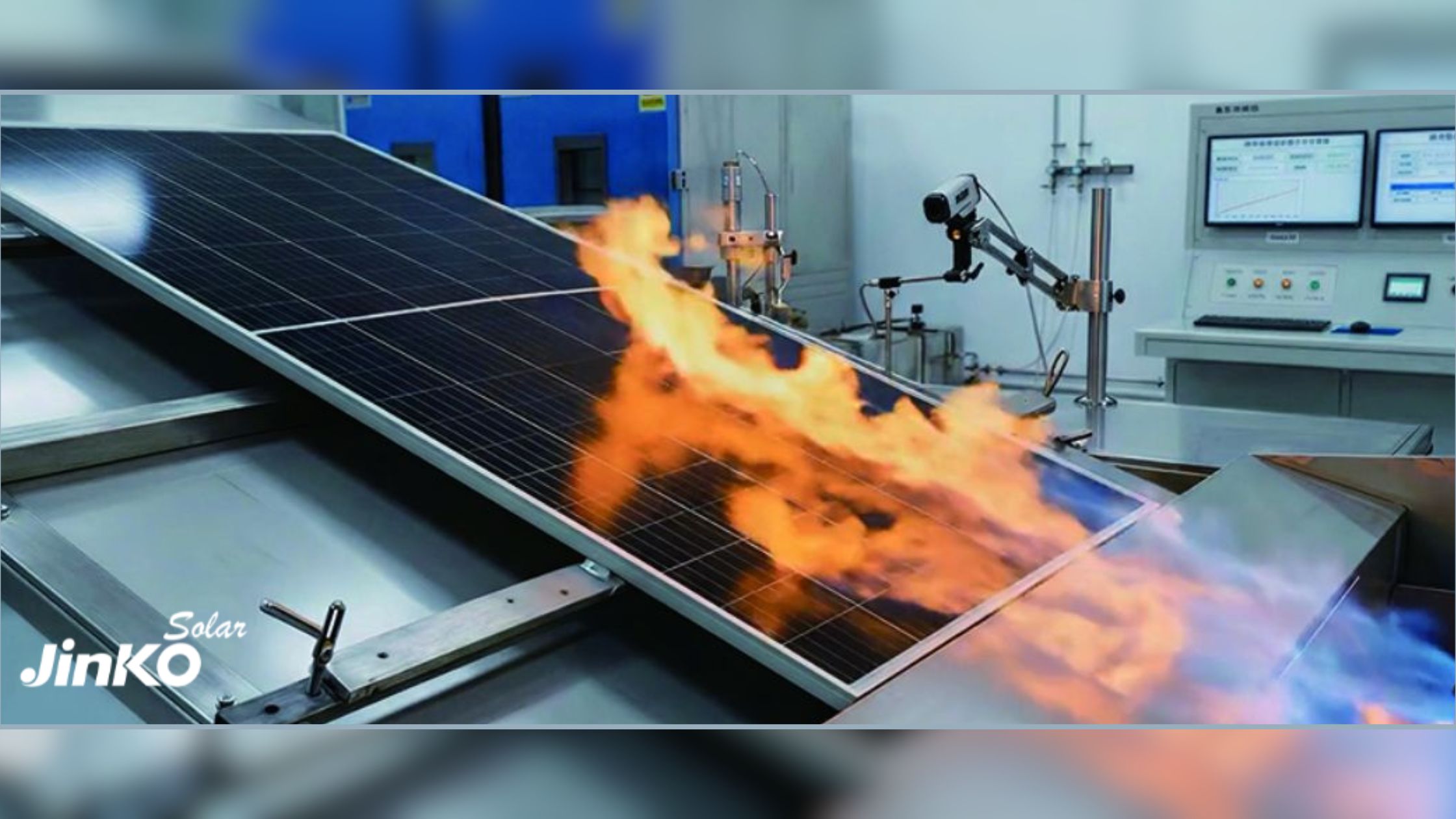
JinkoSolar’s Five-Star Fire-Resistant Modules feature a five-layer active protection system, which sets them apart from standard modules that rely solely on the passive fire resistance of their base materials.
Conventional modules typically follow a “reactive fire protection” approach, meeting only basic flame-retardant requirements and lacking systematic risk prevention capabilities. In contrast, the Five-Star Fire-Resistant Module addresses five key dimensions—fire containment, material flame retardancy, electrical fire prevention, extreme weather protection, and structural integrity—to proactively eliminate fire hazards at their source and actively block the chain of fire spread and risk transmission. It features,
1. Dual Class A fire rating of IEC 61730-2:2023 and UL 790 Class A while conventional module is of Class C fire rating, effectively blocking the spread of external flames. This represents the highest global standard for fire resistance in photovoltaic materials used in distributed systems. According to UL 790 and IEC standards, Class A certification requires passing two rigorous tests, the flame spread test, which requires that the distance the flame spreads across the module surface be strictly limited to 1.82 meters or less. The second is the burning block test, which involves dropping a large, 12-inch-by-12-inch glowing wooden block onto the module’s surface to simulate burning debris in a real fire; the module must not be burned through. In contrast, the Class C rating commonly used for standard PV modules on the market has a flame spread limit of up to 3.9 meters, and the test block measures only 1.5 inches by 1.5 inches.
2. UL 94 V-0 flame-retardant materials throughout, preventing fire from penetrating the module’s interior. Junction boxes are indeed a high-risk area for electrical faults in photovoltaic systems and one of the primary causes of fires. Five-Star Fireproof Modules provide triple-layered protection specifically designed for this critical component. First, the junction box housing is made of UL 94 V-0 rated flame-retardant material, which does not burn or drip when exposed to open flames, eliminating the risk of ignition at the material level;. Secondly, advanced connection techniques and optimized contact designs are employed to reduce the likelihood of loosening and aging, thereby minimizing the risk of arcing at its source. Thirdly, the design incorporates enhanced waterproofing, dustproofing, and high-temperature resistance to prevent moisture and dust from entering and causing internal short circuits, while also withstanding long-term high-temperature operating environments to improve overall stability. In addition, the ultra-strong structural protection eliminates hidden cracks in the glass, preventing microcracks from becoming pathways for current accumulation and thereby preventing the hot spot effect at its source. On the other hand, even in the event of extreme localized high temperatures, all materials in the module are UL 94 V-0 rated for flame retardancy; they will not burn or produce dripping residues at high temperatures, effectively preventing the high temperatures from a hot spot from igniting surrounding materials and, consequently, preventing fires.
3. An advanced anti-arc design, eliminating the risk of fire caused by electrical faults at the source.
4. The ultra-high mechanical load capacity, capable of withstanding impacts from extreme weather conditions such as wind, snow, and hail. The Five-Star Fire-Resistant Module effectively prevents moisture penetration and short circuits through a dual-layer protection
system. The first layer is its exceptional structural integrity, which has passed a 6,000 Pa mechanical load test and a 55 mm hail resistance test, ensuring that the glass and encapsulation layer remain intact and blocking moisture intrusion at the source; The second layer is a professional sealing design, where high-seal-integrity components are used at all connection points—such as the module frame and junction box—to effectively prevent the penetration of moisture and rainwater. Even in humid environments typical of Southeast Asia, such as high temperatures and humidity or coastal typhoons, this design ensures that internal electrical components remain dry, completely eliminating the risk of short circuits caused by moisture.
5. Structural integrity protection, which breaks the chain of transmission from mechanical damage to electrical risk.
These five capabilities form a comprehensive closed-loop system, providing all-around protection against the core safety risks faced by distributed PV systems.
JinkoSolar’s Five-Star Fire-Resistant Modules enhance fire resistance and structural protection while maintaining the same power output and photovoltaic conversion efficiency as conventional modules, with no compromise in core performance metrics. Through the use of high-transmittance specialty glass and optimized optical design, we ensure that safety improvements do not come at the expense of power generation. Customers need not sacrifice power output for safety, truly achieving “dual assurance of safety and power generation.”
Subscribe to get the latest posts sent to your email.