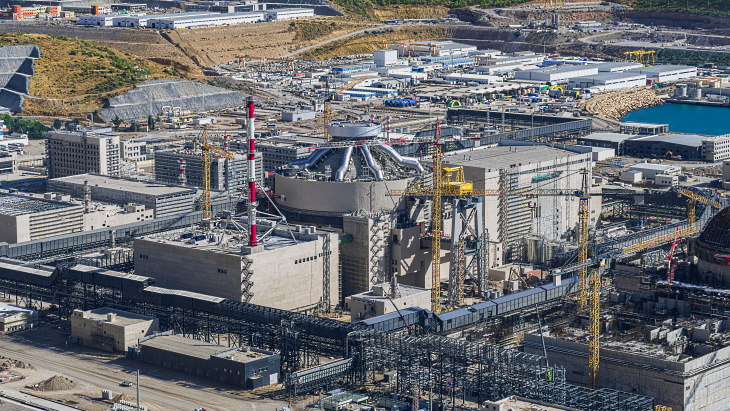
The Kazakhstan Atomic Energy Agency developed the strategy, which has now been adopted. It said that “given the projected growth in electricity consumption, a project to build a fourth plant is envisaged, which will fully meet the growing needs of the economy and the population for reliable and environmentally-friendly energy”.
The agency added that “options for constructing SMR-based nuclear power plants in suitable regions of the country will also be considered, taking into account technological and economic feasibility, as well as for replacing decommissioned coal-fired plants with equivalent nuclear capacity”.
The strategy seeks to define “the goals, approaches and priority areas of state policy in the field of peaceful uses of nuclear energy”.
According to the agency: “The document aims to ensure the country’s energy security and sustainable economic growth, fulfil international climate commitments, develop high-tech industries and strengthen Kazakhstan’s position in the global nuclear industry.”
The key areas for advancement during the period include: the new nuclear plants – one possibly using small modular reactors “is being explored as a promising approach”; the development of nuclear science and applied nuclear technologies to create a modern scientific and technological base; the creation of an effective system for the safe management of radioactive waste and used fuel; strengthening the nuclear, radiation and physical safetry system; training nuclear specialists; and ensuring the “rational use of uranium resources”.
The agency says: “The implementation of the strategy will enable the formation of a modern and sustainable nuclear cluster in Kazakhstan, integrated into the global nuclear ecosystem.”
Background
Kazakhstan is the world’s leading producer of uranium. Although it does not currently use nuclear energy, it is not without nuclear experience: it has three operating research reactors, and a Russian-designed BN-350 sodium-cooled fast reactor operated near Aktau for 26 years, until 1999.
Kazakhstan has been preparing for a possible nuclear power programme to reduce its reliance on fossil fuels, diversify its energy mix and reduce CO2 emissions for some time. Kazakhstan Nuclear Power Plant (KNPP), a subsidiary of Kazakhstan’s Samruk-Kazyna National Welfare Fund JSC, was set up in 2014. In a referendum in 2024 more than 70% of the 7.8 million people who voted answered ‘yes’ to the question: “Do you agree with the construction of a nuclear power plant in Kazakhstan?”
In June last year, Russia’s Rosatom was selected as the leader of an international consortium to build Kazakhstan’s first planned nuclear power plant – to be called the Balkhash plant – in the village of Ulken, also in Zhambyl district, on the shore of Lake Balkhash. China National Nuclear Corporation is lined up to build a second one, at a site also in the Zhambyl district, adjacent to the site selected for the first plant, as well as a third plant, Kazinform News Agency reported last July.
The government has had a target for nuclear to produce a 5% share of the national generation mix by 2035.