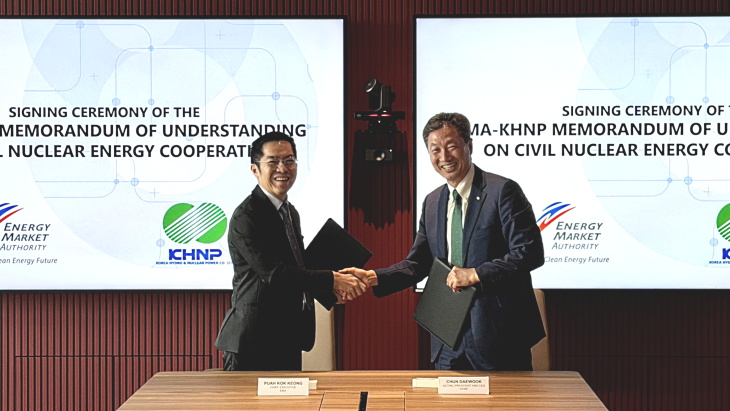
The MoU was signed on 1 March by Korea Hydro & Nuclear Power (KHNP) Acting President and CEO Dae-wook Chun and Energy Market Authority (EMA) Chief Executive Puah Kok Keong during the Korea-Singapore Summit held in Singapore.
EMA – a statutory board under the Singapore Ministry of Trade and Industry – noted this “is the first MoU on civil nuclear energy cooperation between a Korean nuclear power company and a Singapore government agency”.
The MoU formalises civil nuclear energy cooperation between KHNP and EMA and establishes a framework for collaboration. The key areas of cooperation will include: conducting joint studies of small modular reactors (SMRs) for potential applications in Singapore; collaboration in human resource development and training; and sharing of technical information and best practices in the field of advanced nuclear technologies.
“This is part of EMA’s efforts to study various pathways to decarbonise Singapore’s power system, to ensure reliable, secure and sustainable energy supply,” EMA said.
“For a small country with very limited domestic energy resources, it is critical that we explore all pathways that can strengthen our energy resilience in a low-carbon world,” Keong said. “Advanced nuclear energy technologies hold promise as a potential clean energy source. Our partnership with KHNP will deepen our capabilities and technical understanding of SMRs, and enable us to assess the suitability of nuclear energy carefully and rigorously.”
Chun added: “KHNP has responded to the global energy transition based on its accumulated experience in nuclear plant operation and technical expertise. KHNP will actively engage as a responsible partner in EMA’s process of assessing the safety and viability of SMR technology, and will make every effort to ensure that our expertise and experience lead to meaningful outcomes.”
Singapore’s path to nuclear
In 2012, the Singapore government conducted a pre-feasibility study on nuclear energy. While the study concluded that nuclear power plants of the time were not suited for a small and densely populated city-state, it recommended that Singapore continue to monitor the progress of new nuclear energy technologies.
EMA released a report in March 2022 that concluded nuclear energy could supply around 10% of Singapore’s energy needs, helping its power sector achieve net-zero carbon emissions by 2050.
In October 2024, EMA signed a memorandum of understanding with the UAE’s Emirates Nuclear Energy Company to develop capabilities in nuclear energy. Through the MoU, both parties will work together to strengthen capabilities in nuclear science and technology, and identify activities of mutual interest in areas such as the assessment of emerging nuclear technologies and human resource development. The parties will facilitate information sharing through workshops, technical exchanges, and/or staff attachments.
Delivering his Budget 2025 speech in February last year, Prime Minister Lawrence Wong – who is also Finance Minister – said the government will study the potential deployment of nuclear power in Singapore and take further steps to systematically build up capabilities in this area. “We will need new capabilities to evaluate options, and to consider if there is a solution that Singapore can deploy in a safe and cost-effective way,” he said.
In September, the Energy Market Authority appointed UK-headquartered engineering firm Mott MacDonald to conduct a study on the safety and technical feasibility of advanced nuclear energy technologies. The study will evaluate the safety performance and technical feasibility of advanced nuclear energy technologies, such as SMRs, based on their safety features, technology maturity, and commercial readiness.
During his opening speech at Singapore International Energy Week in October, Minister-in-charge of Energy and Science and Technology Tan See Leng said Singapore is “seriously studying the potential deployment of nuclear energy, especially newer technologies such as small modular reactors.”