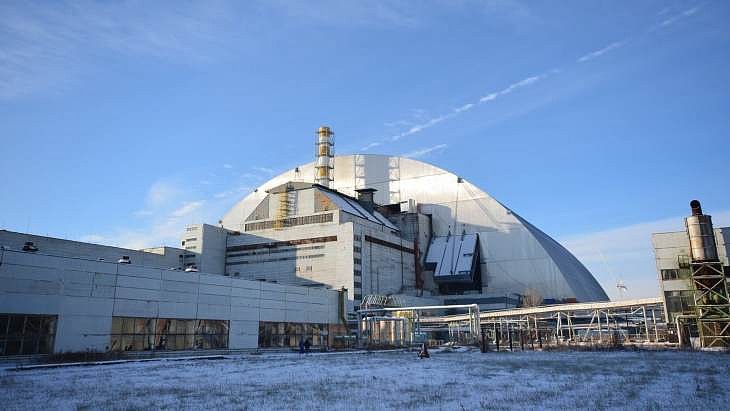
The operators of the Chernobyl nuclear power plant – State Specialised Enterprise Chornobyl NPP (ChNPP) – explained that the work is required because parts of the turbine hall and deaerator stack structures remained outside the area covered by the New Safe Confinement (NSC).
ChNPP added: “Preliminary surveys and expert assessments have established that the premises of the protruding parts of the deaerator stack are functionally necessary for the operation of the NSC-Shelter Object complex and have sufficient structural strength. However, certain structural elements require reinforcement or replacement to ensure reliable long-term operation. At the same time, the protruding parts of the turbine hall are not in use, and their technical condition does not meet the requirements for long-term safe operation, which necessitates their dismantling”.
A consortium consisting of UTEM, the Institute for Nuclear Safety Problems of the National Academy of Sciences of Ukraine, the State Research Institute of Building Structures, and the Design and Research Institute of the Security Service of Ukraine has been appointed as contractor for the works.
ChNPP said the detailed design documentation will include technical solutions “for reconstruction and reinforcement of the structures, determination of the sequence of construction work, definition of radiation protection measures, organisation of monitoring and control activities, with the aim of minimising any impact on the functioning of the NSC”.
It said that the project will be an “important step in maintaining the safe condition of the New Safe Confinement and creating the required conditions for the future dismantling of the unstable” original shelter from 1986.
The work is being funded by contributors to the International Chernobyl Cooperation Account through its administrator, the European Bank for Reconstruction and Development.
Serhiy Tarakanov, Director General of ChNPP, said: “We sincerely appreciate our donors and EBRD’s continued support in the implementation of these essential projects. We are aware of our responsibility and, despite the difficult situation, continue to work hard to transform the Shelter facility into an environmentally safe system and to ensure safety for future generations.”
Background
Chernobyl unit 4 was destroyed in the April 1986 accident (you can read more about it in ) with a shelter constructed in a matter of months to encase the damaged unit, which allowed the other units at the plant to continue operating. It still contains the molten core of the reactor and an estimated 200 tonnes of highly radioactive material.
However that shelter was not designed for the very long-term, and so the New Safe Confinement – the largest moveable land-based structure ever built – was constructed to cover a much larger area including the original shelter. The New Safe Confinement has a span of 257 metres, a length of 162 metres, a height of 108 metres and a total weight of 36,000 tonnes and was designed for a lifetime of about 100 years. It was built nearby in two halves which were moved on specially constructed rail tracks to the current position, where it was completed in 2019.
With the new NSC in place there have been plans to make safe and dismantle the original shelter. However, the New Safe Confinement was damaged by a drone strike last year, and there is an on-going assessment and project to put together a plan to restore its full protective functionality.