Construction has begun on two enormous liquid argon cryostats for a physics experiment seeking to understand the origins of the universe, including how it formed and why matter exists in greater abundance than antimatter.
The giant insulated containers will house part of the Deep Underground Neutrino Experiment (DUNE), a project hosted by the US Department of Energy’s Fermi National Accelerator Laboratory (Fermilab).
DUNE will study neutrinos, tiny subatomic particles with almost no mass and no electrical charge that rarely interact with matter. The experiment will track how they change between three types, known as flavours, as a beam of neutrinos travels 1,300km through the Earth from Illinois to South Dakota.
Liquid argon will be used to detect these rare interactions. A detector at Fermilab will measure neutrinos near their source, while a second, much larger detector will sit nearly a mile underground at the Sanford Underground Research Facility (SURF), in the South Dakota Black Hills.
By comparing measurements taken near the source with those recorded 1,300km away, researchers hope to better understand how neutrinos behave and whether they differ from their antimatter counterparts, antineutrinos.
According to current physics models, the Big Bang should have created equal amounts of matter and antimatter. Because matter and antimatter annihilate each other on contact, they should have wiped each other out, leaving an empty universe full of radiation.
Instead, a tiny fraction of matter survived to form stars, galaxies, and us. By tracking the behaviour of these particles as they travel through argon, scientists at DUNE aim to figure out why this is the case.
Liquid argon will act as the detector medium, allowing scientists to capture and analyse the rare occasions when neutrinos interact with atoms. Its density and enormous volume increase the likelihood of detecting these interactions, while the signals produced allow researchers to reconstruct what happened.

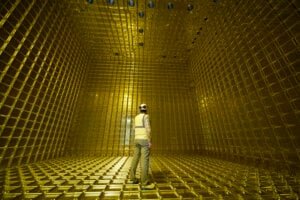
A prototype of the detector before it was filled with argon ©CERN
Each of the two five-storey cryostats will contain around 17,000 tonnes of liquid argon, maintained at approximately -184°C.
The structures will be assembled from around 2,600 steel beams transported nearly a mile underground to the detector caverns. CERN is supplying more than 6,200 tonnes of steel and leading the design, construction planning, logistics and installation of the cryostats alongside Fermilab and SURF.
“Once underway, DUNE has the potential to help us broaden our fundamental understanding of our Universe, as well as potentially open the door to new technological advances,” said Norbert Holtkamp, Director of Fermilab.
Argon supply and refrigeration
A direct supplier of the liquid argon has not been publicly announced. However, Air Products signed a contract with Fermi Research Alliance in 2023 to provide a custom nitrogen liquefier equipment package for the project.
“Air Products engineers have developed an innovative solution incorporating several parts of our business to create a nitrogen refrigeration system that will be transported deep underground and modularly assembled in the underground caverns of the SURF site,” said Dr Samir J. Serhan, COO at Air Products.
Argon will be delivered to the surface facility as a liquid before being vaporised and transported underground through a pipeline. The nitrogen refrigeration system will then recondense the argon gas into liquid form for the detector.
Filling the first cryostat will require around 1,000 truckloads delivered throughout the week for over a year. The argon will be purified before entering the cryostats.
“For DUNE to be successful, we need to maintain impurity concentrations in the argon at less than a trillionth of a percent. The nitrogen refrigeration system is an essential step to achieving that,” said David Montanari, a Fermilab engineer who works on the project.
The underground facility is expected to be completed by 2029, with detector equipment installation planned for 2030.