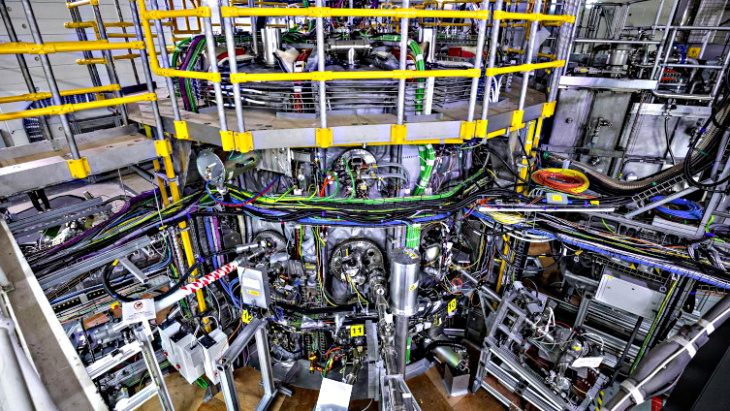
The fifth series of experiments conducted on the Mega Amp Spherical Tokamak (MAST) Upgrade tokamak, at UKAEA’s Culham Campus in Oxfordshire, began in 2025 and produced more than 1,100 fusion plasmas.
To create a plasma in a fusion facility, hydrogen isotopes must be heated, squeezed together and confined at extreme temperatures and pressures. Fusion reactions increase rapidly as density and temperatures rise. A higher-pressure plasma can produce more fusion power per unit volume, making it more representative of the conditions needed in a commercial power plant. The latest experiments conducted by the UKAEA demonstrated the highest pressure ever achieved in the MAST Upgrade machine without the plasma destabilising.
The central challenge of MAST Upgrade’s experiments was to suppress instabilities known as Edge Localised Modes (ELMs). These are sudden bursts at the plasma’s outer edge that can cause a loss of plasma pressure and eject up to one-tenth of its stored energy in a single event and, over time, damage a machine’s inner wall and exhaust components. Left unaddressed, ELMs are seen as a serious obstacle to fusion’s commercial viability.
Building on ELM-suppression results from previous plasma experiments, the MAST Upgrade team adopted the Quasi-Continuous Exhaust mode (QCE-mode) and Resonant Magnetic Perturbations (RMP) ELM suppression modes using coils that apply 3D magnetic fields to reduce the plasma pressure at the edge to keep it stable. The team also accessed two additional stable operating regimes known as Quiescent H-mode (QH-mode) and I-mode. QH-mode and I-mode are improved plasma confinement regimes that deliver better energy confinement while mitigating problems associated with large ELMs. They help manage pressure at the plasma edge without triggering these damaging bursts. Accessing these modes on MAST Upgrade enables plasmas to operate with a more stable boundary, giving confidence that fusion power plants can operate with fewer damaging energy surges.
The MAST Upgrade team also developed a world-first technique for controlling the plasma’s position. By measuring visible light created by deuterium emitted from the machine’s upper and lower outer divertors, minute positional imbalances can be detected in real-time. This method advances fusion towards using automated, real-time control systems that future power plants will need to operate without constant manual intervention.
The team found that injecting small amounts of nitrogen into the plasma edge causes the plasma to emit a large fraction of the exhaust power as light. This dissipates excess heat volumetrically before it reaches the machine’s inner walls and divertor, lowering the peak heat flux and reducing wear and tear on the inner surfaces. This impurity-assisted method is expected to be essential in a fusion power plant, where even the Super-X geometry of MAST Upgrade’s divertor – one of the machine’s innovative plasma control and heat-exhaust methods – would, on its own, still leave heat loads too high.
The experiments also explored ‘negative triangularity’ plasma shapes that allow high-power operations without ELMs, an approach being closely watched by the international fusion community.
“The results genuinely shape the design of future fusion power plants,” said James Harrison, Head of MAST Upgrade Science at UKAEA. “Accessing four stable high-performance plasma regimes, including QH-mode, QCE and I-mode and our world-first plasma position control technique, demonstrates that MAST Upgrade is producing science at the leading edge of what is possible. The level of international interest in our data reflects the UK’s central role in global fusion research, and these findings take us another step closer to practical fusion energy.”
MAST Upgrade will undergo further enhancements this year, including the addition of two new neutral beam injectors, doubling the machine’s neutral beam heating capacity, and the installation of an Electron Bernstein Wave (EBW) system that will provide an additional 1.6 MW of heating power. EBW technology is planned for use in the Spherical Tokamak for Energy Production (STEP), the UK’s prototype fusion power plant to be based in West Burton in Nottinghamshire.
The enhancement programme is expected to conclude in 2027 and a sixth series of experiments focused on STEP-relevant research planned for 2028.
STEP is due to begin operating by 2040. The technical objectives of STEP are: to deliver predictable net electricity greater than 100 MW; to innovate to exploit fusion energy beyond electricity production; to ensure tritium self-sufficiency; to qualify materials and components under appropriate fusion conditions; and to develop a viable path to affordable lifecycle costs.