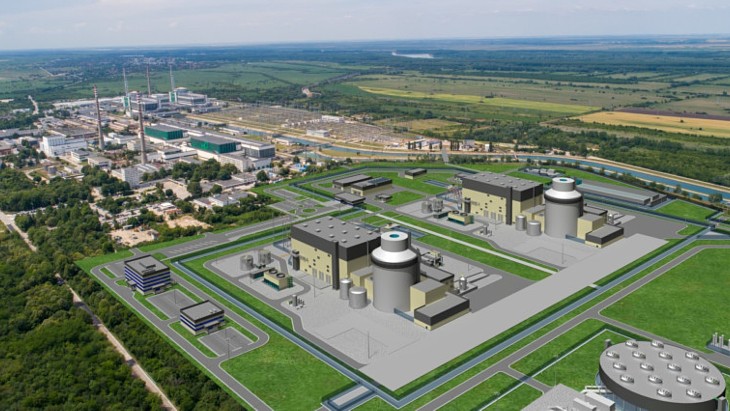
The contract signed by project company Kozloduy NPP-New Build EAD with Laurentis Energy Partners, its subsidiary Canadian Nuclear Partners SA (CNPSA) and BWXT Canada was announced in Sofia at an event attended by Bulgaria’s Energy Minister Zhecko Stankov and Ontario’s Energy and Minister Minister Stephen Lecce.
Bulgaria aims to get the first of the two proposed Westinghouse AP1000 units operational in 2035 and the contract, worth “hundreds of millions of euros”, will provide specialised technical advisory services and project-management oversight for all the major phases of the Kozloduy New Build Project.
Bulgaria’s Energy Ministry said the contract was a “decisive moment” for the new-build project and said it “ensures that the new capacity will be delivered in accordance with all international and national regulatory standards, within the agreed timeframe and budget”.
It said: “The consortium will support Kozloduy NPP-New Builds as an engineering consultant, including in the initial engineering activities, management of the design, procurement, construction, and commissioning processes.”
Energy Minister Stankov said that the contract was the most important one before the Engineering, Procurement and Construction contract, which he said was expected to be signed during 2026.
What was said
Stankov said: “Our country has secured leading international partners with proven experience across the full nuclear lifecycle – from design through commissioning. This project is an investment not only in our long-term energy security, but also in the strength of Bulgarian industry. Thirty percent of the specialists working on the project will be Bulgarian experts, providing our workforce with new knowledge, advanced technologies, and meaningful growth opportunities.”
Petyo Ivanov, Executive Director of Kozloduy NPP New Build, said: “This is another key step in the implementation of the new nuclear capacity in Bulgaria. The companies have many years of experience in providing these services, which guarantees that the project will be completed on time, within budget, and in full compliance with regulatory standards.”
Leslie McWilliams, President and CEO of Laurentis Energy Partners, said: “Laurentis’s foundation is built on decades of experience supporting Candu technology, but our project-management, technical, and owner’s engineer expertise are highly transferable across reactor types and technologies. This contract reflects the confidence placed in Canadian nuclear capability for complex new-build programmes.”
John MacQuarrie, BWXT’s President for Commercial Operations, said: “BWXT has significant experience successfully supporting the execution of large projects in the nuclear industry, including the refurbishments for Bruce Power and Ontario Power Generation. Our customers recognise that experience.”
Giovanbattista Patalano, Managing Director, CNPSA, said: “Supporting the Kozloduy New Build and the Bulgarian nuclear programme reinforces our role as a trusted partner for complex nuclear projects, ensuring safe, efficient, and well-managed execution throughout the lifecycle of these new units.”
Background
Kozloduy units 1-4 were VVER-440 models which the European Commission classified as non-upgradeable and Bulgaria agreed to close them during negotiations to join the European Union in 2007. Units 5 and 6 feature VVER-1000 reactors that were connected to the grid in 1987 and 1991, respectively. Both units have been through refurbishment and life-extension programmes to enable extension of operation from 30 to 60 years. The country’s two operable reactors generate about one-third of its electricity.
Westinghouse’s AP1000 has been selected as the technology for the two proposed new units and in November last year Hyundai Engineering & Construction, Westinghouse and Kozloduy NPP-New Build signed an engineering contract for the new capacity, with ministers saying that signing the contract meant that schedule and finance details would be firmed up within 12 months for the new capacity. The Ministry of Energy and the US’s Citi bank agreed on a partnership in July to secure funding for the construction of the new units, and site location applications have been submitted this year.
The aim is for the first new Westinghouse AP1000 unit – unit 7 at Kozloduy – to be operational in 2035 and the second one – unit 8 – to be operational in 2037. The 2,300 MWe capacity of the two new units would exceed the 1,760 MWe capacity of the closed first four units. The Bulgarian government has also said that further units will be needed to replace units 5 and 6 by 2050. It has also been considering the deployment of small modular reactors in the country.