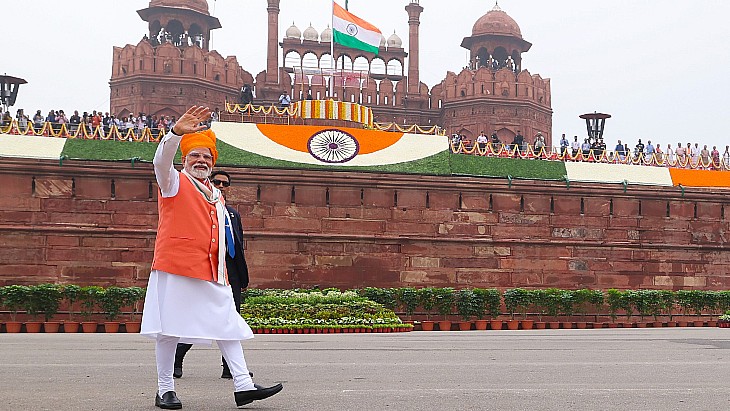
India celebrates its independence on 15 August. Modi’s lasted 103 minutes – his longest yet. It focused on self-reliance, innovation, and citizen empowerment, and the roadmap to Viksit Bharat: the government’s strategy to make India into a completely developed nation by 2047.
It is “essential” for India to become self-reliant in energy, Modi said: in the last 11 years, solar energy has seen a thirtyfold increase; new hydropower dams are being built; and India is investing “thousands of crores of rupees” in green hydrogen initiatives, he said.
“Keeping in mind the future of energy, Bharat is also undertaking major initiatives in nuclear energy,” Modi said. “In the field of nuclear energy, 10 new reactors are progressing rapidly. By 2047, when the nation will complete 100 years of independence – the year we have set as the target for achieving the goal of a ‘Viksit Bharat’ – we are moving forward with the resolve to increase our nuclear energy capacity more than tenfold.”
India plans to achieve this by a two-pronged approach, with the deployment of large-capacity reactors as well as small modular reactors (SMRs). Earlier this month, Minister of State Jitendra Singh outlined to the Parliament the three types of SMR that are being designed and developed by the Bhabha Atomic Research Centre for demonstration: the 200 MWe Bharat Small Modular Reactor (sometimes referred to as BSMR-200); a 55 MWe small modular reactor (SMR); and a 5 MWt high temperature gas cooled reactor for hydrogen production by coupling with suitable thermochemical process for hydrogen production.
India has introduced “major reforms” in the field of nuclear energy, Modi said: “We have now opened the doors of nuclear energy to the private sector as well; we want to combine our strengths.”
The Atomic Energy Act of 1962 prohibits private control of nuclear power generation in India: only two government-owned enterprises – Nuclear Power Corporation of India Ltd (NPCIL) and Bharatiya Nabhikiya Vidyut Nigam Limited (BHAVINI, set up to build and operate fast reactors) – are legally allowed to own and operate nuclear power plants in India. Amendments to the act made in 2016 allow public sector joint ventures, but private sector companies and foreign investments are not allowed to invest directly in nuclear power in India.
However, the government has begun the process to amend the Amending the Atomic Energy Act and the Civil Liability for Nuclear Damage Act of 2010, to enable broader participation by private and state sectors.
According to World Nuclear Association information, India currently has 24 operable nuclear reactors totalling 7,943 MW of capacity, with six reactors – 4,768 MW – under construction. (The Indian government often classes two units at Gorakhpur where site works have begun as being under construction, although the first concrete for the reactor buildings has not yet been poured.) A further 10 units – some 7 GW of capacity – are in pre-project stages.