NASA Administrator Jared Isaacman, speaking at the agency’s ‘Ignition’ event earlier this week, said: “If we concentrate NASA’s extraordinary resources on the objectives of the National Space Policy, clear away needless obstacles that impede progress, and unleash the workforce and industrial might of our nation and partners, then returning to the Moon and building a base will seem pale in comparison to what we will be capable of accomplishing in the years ahead.”
The announcements included “a major step forward in bringing nuclear power and propulsion from the lab to space. NASA will launch the Space Reactor‑1 Freedom, the first nuclear-powered interplanetary spacecraft, to Mars before the end of 2028, demonstrating advanced nuclear electric propulsion in deep space. Nuclear electric propulsion provides an extraordinary capability for efficient mass transport in deep space and enables high-power missions beyond Jupiter where solar arrays are not effective”.
The announced plan is that when the spacecraft reaches Mars “it will deploy the Skyfall payload of Ingenuity‑class helicopters to continue exploring the Red Planet”. NASA said the mission “will establish flight heritage nuclear hardware, set regulatory and launch precedent, and activate the industrial base for future fission power systems across propulsion, surface, and long‑duration missions. NASA and its US Department of Energy partner will unlock the capabilities required for sustained exploration beyond the Moon and eventual journeys to Mars and the outer solar system”.
Plans for the return of people to the surface of the Moon continue, with NASA saying on Wednesday that teams at Kennedy Space Center in Florida continue preparing the SLS (Space Launch System) rocket and Orion spacecraft for its crewed launch as early as Wednesday, 1 April. This rocket aims to take the four crew around the Moon and back to Earth as part of the developing programme for astronauts to land on the Moon in 2028.
Background
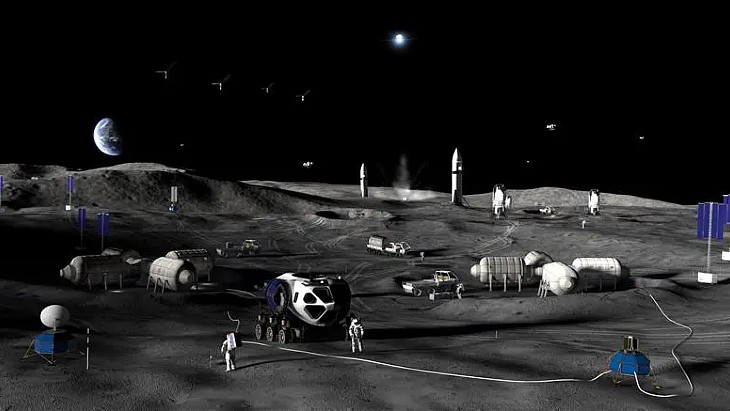
In January NASA and the US Department of Energy (DOE) said they had signed a memorandum of understanding to solidify their collaboration and advance the “vision of American space superiority” set out in . As well as “returning Americans to the Moon by 2028” – through the Artemis Program – this order includes deploying nuclear reactors on the Moon and in orbit, including the development of a lunar surface reactor by 2030, as a priority.
The agencies – which have a 50-year long history of collaboration – said they “anticipate deploying a fission surface power system capable of producing safe, efficient, and plentiful electrical power that will be able to operate for years without the need to refuel. The deployment of a lunar surface reactor will enable future sustained lunar missions by providing continuous and abundant power, regardless of sunlight or temperature”.
Nuclear fission power was one of the two main power generation technologies for crewed surface exploration architectures considered in (the other is solar). The White Paper forms part of the agency’s , which defines the elements needed for long-term, human-led scientific discovery in deep space.
The USA’s said Steven Sinacore, who will also oversee the SR-1 Freedom mission for NASA, had told it there will need to be an information programme to ease any public concerns over the use of nuclear propulsion: “Ultimately, it is safe. On the ground, the reactor is off. There’s no radiation coming from it. It doesn’t actually turn on until you’re up in space.”
According to a report of the event, Sinacore said the SR-1 Freedom will use a nuclear reactor that NASA plans to develop in-house, generating 20 kilowatts of electrical power using high-assay low-enriched uranium (HALEU). The journey time to Mars is expected to be about a year, and NASA said it plans to share the reactor design for SR-1 Freedom with industry.