Speaking at the Accelerating Nuclear for Energy Generation and Shipping conference in London, he said that the International Maritime Organization (IMO) had a long-standing agnostic view on the different fueling options to decarbonise shipping, subject to retaining the key goals of “safe, secure and environmentally-sound shipping”.
He said that in looking at fuels as a source of energy “we’re starting with the life-cycle assessment. In the recent discussions this year, there was a lot of interest in nuclear propulsion, whether it’s going to be propulsion that will support shipping from the shore or the ports’ infrastructure, providing clean energy, or is it going to be on-board vessels. Now, we don’t have the answer to that. But we’re open to all the development, the technical aspects, the practicalities of how this can become a reality”.
The main goal of the IMO, he said, was ensuring safety and security in shipping, and said the organisation would be partnering with the International Atomic Energy Agency on the ATLAS (Atomic Technologies Licensed for Applications at Sea) project which is due to launch in August in the USA.
“We need to review the safety code for nuclear vessels that was adopted back in 1981,” he told the conference, organised by Core Power, on 17 June. “It is in the pipeline and there is a lot interest in the IMO on how this work is going to progress.”
He said that work towards decarbonisation was already under way with interim guidelines for the use of fuels such as ammonia, hydrogen and methanol. “Nuclear is the next step – it’s been discussed together with renewable energy sources, like solar batteries and wind. But I can tell you that the main focus of the discussions this year were actually on nuclear and how we’re going to take that next step forward.”
One area that he highlighted was the need to provide training for seafarers, so that the safety aspects of nuclear propulsion can be discussed alongside the training requirements. A further issue was a liability convention, which is currently being worked on for autonomous vessels, with plans for one for alternative fuels.
Dominguez also said that an important area was “how we’re going to deal with public perception … somehow, when we talk about nuclear, especially what’s happening right now, it tends to be linked to conflict, and that’s not what we want. But the sooner we go out and demonstrate, not only the benefits or how we also address any safety concerns, the quicker they will help us to bring civil society on board with us”. As an example he said that many ports around the world had initially resisted the idea of liquefied natural gas propulsion, but those concerns had been transformed.
“So it’s how we engage not only the people in the sector, not only those that know what we’re talking about, but how we take it to those who have a different perspective and point of view,” he said.
And linked to that idea of needing “to bring everyone involved” together, he said that shipping was a global industry and needs global regulations. Developing countries needed to be involved in the discussions about the transition and the benefits that could flow from nuclear propulsion.
Core Power CEO Mikal Bøe said he had been steering a mission to mainstream maritime nuclear for almost a decade and watched it grow and “become the only long-term viable solution … to meet both the environmental challenges and the economic challenges that we face”.
He said that a rethink was needed on the idea of “shutting down industrial production, exporting emissions overseas and ceding energy security in the name of net zero”. Nuclear energy is “a central pillar of protecting the planet and the prosperity of future generations”, he said.
He added that they were encouraging governments, non-governmental organisations and the IMO and International Atomic Energy Agency to revise and modernise the safety and security standards to include floating nuclear power plants and nuclear ships.
“We’ve learnt that there are key conditions embedded in the regulatory framework and the law, that must sit at the centre of every concept of operations. Some come from the maritime side, whilst others come from the nuclear side. Now we’re blending those together into a perfectly logical framework for licensing, export controls and nuclear safeguards … the entire system of how that is actually going to work. This is a framework which has never existed before, laying the foundation for maritime nuclear in a truly modern context.
“The resulting harmonised regulatory framework for maritime nuclear will become the platform on which an entire new industry … can strive to solve our climate challenge and boost our economic competitiveness … and those conditions will dictate how business models are developed for ship-based nuclear power and nuclear ships.”
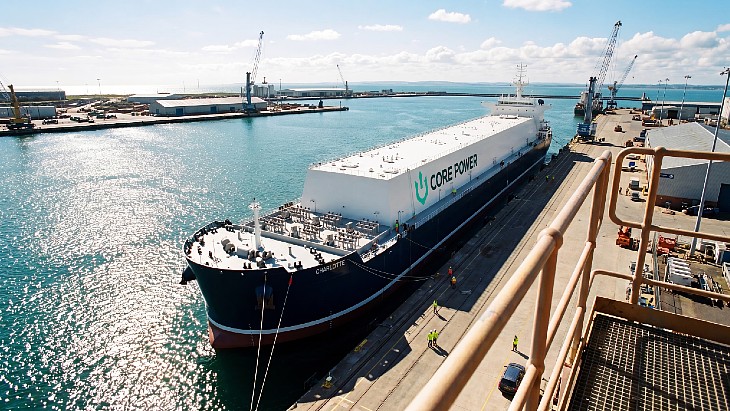
(Image: Core Power)
At the same event Core Power announced it had launched a feasibility study into using BWX Technologies’ mPower small modular reactors in floating nuclear power plants (see picture above for how one might look).
The mPower small modular reactor (SMR) is an integral pressurised light-water design with 195 MWe or 575 MWt capacity. The feasibility study “will cover baseline information exchange, systems engineering, concept of operations development, product requirements definition, regulatory pathway assessment, marine integration studies and techno-economic analysis”.
The IAEA says the ATLAS project aims to bring the maritime and nuclear industries together “to identify and address the key challenges and obstacles to using civil nuclear applications at sea, which will support Member State establishment of a robust framework that promotes and supports the deployment of these technologies. This could include recommendations for revisions to IAEA safety standards and nuclear security guidance and strengthening international cooperation to ensure effective safety, security, and safeguards throughout the lifetime of such vessels and facilities”.