Summary
- International Energy Agency expects heavy oversupply in oil market
- Agency however reports 1.5 million bpd of ‘unaccounted’ oil in August
- IEA bearish outlook clashes with OPEC forecasts
(Reuters) – The International Energy Agency continues to forecast a significant supply glut in the oil market, but uncertainty over the whereabouts of almost 1.5 million barrels per day of crude oil is throwing this projection into doubt.
Get the Latest US Focused Energy News Delivered to You! It’s FREE:
The oil market has struggled for months to establish a clear direction, keeping prices stuck in a narrow range, as traders have sought to make sense of starkly divergent supply and demand projections from the IEA, OPEC and other forecasting agencies.
The IEA has long forecast a severe oil glut this year and next due to rising global production. In its latest report released on Tuesday, the Paris-based agency provided an even more bearish outlook, forecasting a surplus of 2.35 million barrels per day in 2025 and 4 million bpd – or nearly 4% of global demand – next year.
OPEC, on the other hand, expects global oil supply to closely track demand through 2026.
Given that we’re already in the fourth quarter of 2025, this difference is striking, with few precedents in the long history of the world’s largest commodity market.
MISSING BARRELS
The murky crude picture got even muddier on Tuesday when the IEA report also noted that it was unable to account for 1.47 million bpd of oil in its global balances for August, the equivalent of 1.4% of annual demand.
By comparison, the IEA “unaccounted for balance” figure for July was 850,000 bpd, or 370,000 bpd for the second quarter overall.
This 1.47 million bpd figure is a staggeringly big blind spot with significant implications for the overall balance between global supply and demand. The IEA’s figures show supply outstripping demand by 2.04 million bpd in August, meaning that the oversupply could, in theory, grow to 3.5 million bpd or shrink to 500,000 bpd. That’s a huge difference that could have a meaningful effect on crude prices.
The IEA calculates global oil balances using official government data as well as figures from private companies and analysts on production, consumption, exports and storage.
It is quite common for forecasters to have “holes” in their calculations due to delays in government reporting and the periodic absence of some data sets given the sheer size of the global oil market.
Indeed, the IEA regularly updates historical data. In its monthly report in May, the agency made significant upward revisions to recent years’ oil demand, including increasing 2024 oil consumption by 350,000 bpd, thereby flipping a previously reported surplus into a deficit.
But the sheer scale of the missing barrels in the IEA’s August report should give traders and investors pause, particularly because this is coming at a time when the market is already trying to make sense of forecasters’ wildly divergent projections.

DISAPPEARING BARRELS
The IEA said the August discrepancy “may stem from the time-lag of reported data or unavailable data for non-OECD countries.”
Fully accounting for the missing barrels will take time. But it is reasonable to assume that the gap may be due, in large part, to two factors that have been confounding the crude market all year: the trading of heavily sanctioned oil and China’s vast stockpiling.
First, there’s the question of how much sanctioned oil is actually being traded.
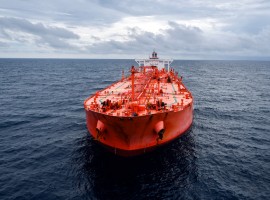
The volume of seaborne crude oil last week hit 1.25 billion barrels, the highest since the start of the Covid-19 pandemic, according to analytics firm Kpler. Excluding the pandemic era, oil being held at sea – or “oil on water” – has never been higher.
This maritime buildup could well be a precursor to a sharp increase in overland storage – and thus significant global oversupply.
Yet the picture is complicated by the fact that over a quarter of oil on water comes from three countries facing western sanctions: Russia, Iran and Venezuela. The majority of the oil from these producers is transported on so-called “shadow fleet” tankers that evade sanctions, often hiding their whereabouts by switching off satellite transponders.
This makes it harder to track seaborne oil movements, potentially accounting for some of the IEA’s missing barrels.

CRUDE HOARDING
Next, there is the uncertainty surrounding China’s massive oil storage volumes.
Global observed inventories – oil in storage and in vessels – swelled by 225 million barrels between January and August to the highest level in four years, according to the IEA, which expects stocks to rise further in September.
A large part of the inventory build clearly took place in China, the world’s largest oil importer.
However, Beijing does not officially disclose the scale of its oil storage capacity or changes in inventories. In the absence of government data, traders rely on secondary sources to estimate the size and fill rate of China’s rapidly expanding storage network.
The IEA estimates that Chinese crude stocks rose by 110 million barrels between April and August 2025, citing data from satellite analytics firm Kayrros.
But given the lack of firm data, it is possible that China’s crude stocks have increased much more than this, accounting for another part of the IEA’s missing barrels.
Calculating production, consumption, exports and storage in the massive global oil market has never been easy, but the IEA’s missing barrels mystery may be an indication that it is going to get even harder moving forward as geopolitics obscure large parts of the market.
Editing by Deepa Babington
Share This:
More News Articles