The Genesis Mission – inspired by the legacy of the Apollo Programme – was launched by President Donald Trump through an Executive Order in November. The mission ultimately aims to develop an integrated platform that connects supercomputers, experimental facilities, AI systems, and unique datasets across every major scientific domain to double the productivity and impact of American research and innovation within a decade.
The Department of Energy (DOE) released the first request for applications under the Genesis Mission in March, inviting teams to apply for smaller scale Phase I awards and larger scale Phase II awards. The request generated the largest response to a funding opportunity in DOE history, the department said as it announced its selections on 22 July.
Of the 278 Genesis Mission projects selected following a “rigorous merit review process”, 87 are led by DOE and National Nuclear Security Administration National Laboratories, 168 led by universities, 19 led by companies, and 4 led by nonprofit organisations.
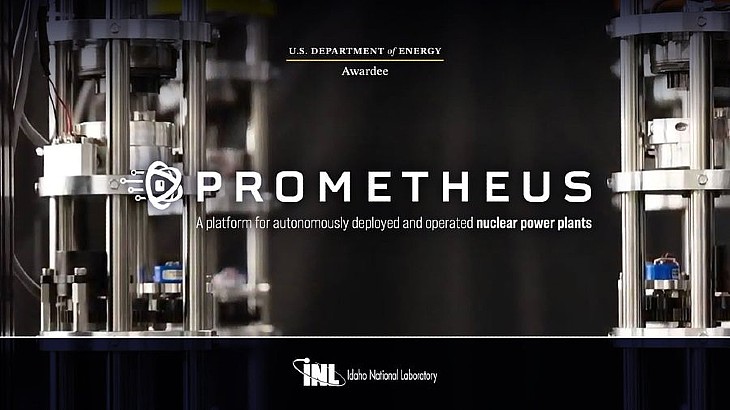
Prometheus is a 32‑partner collaborative effort between Idaho National Laboratory (INL), Oak Ridge National Laboratory, Argonne National Laboratory, Sandia National Laboratories, North Carolina State University, Pennsylvania State University, University of Tennessee – Knoxville, University of Texas – Austin, and an extensive list of industry partners including Aalo Atomics, Amazon Web Services, Antares Industries, Deployable Energy, GE Vernova, Kiewit Nuclear Solutions, Nvidia, Oklo Inc, Standard Nuclear, Valar Atomics, Westinghouse Electric Corporation and X-energy (a full list of partners can be found on the Prometheus ).
The public-private partnership aims to leverage artificial intelligence (AI) to design, licence, manufacture, construct, and operate nuclear reactors “with human-in-the-loop workflows”; integrate AI into nuclear fuel fabrication; and use AI for nuclear legacy document management: according to INL, by improving every stage of the reactor lifecycle Prometheus is designed to cut reactor deployment timelines and operating costs in half. The team has already raised more than USD200 million in industry cost share and USD30 million in industry capital.
In February, multinational technology company Nvidia and INL announced they would collaborate under the Genesis Mission to create a “virtuous cycle” with AI enabling rapid nuclear deployment, and nuclear energy providing the baseload power required for next-generation AI infrastructure.
“America’s nuclear future depends on our ability to move with greater urgency and drive down costs, while maintaining the uncompromising commitment to safety and technical rigor that defines our industry,” INL Director John Wagner said as the selectees were announced at the Genesis Mission Summit in Washington, DC. “Prometheus brings together nuclear science and artificial intelligence to help us do exactly that.”
“The extraordinary response to this Genesis Mission application process demonstrates that America’s scientific community is ready to reimagine how discovery happens,” Under Secretary for Science Darío Gil said. “Through the Genesis Mission, we are bringing together the nation’s leading researchers, institutions, and technology partners to build the next generation of scientific capability. We look forward to seeing these teams demonstrate new research workflows that accelerate discovery and reveal what is possible when AI and science advance together.”
The DOE and the Genesis Mission selectees will now undergo a negotiation process before any funding is issued, the DOE said.